How Secure Are Modern Front Doors? A Technical Guide to Door Security Standards
An evidence based technical guide to UK door security: resistance classes, PAS 24, multi point locking, cylinder and hinge security, glazing, forced entry testing, common burglary methods, and specification recommendations.
How Secure Are Modern Front Doors? A modern front door’s security is not a matter of how heavy or expensive it looks, but of how it performs against defined, repeatable attack tests and how its weakest component resists the specific methods burglars actually use. A door is a system: leaf, frame, hinges, lock mechanism, cylinder, keeps, and glazing must all resist attack, because an intruder will target the weakest element.
This guide explains the UK security standards that quantify door performance principally PAS 24:2022 and the RC1–RC6 resistance classes of BS EN 1627 and the component level features (multi point locks, cylinder grades, hinge security, laminated glass) that determine real world resistance. It also summarises the most common forced entry methods recorded in burglary data and how to specify against them.
For homeowners comparing tested physical protection rather than marketing claims, high security doors are worth reviewing alongside standard modern front door specifications. Where the project also includes smart access or biometric entry, fingerprint aluminium doors can be compared as a premium keyless entrance option.
Key Takeaways
- PAS 24:2022 is the UK’s principal enhanced security performance standard for doors; it is referenced by Approved Document Q of the Building Regulations for new dwellings.
- BS EN 1627 classifies burglar resistance from RC1 (lowest) to RC6 (highest) by tools, attacker skill, and resistance time.
- A door is only as strong as its weakest component most defeated doors fail at the cylinder, glazing bead, or frame fixing, not the leaf.
- Cylinder snapping is among the most common forced entry methods; TS 007 3 star or Sold Secure SS 312 Diamond cylinders are engineered to resist it.
- Multi point locks distribute force across several engagement points, dramatically improving leverage resistance over single deadbolts.
- Laminated glass in or beside a door resists being broken through for access, unlike standard toughened glass.
How Door Security Is Measured
PAS 24:2022
PAS 24 (“Enhanced security performance requirements for doorsets and windows in the UK”) is the benchmark security specification for UK residential doors. A doorset tested to PAS 24:2022 is subjected to a defined sequence including:
- Mechanical loading tests simulating attempts to spread or distort the frame.
- Manipulation tests of the locking mechanism.
- Cylinder attack tests (including snapping, drilling, picking).
- Manual attack tests by a trained operator using a defined tool kit within a time limit, simulating an opportunist burglar.
Passing PAS 24 demonstrates the doorset resists the methods and tools an opportunist intruder is likely to deploy. PAS 24 is the standard referenced by Approved Document Q (Security) of the Building Regulations in England, which applies to new dwellings.
BS EN 1627 Resistance Classes (RC1–RC6)
BS EN 1627 classifies burglar resistance by combining tool sets, assumed attacker experience, and the time the doorset withstands attack:
| Resistance class | Attacker profile | Tools used | Resistance (contact) time |
|---|---|---|---|
| RC1 N | Opportunist using bodily force | Kicking, shoulder, body weight | Minimal |
| RC2 | Opportunist with simple tools | Screwdriver, pliers, wedge | 3 minutes |
| RC3 | Determined burglar | Crowbar, second screwdriver | 5 minutes |
| RC4 | Experienced burglar | Saw, drill, hammer, chisel, cordless tools | 10 minutes |
| RC5 | Experienced, power tools | Angle grinder, jigsaw, drills | 15 minutes |
| RC6 | Highly experienced | Powerful power tools | 20 minutes |
For UK homes, RC2 is a solid baseline and RC3 a premium target. RC4–RC6 are typically reserved for high value, high risk, commercial, or institutional applications.
Where stronger entrance protection is the main priority, comparing high security entrance doors can help clarify whether a security focused doorset is more suitable than a standard residential specification.
How PAS 24 and BS EN 1627 Relate
PAS 24 broadly aligns with the resistance expected around the RC2 level against opportunist attack, with a UK specific test protocol and tool list. A door can hold both a PAS 24 certificate and a BS EN 1627 RC classification; they are complementary rather than interchangeable.
Multi Point Locking
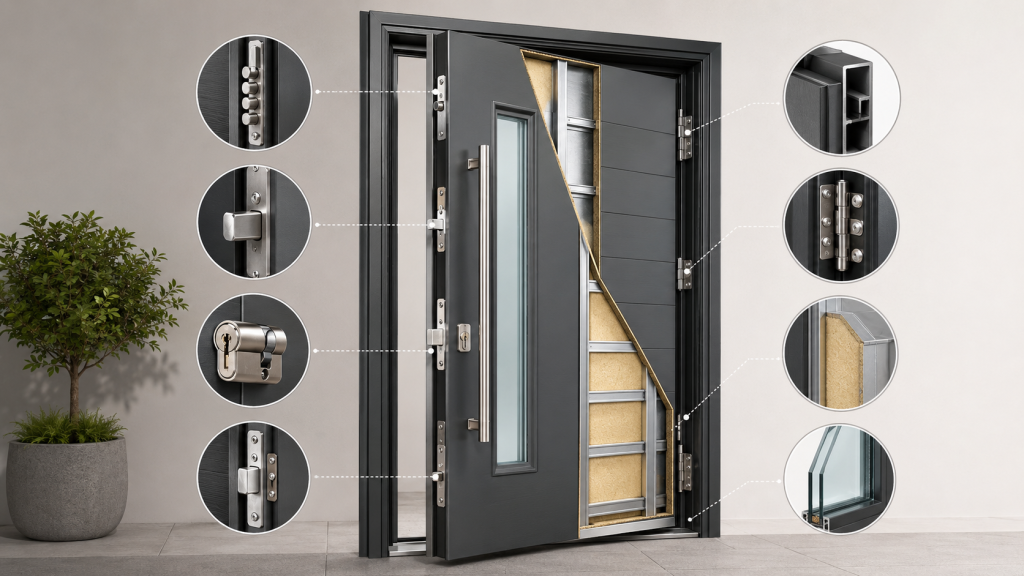
A multi point lock (MPL) engages the frame at several points simultaneously commonly a central latch/deadbolt plus hooks, rollers, or bolts top and bottom operated together by lifting the handle and turning the key.
Why it matters: A single deadbolt concentrates all resistance at one point, which can be overcome by spreading the frame or applying leverage. A multi point lock distributes load across the full height of the door, making frame spreading and jemmy attacks far harder. Premium mechanisms add automatic deadlocking, engaging the bolts on closing so the door is locked without lifting the handle, removing reliance on the occupant to lock it fully.
Key multi point lock features to specify:
- Hook bolts that resist the door being forced back against the frame.
- Automatic deadlocking on closing.
- Anti lift and anti manipulation keeps.
- Mechanism conformance to recognised cycle testing and security criteria.
Winkhaus AV3
The Winkhaus AV3 (autoLock AV3) is a widely specified automatic multi point locking mechanism used in premium UK entrance doors. Its defining characteristic is automatic locking on closing: as the door shuts, the mechanism’s hooks and bolts deploy automatically, so the door is deadlocked the instant it closes without the occupant needing to lift the handle or turn the key. A key turn from outside, or thumbturn from inside, then provides full security. This eliminates the common vulnerability of a door left on the latch and is a feature found in doors specified to PAS 24 and higher resistance classes.
For projects where automatic multi point locking is being combined with smart or biometric access, smart aluminium entrance doors can be compared as a premium specification route.
Cylinder Security
The euro cylinder is the lock barrel the key turns. It is statistically the most attacked component on a multi point locked door, because defeating it can release the entire mechanism. Cylinder attack methods include:
- Snapping applying force to break the cylinder at its weak point and manipulate the cam (the most common method on vulnerable cylinders).
- Drilling destroying the pin stack.
- Picking manipulating pins to the shear line.
- Bumping using a specially cut key and impact to jump the pins.
Cylinder Security Standards
| Standard | What it certifies |
|---|---|
| TS 007 (1–3 star) | Kitemark scheme; a 3 star cylinder alone, or a 1 star cylinder with 2 star security hardware, gives full anti snap/anti pick/anti drill protection |
| Sold Secure SS 312 Diamond | Highest Sold Secure cylinder grade; tested specifically against snapping and advanced manipulation |
| Sold Secure SS 312 Gold | High grade below Diamond |
Recommendation: Specify a TS 007 3 star or Sold Secure SS 312 Diamond cylinder. These incorporate anti snap sacrificial sections, hardened anti drill pins, and anti pick/anti bump pin designs. A high security door fitted with a cheap cylinder is only as secure as that cylinder.
Hinge Security
Hinges are an attack point if the door opens outward or if hinges are exposed. Security features include:
- Hinge bolts (dog bolts) fixed studs on the hinge edge that locate into the frame, so the door cannot be lifted off or forced open even if the hinge pins are removed.
- Security hinges with non removable or concealed pins.
- Concealed hinges, common on contemporary aluminium doors, which present no external attack surface at all.
On inward opening doors the hinge knuckles face inside and are inherently protected; outward opening doors must use hinge bolts or security hinges to be PAS 24 compliant.
Glass Security
Glazing in or adjacent to a door is a vulnerability if it can be broken to reach the lock or to climb through. The key distinction:
- Toughened (tempered) glass is strong against impact but shatters completely into small pieces when defeated, creating an opening.
- Laminated glass has a tough interlayer (typically PVB) bonding two or more panes; when struck it cracks but the interlayer holds the glass in place, resisting penetration and preventing a clean opening.
| Glazing type | Impact resistance | Resists break through for access | Used in secure doorsets |
|---|---|---|---|
| Standard annealed | Low | No | No |
| Toughened | High (shatters safely) | No | Limited |
| Laminated | High | Yes (interlayer holds) | Yes |
Recommendation: Doors and side panels within reach of the lock should use laminated glass (often laminated on the inner pane of a double/triple glazed unit) to meet PAS 24 and resist break and reach attacks. Beading should be internally glazed or secured so the unit cannot be removed from outside.
Forced Entry Testing
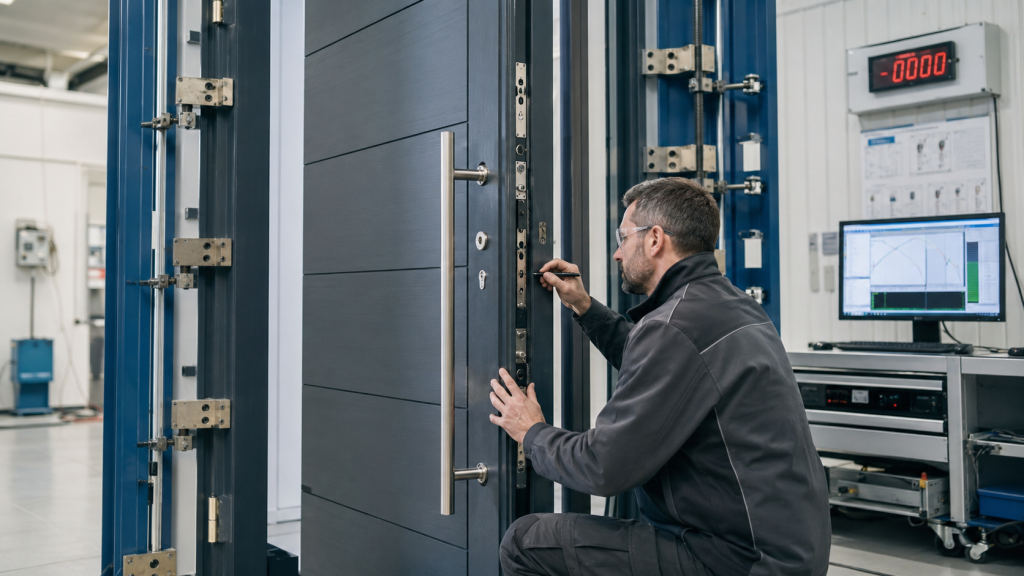
Independent forced entry testing underpins every credible security claim. A PAS 24 or BS EN 1627 test is performed by accredited laboratories and involves:
- Tool based manual attack by a trained operator within a defined time limit, using only the tools permitted for the target class.
- Mechanical load testing to simulate frame spreading and prying.
- Component attack on cylinder, handle, and keeps.
- Repeatability tests follow strict protocols so results are comparable across products.
A genuine security certificate names the test standard, the test house, and the specific doorset configuration tested. Security claims without an independent certificate carry no verifiable meaning. “Secured by Design” accreditation additionally requires audited manufacturing, not just a one off test pass.
Most Common Burglary Attack Methods
UK burglary data and security testing consistently identify a small set of dominant entry methods at doors:
- Cylinder snapping breaking a vulnerable euro cylinder to manipulate the lock. Defeated by TS 007 3 star / SS 312 Diamond cylinders.
- Forcing/kicking bodily force against the leaf or frame. Resisted by multi point locks and reinforced frames/keeps.
- Leverage/jemmy attacks prying the door from the frame with a crowbar. Resisted by multi point hook bolts and rigid frames.
- Glass break and reach breaking adjacent glazing to reach the lock or thumbturn. Resisted by laminated glass and lock positioning.
- Lock picking/bumping manipulating the cylinder. Resisted by anti pick/anti bump cylinders.
- Letterplate attacks using tools through the letterplate to reach the latch or keys. Resisted by anti manipulation letterplate cowls and lock design.
Opportunist burglars favour speed and low noise; most defeated doors are overcome in under a few minutes via the cylinder or a weak frame fixing. This is precisely what PAS 24 and the RC2/RC3 time thresholds are designed to test.
Security Recommendations
A genuinely secure modern front door combines the following:
| Component | Minimum recommendation | Premium recommendation |
|---|---|---|
| Standard | PAS 24:2022 | PAS 24:2022 + RC3 (BS EN 1627) |
| Lock mechanism | Multi point lock | Automatic multi point (e.g. Winkhaus AV3) |
| Cylinder | TS 007 3 star | TS 007 3 star + SS 312 Diamond |
| Hinges | Inward opening or hinge bolts | Concealed security hinges |
| Glazing | Laminated where within reach | Laminated, internally beaded |
| Frame | Reinforced fixings, secure keeps | Reinforced keeps + steel/aluminium frame |
| Accreditation | Manufacturer test certificate | Secured by Design |
A modern entrance should feel convenient, but it also needs to match the security expectations of the home. Comparing secure front doors can help homeowners decide whether a stronger door system is the better long term choice.
Expert Summary
Modern front door security is defined by independent performance testing, not appearance. The two anchoring UK frameworks are PAS 24:2022 (the enhanced security standard referenced by Building Regulations Approved Document Q) and BS EN 1627, which grades resistance from RC1 to RC6 by tools, attacker skill, and time. A door is only as strong as its weakest part: the euro cylinder, glazing, and frame fixings are the components most often defeated, not the leaf. The single highest value upgrade for most homes is a TS 007 3 star or Sold Secure SS 312 Diamond anti snap cylinder, since cylinder snapping is among the most common attacks. A complete secure specification pairs that cylinder with an automatic multi point lock (such as the Winkhaus AV3), laminated glazing within reach of the lock, hinge bolts or concealed hinges, and reinforced frame keeps ideally evidenced by PAS 24 certification and Secured by Design accreditation.
Before making a final decision, homeowners should compare both physical security and access features. Reviewing high security doors can help identify whether stronger protection is needed, while fingerprint aluminium doors may be relevant where smart access and modern aluminium design are priorities.
Frequently Asked Questions
1. What is the most secure type of front door lock? An automatic multi point lock combined with a TS 007 3 star or Sold Secure SS 312 Diamond anti snap cylinder. The multi point mechanism resists leverage; the high grade cylinder resists snapping, drilling, picking, and bumping.
2. What is PAS 24? PAS 24:2022 is the UK’s enhanced security performance standard for doors and windows. It involves manual attack, mechanical loading, and cylinder tests, and is referenced by Building Regulations Approved Document Q for new dwellings.
3. What is the difference between RC2 and RC3? Both are BS EN 1627 resistance classes. RC2 resists an opportunist with simple tools for 3 minutes; RC3 resists a more determined burglar with leverage tools for 5 minutes.
4. What is cylinder snapping and how do I prevent it? Cylinder snapping is breaking a vulnerable euro cylinder to manipulate the lock. It is prevented by fitting a TS 007 3 star or Sold Secure SS 312 Diamond cylinder with a sacrificial anti snap section.
5. What is a multi point lock? A locking mechanism that engages the frame at several points simultaneously typically a central deadbolt plus hooks or bolts top and bottom distributing force and resisting leverage far better than a single deadbolt.
6. What is the Winkhaus AV3? The Winkhaus AV3 (autoLock AV3) is an automatic multi point lock that deadlocks the door automatically the moment it closes, without needing to lift the handle or turn the key.
7. Is laminated glass more secure than toughened glass? Yes for resisting entry. Toughened glass shatters into an opening when defeated; laminated glass has an interlayer that holds the glass together, resisting break through.
8. What cylinder rating should I choose? TS 007 3 star or Sold Secure SS 312 Diamond, both of which are tested against snapping, drilling, picking, and bumping.
9. Are aluminium doors secure? Yes. Aluminium’s rigid frame resists leverage well, and aluminium doors are readily specified to PAS 24:2022 and RC3 of BS EN 1627 with appropriate hardware.
10. What is Secured by Design? Secured by Design is the UK police security certification scheme. It requires the door to pass PAS 24 (or equivalent) and to be manufactured under audited conditions, not just to pass a single test.
11. How long does a burglar take to defeat a typical door? Opportunist burglars favour speed; vulnerable doors are often defeated in under a few minutes, usually via the cylinder or a weak frame fixing. PAS 24 and the RC class time thresholds test resistance against exactly this.
12. What are hinge bolts? Hinge bolts (dog bolts) are fixed studs on the hinge edge of a door that locate into the frame, preventing the door being lifted off or forced even if the hinge pins are removed.
13. Can burglars get in through the letterplate? A poorly designed letterplate can allow tools through to reach the latch or keys. Anti manipulation letterplate cowls and correct lock positioning prevent this.
14. Does a PAS 24 door guarantee I won’t be burgled? No standard guarantees that, but a PAS 24 doorset resists the common opportunist attack methods for the tested duration, significantly reducing risk and often satisfying insurers.
15. What is the weakest part of a front door? Most commonly the euro cylinder, followed by adjacent glazing and frame fixings. The leaf itself is rarely the failure point on a quality door.
16. Do I need RC3, or is PAS 24 enough? PAS 24 satisfies most homes and insurers. RC3 is recommended for higher value, higher risk, or premium properties wanting longer resistance against determined attack.
17. What is anti bump and anti pick? Anti bump and anti pick are cylinder design features (special pin shapes, security pins) that resist the bumping and picking manipulation techniques used to open standard cylinders.
18. Will better door security lower my home insurance? Many insurers offer better terms for doors meeting recognised standards such as PAS 24 or carrying Secured by Design accreditation; check with your specific insurer.
19. Should glazing beside the door be laminated? Yes. Any glazing within reach of the lock or thumbturn should be laminated and internally beaded to resist break and reach attacks.
20. How do I verify a security claim? Ask for the independent test certificate naming the standard (e.g. PAS 24:2022), the test house, and the exact configuration tested. Claims without a certificate are unverifiable.
21. Is automatic deadlocking worth it? Yes. Automatic deadlocking (as in the Winkhaus AV3) removes the risk of a door being left insecure on the latch, as it locks the moment it closes.
Leave a Reply