Blog

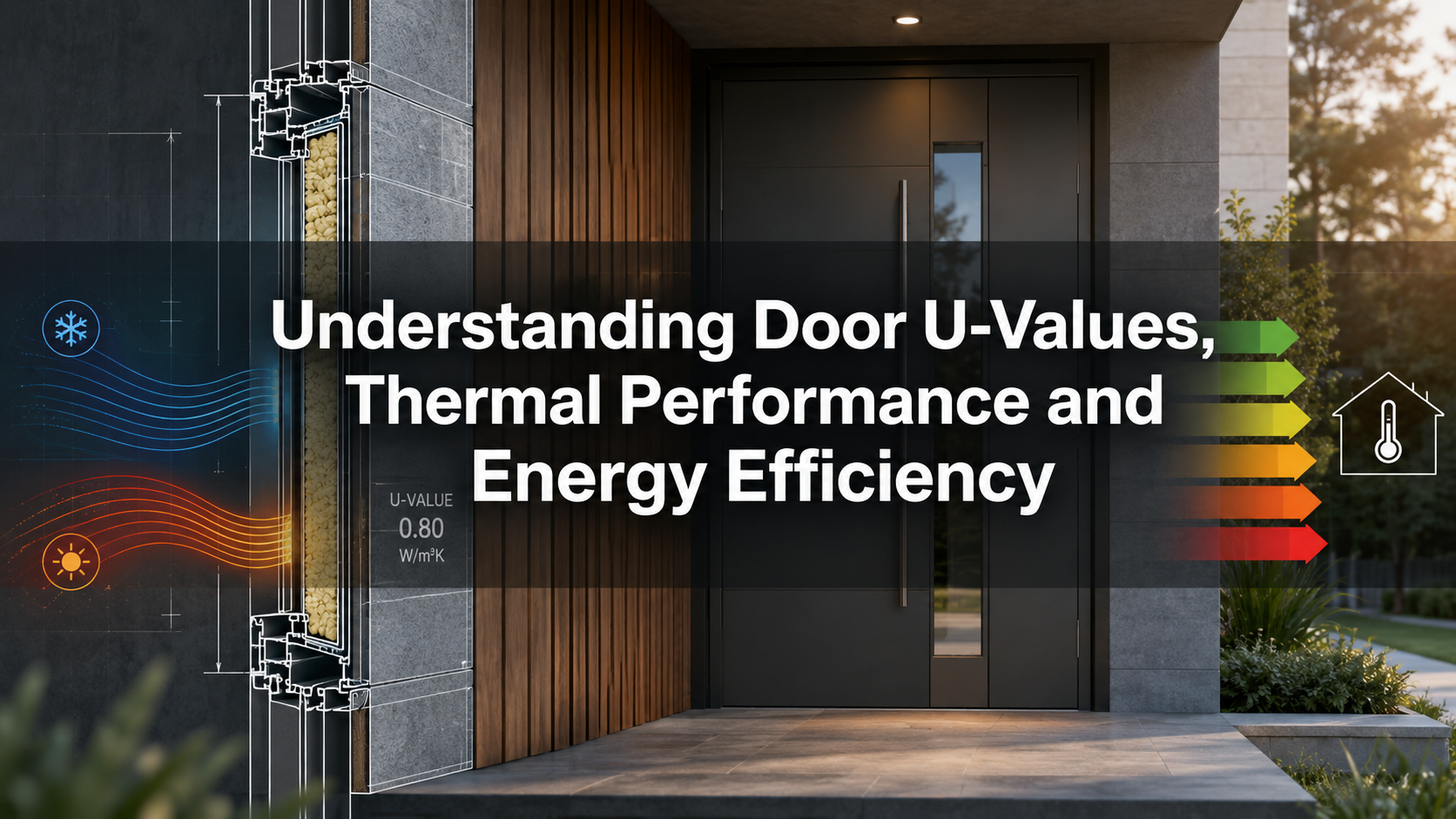
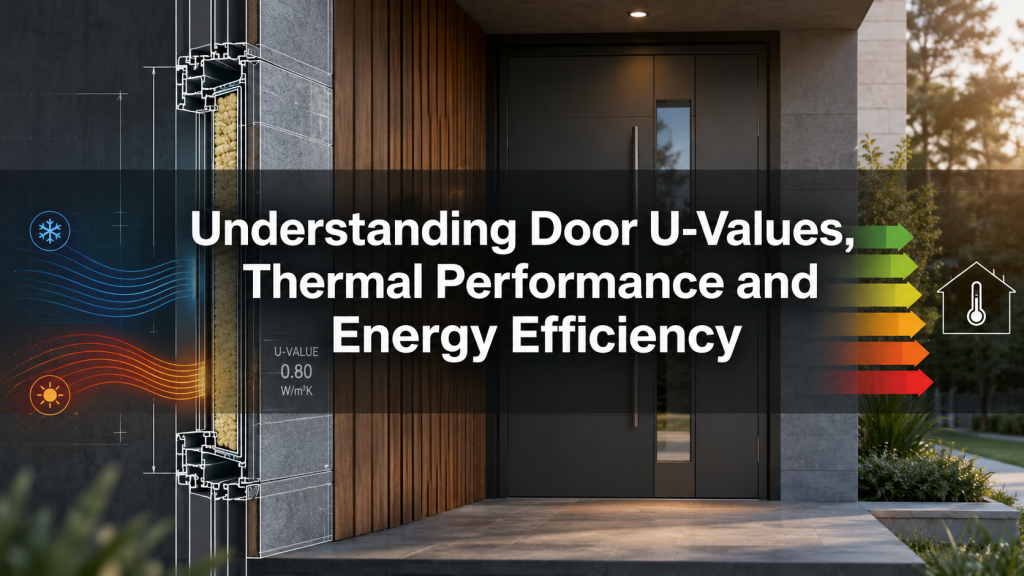
Understanding Door U Values, Thermal Performance and Energy Efficiency

Understanding Door U Values, Thermal Performance and Energy Efficiency

An evidence based technical guide to door U values: what they mean, whole door versus panel figures, Building Regulations, heat loss calculation, aluminium thermal breaks, composite insulation, triple glazing, and how to compare door specifications correctly.

Understanding Door U Values, Thermal Performance and Energy Efficiency. The thermal performance of an external door is one of the most frequently quoted   and most frequently misunderstood figures in the door market. The headline metric is the U value, and small differences in how it is measured and reported can make a poor door look better than a good one. Understanding what a U value actually represents, the difference between a panel figure and a whole door figure, and how the number translates into real heat loss is essential to comparing doors fairly and to meeting the Building Regulations.

This guide explains door thermal performance from first principles, with the relevant calculation methods and UK regulatory thresholds, and sets out how homeowners and specifiers should interpret and compare the figures manufacturers publish.

For homeowners comparing energy efficiency with stronger entrance protection, high security doors are worth reviewing alongside standard thermal performance specifications. Where the brief also includes smart access or biometric entry, fingerprint aluminium doors can be compared as a premium thermally broken entrance option. 
Understanding Door U Values

Key Takeaways

  • A U value is the rate of heat transfer through a building element, measured in W/m²K. Lower is better.
  • Always compare the whole door U value (the regulated, real world figure), not the panel/centre U value (which is always more flattering).
  • Under Approved Document L, a replacement external pedestrian door in England must have a U value of 1.4 W/m²K or lower.
  • Aluminium needs a polyamide thermal break because the metal itself is highly conductive; the thermal break is what makes aluminium doors energy efficient.
  • Composite doors insulate inherently through a high density foam core.
  • Triple glazing and deeper thermal breaks push whole door U values below 1.0 W/m²K in the best systems.

What a U Value Means

A U value (thermal transmittance) measures how much heat passes through one square metre of a building element for each one degree Kelvin (or Celsius) temperature difference between the two sides. Its units are watts per square metre per kelvin (W/m²K).

The relationship is simple and linear:

Heat loss (watts) = U value × Area (m²) × Temperature difference (K)

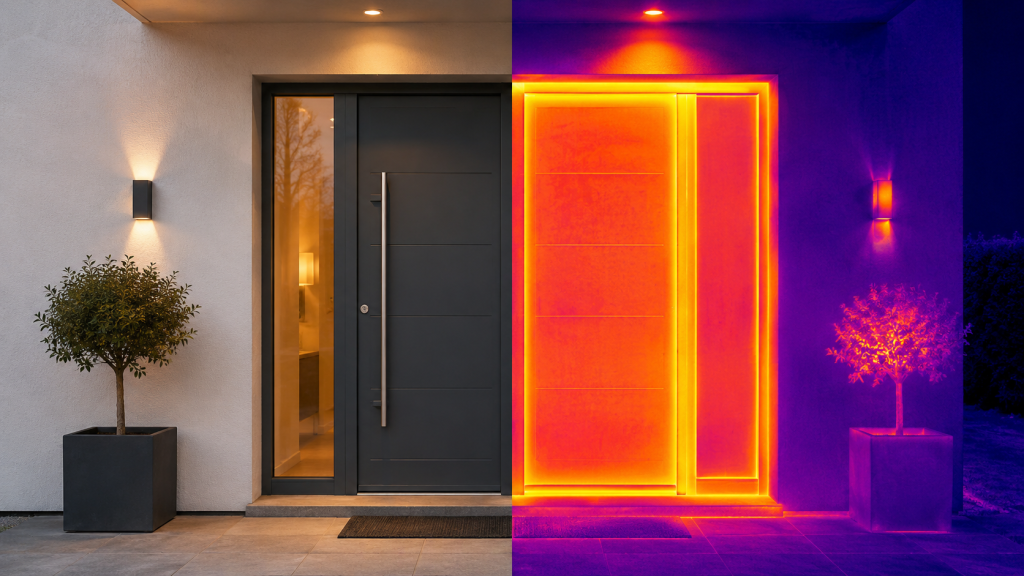
A door with a U value of 1.0 W/m²K loses heat at half the rate of one rated 2.0 W/m²K of the same size under the same conditions. The lower the U value, the better the insulation and the less heat escapes.

The U value is the inverse of total thermal resistance (the R value): U = 1 / R total. A door’s R total is the sum of the resistances of its layers (skin, core, glazing, air films), so adding insulation or interrupting conductive paths raises R and lowers U.
Understanding Door U Values

Whole Door vs Panel U Values

This is the single most important distinction for comparing doors honestly.

  • The panel U value (also called centre panel or centre pane U value) measures heat transfer through only the central insulated or glazed section of the door, away from the frame and edges. Because the centre is the best insulated part, this figure is always the lowest and most flattering.
  • The whole door U value (U_D) accounts for the entire assembled doorset   frame, sash/leaf, thermal break, glazing edges, and panel   area weighted into a single figure. The frame and edges conduct more heat than the centre, so the whole door figure is always higher (worse) than the panel figure.
MetricWhat it measuresTypical relationshipUse
Panel / centre U valueCentral section onlyLowest (best looking)Marketing; component data
Whole door U value (U_D)Complete doorset incl. frameHigher than panelBuilding Regulations & real world

A quoted “0.8 W/m²K” on a door almost always refers to the panel, not the assembled door. Building Regulations compliance and genuine energy performance are based on the whole door figure. Always ask which one a quote refers to.

Building Regulations

In England, door thermal performance is governed by Approved Document L (Conservation of fuel and power) of the Building Regulations.

  • For a replacement external pedestrian door in an existing dwelling, the maximum permitted U value is 1.4 W/m²K.
  • For new dwellings, doors are assessed within the building’s overall energy calculation (SAP), with notional door U values around 1.0 W/m²K in the latest standards driving toward lower whole element values.
  • The figure used for compliance is the whole door U value, calculated or tested to the recognised methods below.

Equivalent regulations apply in the devolved administrations (Scotland’s Technical Handbooks, Wales’s Approved Documents, and Northern Ireland’s Technical Booklets), with broadly similar door U value thresholds.

Calculation and Test Standards

Whole door U values are determined by:

  • BS EN ISO 10077 1 and  2   calculation of thermal transmittance of windows, doors, and shutters (the standard calculation route).
  • BS EN ISO 12567 1   measurement of thermal transmittance by the hot box method (the test route).
  • BS EN ISO 6946   calculation of thermal resistance and transmittance for building components generally.

A credible U value figure should state the method and the configuration it applies to.

Heat Loss Calculations

The practical impact of a U value is easy to quantify. Consider a standard single entrance door of approximately 2.0 m² area, with an internal temperature of 21°C and an external temperature of 1°C   a temperature difference of 20 K:

Whole door U valueHeat loss (U × Area × ΔT)Relative loss
2.0 W/m²K2.0 × 2.0 × 20 = 80 WBaseline
1.4 W/m²K1.4 × 2.0 × 20 = 56 W−30%
1.2 W/m²K1.2 × 2.0 × 20 = 48 W−40%
1.0 W/m²K1.0 × 2.0 × 20 = 40 W−50%
0.8 W/m²K0.8 × 2.0 × 20 = 32 W−60%

Interpretation: Upgrading from a 2.0 to a 1.0 W/m²K door halves the conductive heat loss through that door. However, the absolute difference between a 1.2 and a 1.0 door (8 W in this example) is small relative to a whole dwelling’s heat loss, so thermal performance should be weighed alongside security, durability, and aesthetics rather than pursued in isolation. A door is a small fraction of a home’s total thermal envelope; the U value matters, but marginal differences at the low end deliver diminishing returns.

For homeowners balancing thermal performance with physical protection, comparing high security entrance doors can 
Understanding Door U Values

Aluminium Thermal Breaks

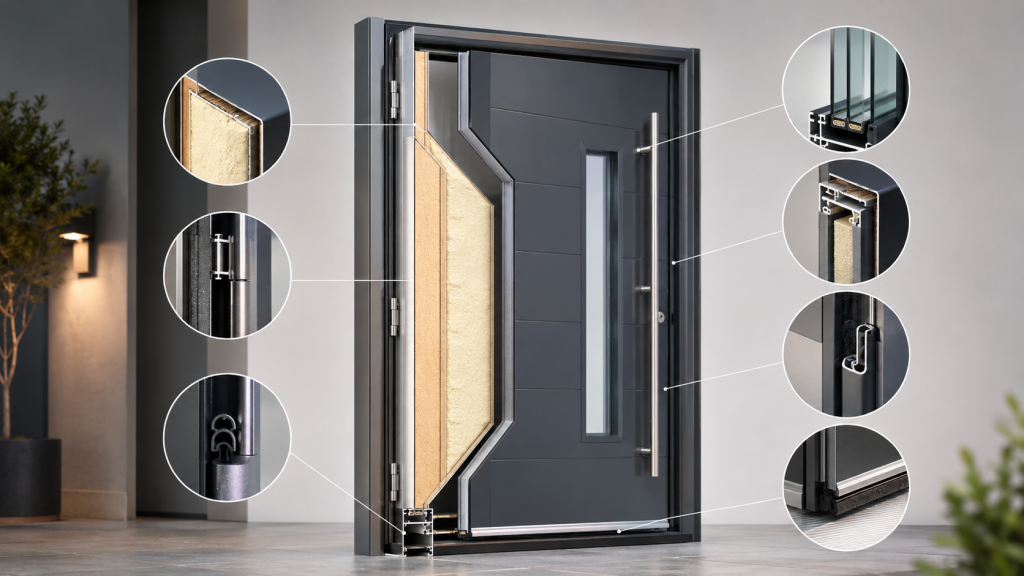
Aluminium has a thermal conductivity of roughly 160–235 W/mK   orders of magnitude higher than UPVC (~0.17 W/mK) or timber (~0.13 W/mK). A solid aluminium profile would therefore conduct heat straight through the door, creating a cold bridge, cold internal surfaces, and condensation risk.

The thermal break solves this. It is a strip of polyamide (glass fibre reinforced nylon), with a thermal conductivity around 0.25–0.30 W/mK, mechanically swaged or bonded between the inner and outer aluminium profiles. This:

  1. Joins the inner and outer aluminium structurally.
  2. Interrupts the conductive heat path between them.
  3. Keeps the internal surface warm, eliminating cold bridging and condensation.

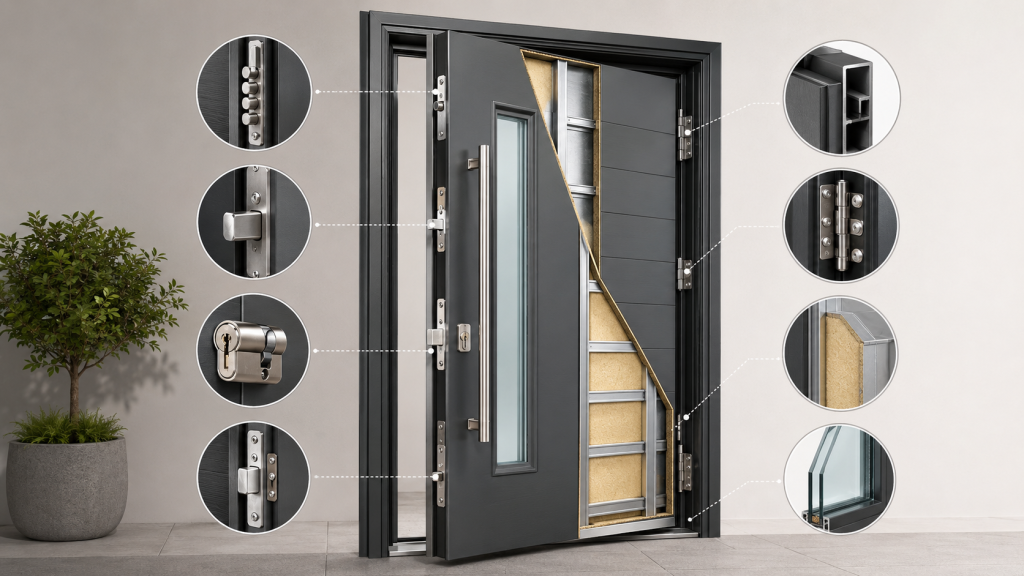
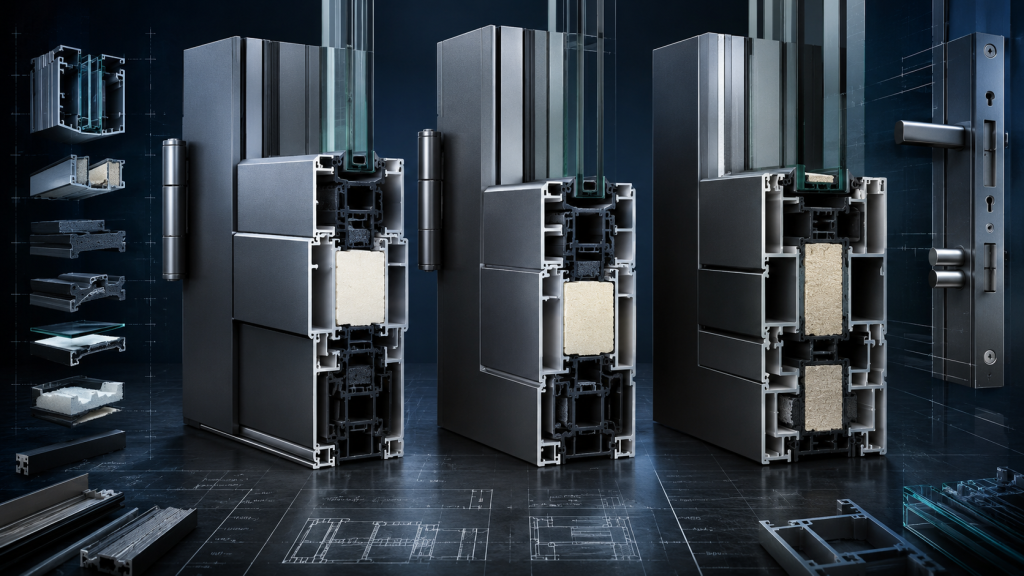
Deeper thermal breaks insulate better. Modern systems use breaks 24–44 mm deep; the deepest systems (e.g. ~105 mm build depth doors) accommodate the deepest breaks and thickest cores, achieving the lowest U values. The thermal break is the single feature that makes aluminium doors thermally competitive; without it, an aluminium door would be unfit for a heated dwelling.

For projects where thermally broken aluminium construction is being combined with smart or biometric access, smart aluminium entrance doors can be compared as a premium specification route. 

Composite Door Insulation

Composite doors achieve insulation differently. Rather than interrupting a conductive metal, they are built around an inherently low conductivity high density polyurethane (PU) foam core, typically 40–48 mm thick, encased in a GRP or laminate skin with a timber/polymer sub frame.

  • The PU foam core has low thermal conductivity (around 0.022–0.028 W/mK), giving strong insulation per unit thickness.
  • The main conductive paths are the sub frame and the outer frame the door hangs in, which is where heat is lost relative to the well insulated core   again making the whole door figure higher than the panel figure.
  • A good composite door achieves a whole door U value of approximately 1.2–1.8 W/m²K.

The contrast is instructive: aluminium starts from a highly conductive material and engineers the heat path out with a thermal break, while composite starts from an insulating core and manages the lesser conductivity of its frame. Both can meet Building Regulations; aluminium’s deepest systems reach the lowest figures.

Triple Glazing Options

For doors with significant glazed area, the glazing unit’s performance heavily influences the whole door U value.

GlazingTypical centre pane U value (W/m²K)Notes
Single glazing~5.0+Obsolete for external doors
Double glazing (standard)~1.4–1.6Argon filled, one low E coating
Double glazing (high performance)~1.0–1.2Argon, soft coat low E, warm edge spacer
Triple glazing~0.5–0.8Two cavities, two low E coatings, argon/krypton

Triple glazing adds a third pane and a second insulating cavity, with low emissivity (low E) coatings and argon or krypton fill, and a warm edge spacer to reduce edge conduction. In deep aluminium systems, triple glazing helps drive whole door U values below 1.0 W/m²K. The trade offs are increased weight (requiring robust hinges and frame, which aluminium handles well) and higher cost. For predominantly solid doors, the insulated core matters more than glazing; for heavily glazed doors, triple glazing is the key lever.

How Homeowners Should Compare Door Specifications

Use this checklist to compare doors on a like for like basis:

  1. Confirm whole door, not panel. Ask explicitly: “Is this U value the whole door (U_D) figure or the centre panel figure?” Only compare whole door to whole door.
  2. Check the size it was calculated at. U values are calculated for a reference door size; very different sizes shift the figure because the frame to area ratio changes.
  3. Check the standard. A credible figure cites BS EN ISO 10077 (calculation) or BS EN ISO 12567 (hot box test).
  4. Match the glazing. A glazed door’s U value depends on its glazing unit; compare like glazing (double vs triple).
  5. Confirm regulatory compliance. The whole door figure must be ≤1.4 W/m²K for a replacement door under Approved Document L.
  6. Weigh against other factors. Below ~1.2 W/m²K, further U value reductions yield small absolute energy savings; balance them against security, durability, and cost.
Comparison pitfallWhat to do
Panel figure quoted as if whole doorAsk for the whole door (U_D) value
No calculation standard citedRequest BS EN ISO 10077 or 12567 basis
Different glazing being comparedCompare same glazing type
Different reference sizesCompare at comparable door sizes
Chasing the lowest U value aloneBalance with security, durability, cost

Before making a final decision, homeowners should compare both energy performance and physical security. Reviewing secure front doors can help identify whether stronger protection is needed, while fingerprint aluminium doors may be relevant where smart access and thermally broken aluminium design are priorities. 

Expert Summary

A door’s U value measures heat transfer in W/m²K, and lower is better   but only the whole door figure is meaningful for compliance and real performance. The panel U value, measuring just the central section, is always more flattering and is frequently quoted in marketing. Under Approved Document L, a replacement door in England must achieve a whole door U value of 1.4 W/m²K or lower. Aluminium doors reach competitive U values (1.0–1.4 W/m²K, below 1.0 in the deepest triple glazed systems) because a polyamide thermal break interrupts the metal’s otherwise high conductivity; composite doors achieve 1.2–1.8 W/m²K through an insulating foam core. When comparing doors, always confirm the figure is whole door, calculated to BS EN ISO 10077 or tested to BS EN ISO 12567, and at a comparable size and glazing. Below about 1.2 W/m²K, further reductions deliver diminishing absolute savings, so thermal performance should be balanced against security, durability, and cost rather than maximised in isolation.
Understanding Door U Values

Frequently Asked Questions

1. What is a good U value for a front door? For a UK external door, a whole door U value of 1.4 W/m²K meets Building Regulations; 1.0–1.2 W/m²K is very good; below 1.0 W/m²K is excellent and achievable with deep aluminium systems and triple glazing.

2. What does U value mean? It is the rate of heat transfer through a building element, in watts per square metre per kelvin (W/m²K). A lower U value means better insulation.

3. What is the difference between whole door and panel U values? The panel U value measures only the central section and is more flattering. The whole door U value includes the frame and edges and is the regulated, real world figure. Always compare whole door values.

4. What U value do UK Building Regulations require for a door? Under Approved Document L (England), a replacement external pedestrian door must have a whole door U value of 1.4 W/m²K or lower.

5. Why do aluminium doors need a thermal break? Aluminium is highly conductive (~160–235 W/mK), so without a thermal break it would conduct heat straight through, causing cold surfaces and condensation. The polyamide thermal break interrupts this heat path.

6. What is the lowest U value a door can achieve? The best deep aluminium systems with triple glazing achieve whole door U values below 1.0 W/m²K, sometimes around 0.8 W/m²K.

7. How much heat does a door lose? For a 2 m² door at a 20 K temperature difference, a 1.0 W/m²K door loses about 40 W, compared with 80 W for a 2.0 W/m²K door   half the loss.

8. Is a lower U value always worth paying for? Not always. Below about 1.2 W/m²K, the absolute energy saving per further reduction is small relative to a whole home, so balance it against security, durability, and cost.

9. What U value do composite doors have? Composite doors typically achieve whole door U values of 1.2–1.8 W/m²K via their insulating foam core.

10. What U value do aluminium doors have? Thermally broken aluminium doors typically achieve whole door U values of 1.0–1.4 W/m²K, with the deepest triple glazed systems below 1.0.

11. Does triple glazing improve a door’s U value? Yes, significantly for glazed doors. Triple glazing has a centre pane U value around 0.5–0.8 W/m²K and helps drive whole door figures below 1.0 in deep systems.

12. How is a door’s U value calculated? By calculation to BS EN ISO 10077 1/ 2 or by hot box test to BS EN ISO 12567 1, area weighting the frame, edges, and panel into a single whole door figure.

13. What is a thermal break made of? Polyamide   glass fibre reinforced nylon   with a low thermal conductivity around 0.25–0.30 W/mK, swaged or bonded between the inner and outer aluminium profiles.

14. Do deeper aluminium doors insulate better? Generally yes. Deeper systems accommodate deeper thermal breaks and thicker insulating cores or triple glazing, achieving lower whole door U values.

15. Will a low U value door stop condensation? A thermally broken or well insulated door keeps the internal surface warm, which prevents the surface condensation associated with cold, conductive doors.

16. Is U value the same as energy rating? No. The U value measures conductive heat transfer; door energy ratings (where used) combine U value with air leakage and solar factors into a banded label.

17. Does door size affect the U value? Yes. U values are calculated at a reference size; the frame to area ratio changes with size, so figures should be compared at comparable sizes.

18. What is the R value and how does it relate to U value? The R value is thermal resistance; the U value is its inverse (U = 1/R total). Higher R and lower U both mean better insulation.

19. Does a solid door insulate better than a glazed door? Usually yes, because a well insulated solid core typically outperforms even good glazing. For glazed doors, triple glazing narrows the gap.

20. How do I compare two doors’ thermal claims fairly? Confirm both figures are whole door, calculated to the same standard, at comparable sizes and with comparable glazing, then compare directly.

21. What U value applies to new build doors? New dwellings are assessed in the overall SAP energy calculation, with notional door U values around 1.0 W/m²K in the latest Approved Document L standards.
How Secure Are Modern Front Doors

How Secure Are Modern Front Doors? A Technical Guide to Door Security Standards

An evidence based technical guide to UK door security: resistance classes, PAS 24, multi point locking, cylinder and hinge security, glazing, forced entry testing, common burglary methods, and specification recommendations.

How Secure Are Modern Front Doors? A modern front door’s security is not a matter of how heavy or expensive it looks, but of how it performs against defined, repeatable attack tests and how its weakest component resists the specific methods burglars actually use. A door is a system: leaf, frame, hinges, lock mechanism, cylinder, keeps, and glazing must all resist attack, because an intruder will target the weakest element.

This guide explains the UK security standards that quantify door performance principally PAS 24:2022 and the RC1–RC6 resistance classes of BS EN 1627 and the component level features (multi point locks, cylinder grades, hinge security, laminated glass) that determine real world resistance. It also summarises the most common forced entry methods recorded in burglary data and how to specify against them.

For homeowners comparing tested physical protection rather than marketing claims, high security doors are worth reviewing alongside standard modern front door specifications. Where the project also includes smart access or biometric entry, fingerprint aluminium doors can be compared as a premium keyless entrance option. 

How Secure Are Modern Front Doors

Key Takeaways

  • PAS 24:2022 is the UK’s principal enhanced security performance standard for doors; it is referenced by Approved Document Q of the Building Regulations for new dwellings.
  • BS EN 1627 classifies burglar resistance from RC1 (lowest) to RC6 (highest) by tools, attacker skill, and resistance time.
  • A door is only as strong as its weakest component most defeated doors fail at the cylinder, glazing bead, or frame fixing, not the leaf.
  • Cylinder snapping is among the most common forced entry methods; TS 007 3 star or Sold Secure SS 312 Diamond cylinders are engineered to resist it.
  • Multi point locks distribute force across several engagement points, dramatically improving leverage resistance over single deadbolts.
  • Laminated glass in or beside a door resists being broken through for access, unlike standard toughened glass.

How Door Security Is Measured

PAS 24:2022

PAS 24 (“Enhanced security performance requirements for doorsets and windows in the UK”) is the benchmark security specification for UK residential doors. A doorset tested to PAS 24:2022 is subjected to a defined sequence including:

  • Mechanical loading tests simulating attempts to spread or distort the frame.
  • Manipulation tests of the locking mechanism.
  • Cylinder attack tests (including snapping, drilling, picking).
  • Manual attack tests by a trained operator using a defined tool kit within a time limit, simulating an opportunist burglar.

Passing PAS 24 demonstrates the doorset resists the methods and tools an opportunist intruder is likely to deploy. PAS 24 is the standard referenced by Approved Document Q (Security) of the Building Regulations in England, which applies to new dwellings.

BS EN 1627 Resistance Classes (RC1–RC6)

BS EN 1627 classifies burglar resistance by combining tool sets, assumed attacker experience, and the time the doorset withstands attack:

Resistance classAttacker profileTools usedResistance (contact) time
RC1 NOpportunist using bodily forceKicking, shoulder, body weightMinimal
RC2Opportunist with simple toolsScrewdriver, pliers, wedge3 minutes
RC3Determined burglarCrowbar, second screwdriver5 minutes
RC4Experienced burglarSaw, drill, hammer, chisel, cordless tools10 minutes
RC5Experienced, power toolsAngle grinder, jigsaw, drills15 minutes
RC6Highly experiencedPowerful power tools20 minutes

For UK homes, RC2 is a solid baseline and RC3 a premium target. RC4–RC6 are typically reserved for high value, high risk, commercial, or institutional applications.

Where stronger entrance protection is the main priority, comparing high security entrance doors can help clarify whether a security focused doorset is more suitable than a standard residential specification. 

How PAS 24 and BS EN 1627 Relate

PAS 24 broadly aligns with the resistance expected around the RC2 level against opportunist attack, with a UK specific test protocol and tool list. A door can hold both a PAS 24 certificate and a BS EN 1627 RC classification; they are complementary rather than interchangeable.

How Secure Are Modern Front Doors

Multi Point Locking

A multi point lock (MPL) engages the frame at several points simultaneously commonly a central latch/deadbolt plus hooks, rollers, or bolts top and bottom operated together by lifting the handle and turning the key.

Why it matters: A single deadbolt concentrates all resistance at one point, which can be overcome by spreading the frame or applying leverage. A multi point lock distributes load across the full height of the door, making frame spreading and jemmy attacks far harder. Premium mechanisms add automatic deadlocking, engaging the bolts on closing so the door is locked without lifting the handle, removing reliance on the occupant to lock it fully.

Key multi point lock features to specify:

  • Hook bolts that resist the door being forced back against the frame.
  • Automatic deadlocking on closing.
  • Anti lift and anti manipulation keeps.
  • Mechanism conformance to recognised cycle testing and security criteria.

Winkhaus AV3

The Winkhaus AV3 (autoLock AV3) is a widely specified automatic multi point locking mechanism used in premium UK entrance doors. Its defining characteristic is automatic locking on closing: as the door shuts, the mechanism’s hooks and bolts deploy automatically, so the door is deadlocked the instant it closes without the occupant needing to lift the handle or turn the key. A key turn from outside, or thumbturn from inside, then provides full security. This eliminates the common vulnerability of a door left on the latch and is a feature found in doors specified to PAS 24 and higher resistance classes.

For projects where automatic multi point locking is being combined with smart or biometric access, smart aluminium entrance doors can be compared as a premium specification route. 

Cylinder Security

The euro cylinder is the lock barrel the key turns. It is statistically the most attacked component on a multi point locked door, because defeating it can release the entire mechanism. Cylinder attack methods include:

  • Snapping applying force to break the cylinder at its weak point and manipulate the cam (the most common method on vulnerable cylinders).
  • Drilling destroying the pin stack.
  • Picking manipulating pins to the shear line.
  • Bumping using a specially cut key and impact to jump the pins.

Cylinder Security Standards

StandardWhat it certifies
TS 007 (1–3 star)Kitemark scheme; a 3 star cylinder alone, or a 1 star cylinder with 2 star security hardware, gives full anti snap/anti pick/anti drill protection
Sold Secure SS 312 DiamondHighest Sold Secure cylinder grade; tested specifically against snapping and advanced manipulation
Sold Secure SS 312 GoldHigh grade below Diamond

Recommendation: Specify a TS 007 3 star or Sold Secure SS 312 Diamond cylinder. These incorporate anti snap sacrificial sections, hardened anti drill pins, and anti pick/anti bump pin designs. A high security door fitted with a cheap cylinder is only as secure as that cylinder.

Hinge Security

Hinges are an attack point if the door opens outward or if hinges are exposed. Security features include:

  • Hinge bolts (dog bolts) fixed studs on the hinge edge that locate into the frame, so the door cannot be lifted off or forced open even if the hinge pins are removed.
  • Security hinges with non removable or concealed pins.
  • Concealed hinges, common on contemporary aluminium doors, which present no external attack surface at all.

On inward opening doors the hinge knuckles face inside and are inherently protected; outward opening doors must use hinge bolts or security hinges to be PAS 24 compliant.

Glass Security

Glazing in or adjacent to a door is a vulnerability if it can be broken to reach the lock or to climb through. The key distinction:

  • Toughened (tempered) glass is strong against impact but shatters completely into small pieces when defeated, creating an opening.
  • Laminated glass has a tough interlayer (typically PVB) bonding two or more panes; when struck it cracks but the interlayer holds the glass in place, resisting penetration and preventing a clean opening.
Glazing typeImpact resistanceResists break through for accessUsed in secure doorsets
Standard annealedLowNoNo
ToughenedHigh (shatters safely)NoLimited
LaminatedHighYes (interlayer holds)Yes

Recommendation: Doors and side panels within reach of the lock should use laminated glass (often laminated on the inner pane of a double/triple glazed unit) to meet PAS 24 and resist break and reach attacks. Beading should be internally glazed or secured so the unit cannot be removed from outside.

Forced Entry Testing

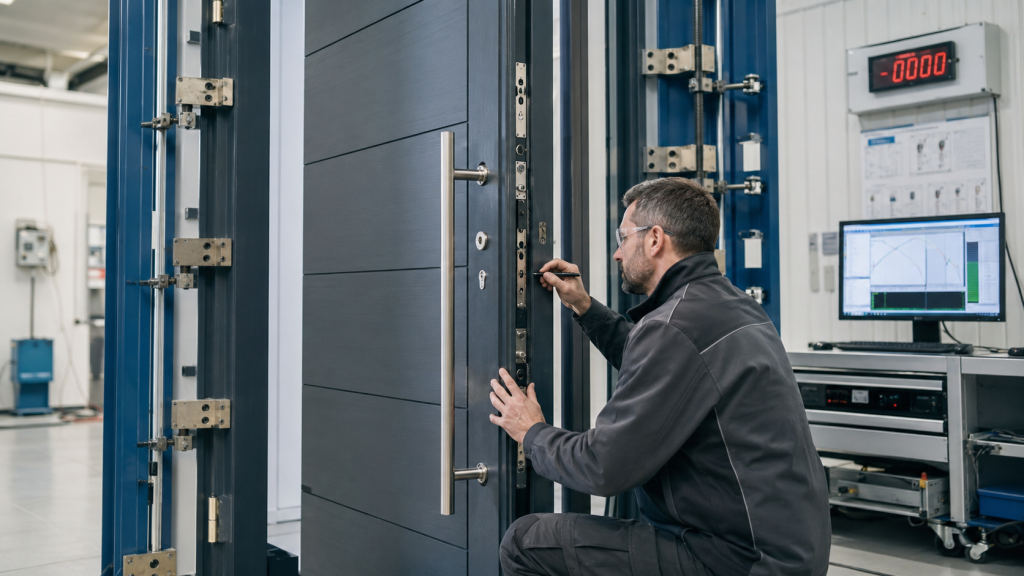
Independent forced entry testing underpins every credible security claim. A PAS 24 or BS EN 1627 test is performed by accredited laboratories and involves:

  1. Tool based manual attack by a trained operator within a defined time limit, using only the tools permitted for the target class.
  2. Mechanical load testing to simulate frame spreading and prying.
  3. Component attack on cylinder, handle, and keeps.
  4. Repeatability tests follow strict protocols so results are comparable across products.

A genuine security certificate names the test standard, the test house, and the specific doorset configuration tested. Security claims without an independent certificate carry no verifiable meaning. “Secured by Design” accreditation additionally requires audited manufacturing, not just a one off test pass.

How Secure Are Modern Front Doors

Most Common Burglary Attack Methods

UK burglary data and security testing consistently identify a small set of dominant entry methods at doors:

  1. Cylinder snapping breaking a vulnerable euro cylinder to manipulate the lock. Defeated by TS 007 3 star / SS 312 Diamond cylinders.
  2. Forcing/kicking bodily force against the leaf or frame. Resisted by multi point locks and reinforced frames/keeps.
  3. Leverage/jemmy attacks prying the door from the frame with a crowbar. Resisted by multi point hook bolts and rigid frames.
  4. Glass break and reach breaking adjacent glazing to reach the lock or thumbturn. Resisted by laminated glass and lock positioning.
  5. Lock picking/bumping manipulating the cylinder. Resisted by anti pick/anti bump cylinders.
  6. Letterplate attacks using tools through the letterplate to reach the latch or keys. Resisted by anti manipulation letterplate cowls and lock design.

Opportunist burglars favour speed and low noise; most defeated doors are overcome in under a few minutes via the cylinder or a weak frame fixing. This is precisely what PAS 24 and the RC2/RC3 time thresholds are designed to test.

Security Recommendations

A genuinely secure modern front door combines the following:

ComponentMinimum recommendationPremium recommendation
StandardPAS 24:2022PAS 24:2022 + RC3 (BS EN 1627)
Lock mechanismMulti point lockAutomatic multi point (e.g. Winkhaus AV3)
CylinderTS 007 3 starTS 007 3 star + SS 312 Diamond
HingesInward opening or hinge boltsConcealed security hinges
GlazingLaminated where within reachLaminated, internally beaded
FrameReinforced fixings, secure keepsReinforced keeps + steel/aluminium frame
AccreditationManufacturer test certificateSecured by Design

A modern entrance should feel convenient, but it also needs to match the security expectations of the home. Comparing secure front doors can help homeowners decide whether a stronger door system is the better long term choice.

Expert Summary

Modern front door security is defined by independent performance testing, not appearance. The two anchoring UK frameworks are PAS 24:2022 (the enhanced security standard referenced by Building Regulations Approved Document Q) and BS EN 1627, which grades resistance from RC1 to RC6 by tools, attacker skill, and time. A door is only as strong as its weakest part: the euro cylinder, glazing, and frame fixings are the components most often defeated, not the leaf. The single highest value upgrade for most homes is a TS 007 3 star or Sold Secure SS 312 Diamond anti snap cylinder, since cylinder snapping is among the most common attacks. A complete secure specification pairs that cylinder with an automatic multi point lock (such as the Winkhaus AV3), laminated glazing within reach of the lock, hinge bolts or concealed hinges, and reinforced frame keeps ideally evidenced by PAS 24 certification and Secured by Design accreditation.

Before making a final decision, homeowners should compare both physical security and access features. Reviewing high security doors can help identify whether stronger protection is needed, while fingerprint aluminium doors may be relevant where smart access and modern aluminium design are priorities. 

How Secure Are Modern Front Doors

Frequently Asked Questions

1. What is the most secure type of front door lock? An automatic multi point lock combined with a TS 007 3 star or Sold Secure SS 312 Diamond anti snap cylinder. The multi point mechanism resists leverage; the high grade cylinder resists snapping, drilling, picking, and bumping.

2. What is PAS 24? PAS 24:2022 is the UK’s enhanced security performance standard for doors and windows. It involves manual attack, mechanical loading, and cylinder tests, and is referenced by Building Regulations Approved Document Q for new dwellings.

3. What is the difference between RC2 and RC3? Both are BS EN 1627 resistance classes. RC2 resists an opportunist with simple tools for 3 minutes; RC3 resists a more determined burglar with leverage tools for 5 minutes.

4. What is cylinder snapping and how do I prevent it? Cylinder snapping is breaking a vulnerable euro cylinder to manipulate the lock. It is prevented by fitting a TS 007 3 star or Sold Secure SS 312 Diamond cylinder with a sacrificial anti snap section.

5. What is a multi point lock? A locking mechanism that engages the frame at several points simultaneously typically a central deadbolt plus hooks or bolts top and bottom distributing force and resisting leverage far better than a single deadbolt.

6. What is the Winkhaus AV3? The Winkhaus AV3 (autoLock AV3) is an automatic multi point lock that deadlocks the door automatically the moment it closes, without needing to lift the handle or turn the key.

7. Is laminated glass more secure than toughened glass? Yes for resisting entry. Toughened glass shatters into an opening when defeated; laminated glass has an interlayer that holds the glass together, resisting break through.

8. What cylinder rating should I choose? TS 007 3 star or Sold Secure SS 312 Diamond, both of which are tested against snapping, drilling, picking, and bumping.

9. Are aluminium doors secure? Yes. Aluminium’s rigid frame resists leverage well, and aluminium doors are readily specified to PAS 24:2022 and RC3 of BS EN 1627 with appropriate hardware.

10. What is Secured by Design? Secured by Design is the UK police security certification scheme. It requires the door to pass PAS 24 (or equivalent) and to be manufactured under audited conditions, not just to pass a single test.

11. How long does a burglar take to defeat a typical door? Opportunist burglars favour speed; vulnerable doors are often defeated in under a few minutes, usually via the cylinder or a weak frame fixing. PAS 24 and the RC class time thresholds test resistance against exactly this.

12. What are hinge bolts? Hinge bolts (dog bolts) are fixed studs on the hinge edge of a door that locate into the frame, preventing the door being lifted off or forced even if the hinge pins are removed.

13. Can burglars get in through the letterplate? A poorly designed letterplate can allow tools through to reach the latch or keys. Anti manipulation letterplate cowls and correct lock positioning prevent this.

14. Does a PAS 24 door guarantee I won’t be burgled? No standard guarantees that, but a PAS 24 doorset resists the common opportunist attack methods for the tested duration, significantly reducing risk and often satisfying insurers.

15. What is the weakest part of a front door? Most commonly the euro cylinder, followed by adjacent glazing and frame fixings. The leaf itself is rarely the failure point on a quality door.

16. Do I need RC3, or is PAS 24 enough? PAS 24 satisfies most homes and insurers. RC3 is recommended for higher value, higher risk, or premium properties wanting longer resistance against determined attack.

17. What is anti bump and anti pick? Anti bump and anti pick are cylinder design features (special pin shapes, security pins) that resist the bumping and picking manipulation techniques used to open standard cylinders.

18. Will better door security lower my home insurance? Many insurers offer better terms for doors meeting recognised standards such as PAS 24 or carrying Secured by Design accreditation; check with your specific insurer.

19. Should glazing beside the door be laminated? Yes. Any glazing within reach of the lock or thumbturn should be laminated and internally beaded to resist break and reach attacks.

20. How do I verify a security claim? Ask for the independent test certificate naming the standard (e.g. PAS 24:2022), the test house, and the exact configuration tested. Claims without a certificate are unverifiable.

21. Is automatic deadlocking worth it? Yes. Automatic deadlocking (as in the Winkhaus AV3) removes the risk of a door being left insecure on the latch, as it locks the moment it closes.

Composite Doors vs Aluminium Doors

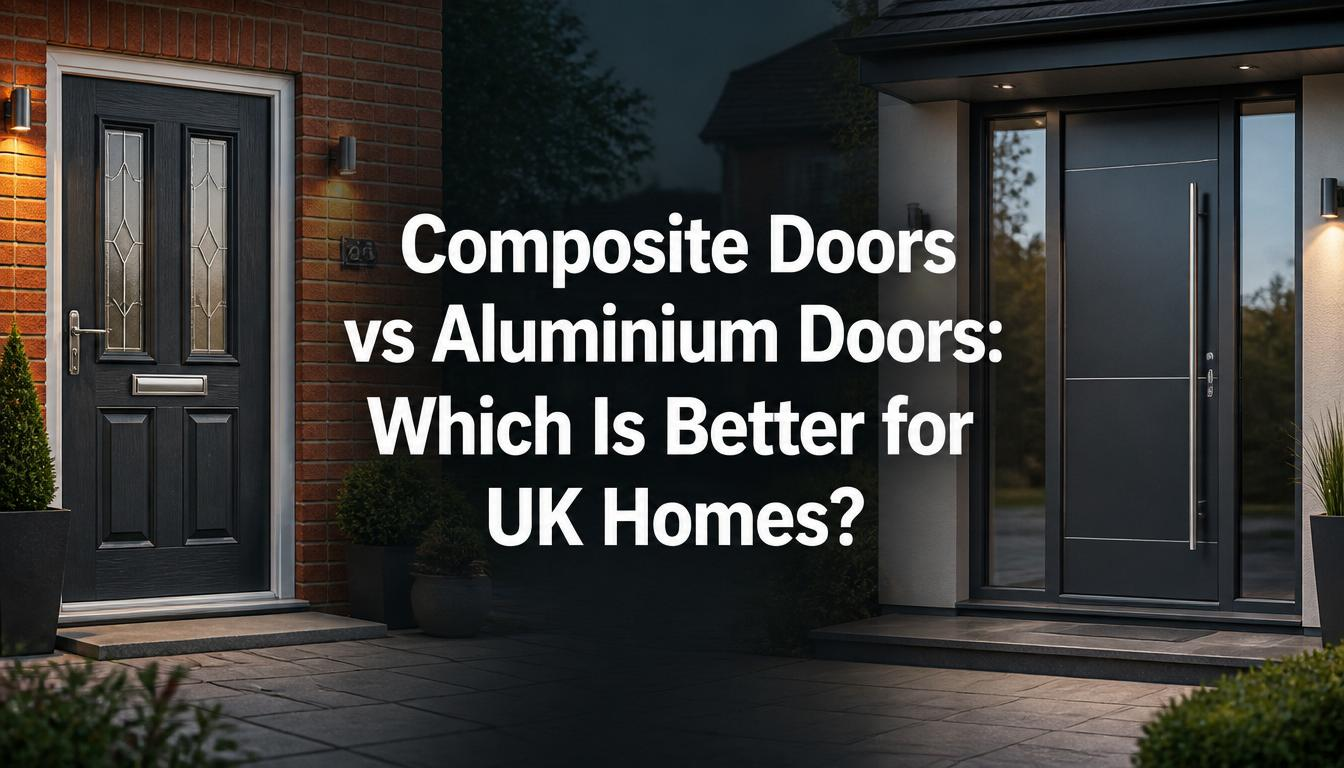
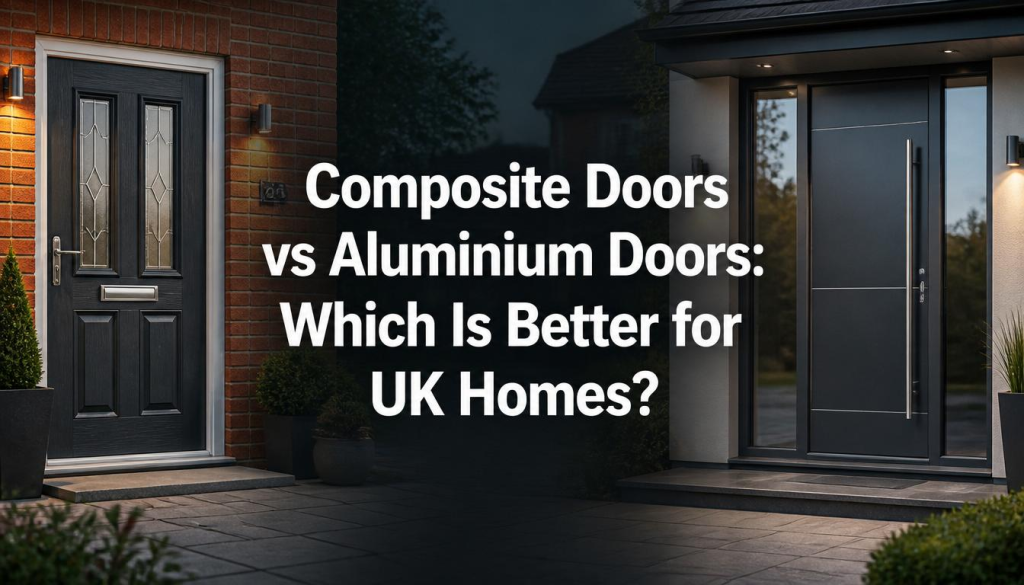
Composite Doors vs Aluminium Doors: Which Is Better for UK Homes?

An evidence-based comparison of composite and aluminium entrance doors across security, energy efficiency, weather resistance, appearance, lifespan, environmental impact, 20-year cost of ownership, and common misconceptions.

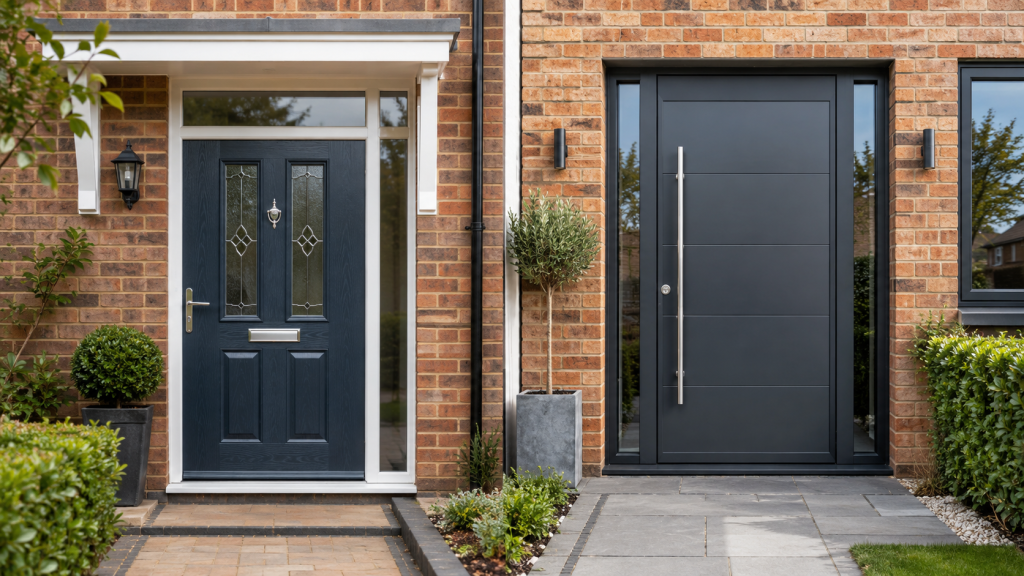
Composite Doors vs Aluminium Doors: Which Is Better for UK Homes?, having largely displaced timber and UPVC at the upper end of the market. They achieve comparable real-world results by very different means. A composite door is built from multiple materials typically a glass-reinforced plastic (GRP) or laminated skin, a timber or polymer sub-frame, and a high-density insulating foam core. An aluminium door is built from extruded aluminium profiles incorporating a polyamide thermal break around an insulated core or glazing unit.

This article compares the two objectively across the criteria that matter most to UK homeowners and specifiers, with reference to the relevant standards. Neither is universally “better”; each is optimal for different priorities.
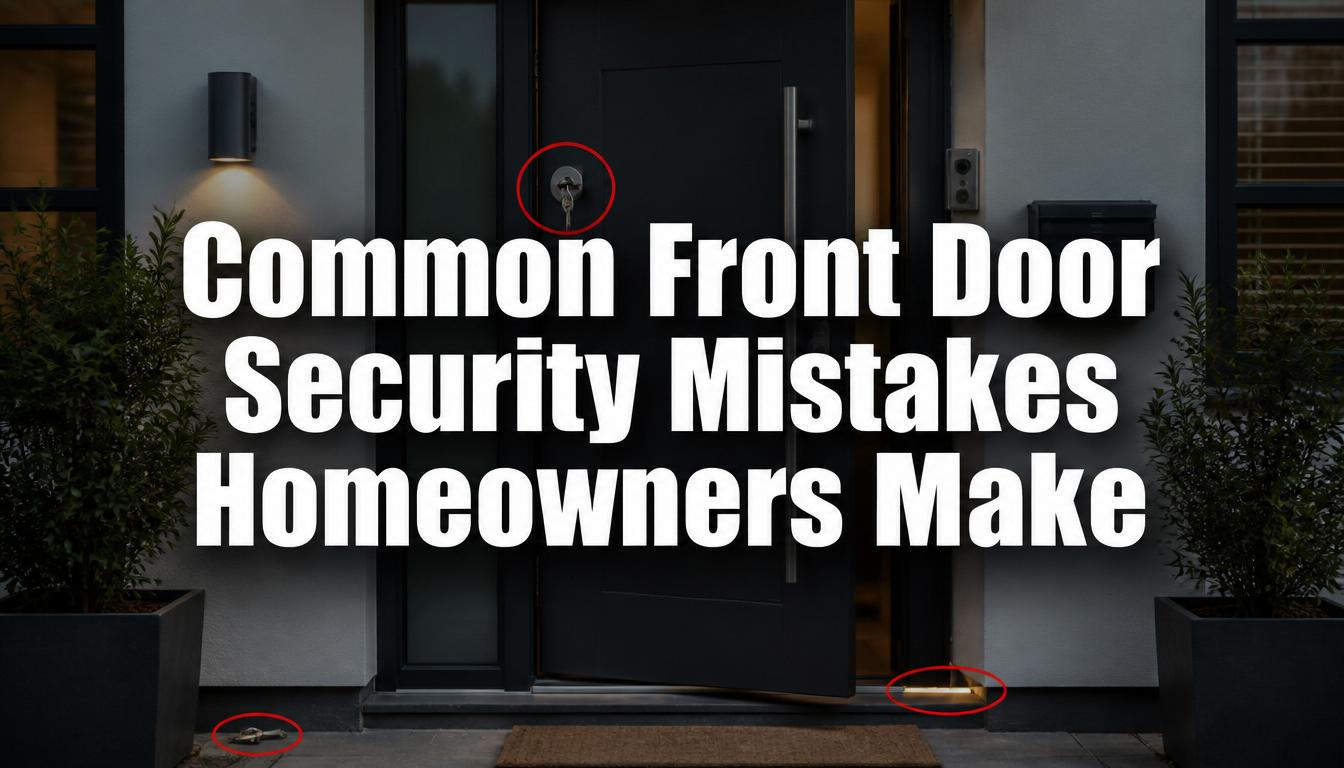
For homeowners comparing material choice with stronger physical protection, high security doors are worth reviewing alongside standard composite and aluminium entrance systems. Where aluminium construction is being considered with smart or biometric access, fingerprint aluminium doors can also be compared as a premium keyless entrance option. 

Composite Doors vs Aluminium Doors

Key Takeaways

  • Both can meet the same security standards PAS 24:2022 and, in many cases, RC2 of BS EN 1627. Aluminium more readily reaches RC3.
  • Both can be highly energy efficient. Composite cores insulate inherently; aluminium relies on its thermal break. Quality examples of both achieve whole-door U-values ≤1.4 W/m²K.
  • Aluminium leads on lifespan, large-format capability, dimensional stability, and recyclability.
  • Composite leads on upfront affordability and offers a traditional timber-look aesthetic difficult to replicate in metal.
  • Over 20 years, aluminium’s higher purchase price is partly offset by longer life and finish durability, narrowing the total-cost gap.
  • A widespread misconception is that aluminium doors are cold; thermally broken aluminium doors are not.
Composite Doors vs Aluminium Doors

Construction Compared

Composite Door Construction

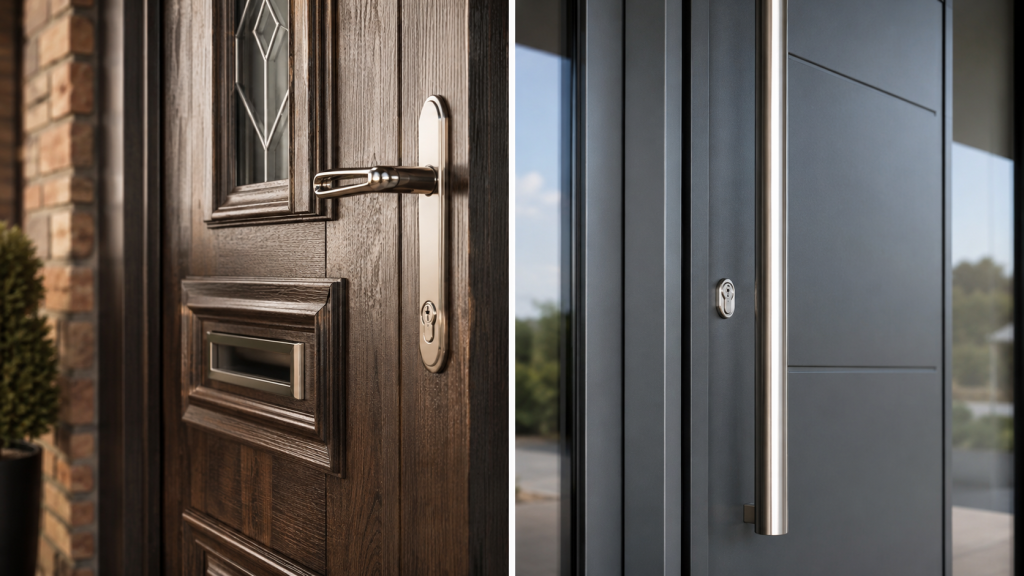
A typical composite door comprises an outer GRP or laminated skin (impact- and weather-resistant), a sub-frame of timber and/or polymer providing rigidity and fixing points, and a high-density polyurethane (PU) foam core that provides insulation. The skin is moulded, often with a woodgrain texture, and colour is integral or foiled. Composite doors are usually hung in a UPVC or aluminium outer frame.

Aluminium Door Construction

An aluminium door uses extruded aluminium alloy profiles for both frame and leaf, joined by a polyamide thermal break that interrupts heat flow. The leaf encloses an insulated core (for solid panels) or a double/triple-glazed unit. The finish is powder coating to a Qualicoat / BS EN 12206 standard. Aluminium’s strength permits slim sightlines and large formats.

Security

Both materials can be engineered to recognised UK security standards. The decisive factors are the locking system, cylinder, hinges, glazing, and reinforcement not the skin material alone.
Security factorCompositeAluminium
PAS 24:2022AchievableAchievable
RC2 (BS EN 1627)AchievableAchievable
RC3 (BS EN 1627)Less commonReadily achievable
Resistance to impact/kickHigh (GRP skin tough)High (rigid metal leaf)
Resistance to leverage/jemmyGoodExcellent (rigid frame)
Multi-point lockingStandardStandard
Anti-snap cylinder (TS 007/SS 312)AvailableAvailable
Secured by Design eligibleYesYes

Verdict: Both are secure when properly specified. Composite’s tough GRP skin resists impact well; aluminium’s rigid frame better resists leverage attacks and reaches RC3 more easily. For most homes, either meets PAS 24 and satisfies insurers; for higher-risk or premium properties targeting RC3, aluminium has the edge.

Where stronger entrance protection is the main priority, comparing high security entrance doors can help clarify whether a security-focused doorset is more suitable than a standard residential specification. 

Energy Efficiency

Both door types can be highly insulating, by different mechanisms.

  • Composite doors insulate primarily through their PU foam core, which has inherently low thermal conductivity. A good composite door achieves a whole-door U-value of approximately 1.2–1.8 W/m²K.
  • Aluminium doors overcome metal’s high conductivity with a polyamide thermal break and an insulated/triple-glazed core, achieving approximately 1.0–1.4 W/m²K whole-door, with the deepest systems reaching below 1.0.
Energy metricCompositeAluminium (thermally broken)
Typical whole-door U-value1.2–1.8 W/m²K1.0–1.4 W/m²K
Best-case U-value~1.0 W/m²K<1.0 W/m²K (deep systems, triple glazed)
Meets Approved Document L (≤1.4)Better units onlyYes
Cold-bridging riskLow (no metal path)Eliminated by thermal break

Verdict: Both can meet Building Regulations. The best composite doors rival mid-range aluminium, but aluminium’s deepest, triple-glazed systems achieve the lowest U-values overall.

Weather Resistanc

The UK climate subjects entrance doors to wind-driven rain, temperature swings, UV, and near coasts salt.

Weather factorCompositeAluminium
Water ingress resistanceHighHigh (multi-seal EPDM)
Warping / swellingLow (stable skin/core)None (dimensionally stable metal)
UV colour fadeLow–moderate (skin dependent)Very low (Qualicoat coating)
CorrosionNot applicable (non-metal)Resistant; Seaside grade for coast
Thermal expansion/contractionLowLow–moderate (accommodated by design)
Performance in exposed/coastal sitesGoodExcellent (with Seaside coating)

Verdict: Both handle UK weather well. Aluminium has a slight edge in dimensional stability and finish longevity; composite carries no corrosion risk at all but can experience some colour fade depending on skin quality.

Appearance

Aesthetics often decide the choice between the two.

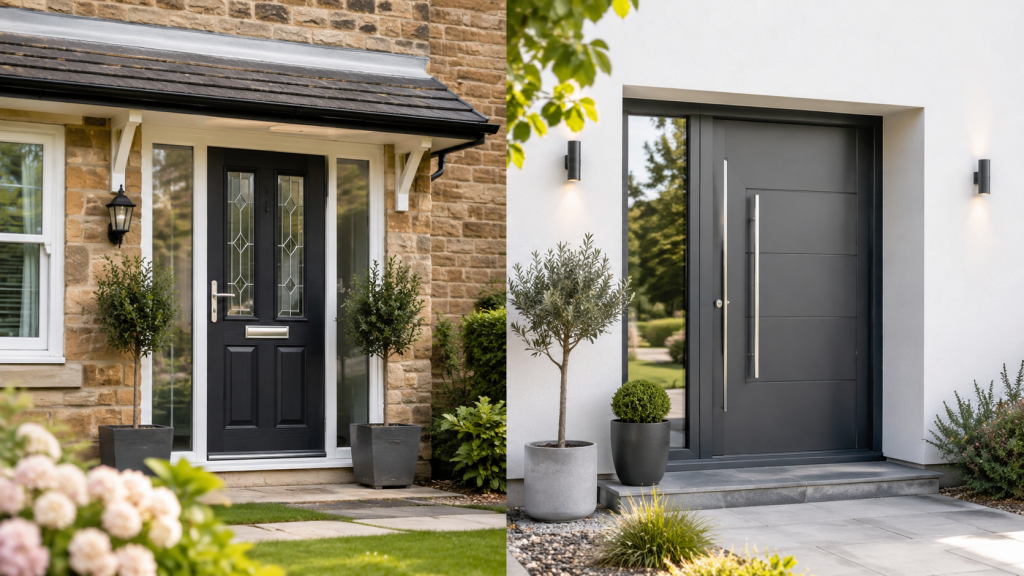
  • Composite excels at traditional and timber-effect styles. Moulded woodgrain skins convincingly mimic painted timber, suiting period, cottage, and classic suburban properties. Colour range is good but typically narrower than powder coating.
  • Aluminium excels at contemporary and minimalist designs. Slim sightlines, flush-bonded faces, large formats, and 200+ RAL powder-coat colours (plus dual-colour and metallic/textured finishes) suit modern architecture and statement entrances.
Appearance factorCompositeAluminium
Traditional / timber lookExcellentLimited
Contemporary / minimalist lookModerateExcellent
Colour optionsGood (foiled/integral)Excellent (200+ RAL, dual-colour)
Slim sightlinesModerateExcellent
Large-format capabilityLimitedExcellent
Finish longevityGoodExcellent (no repainting)

Verdict: Choose composite for authentic traditional aesthetics; choose aluminium for contemporary designs, slim frames, large formats, and the widest colour and finish range.

For projects where a contemporary aluminium appearance is being combined with keyless or biometric access, smart aluminium entrance doors can be compared as a premium specification route. 

Lifespan

ComponentCompositeAluminium
Structural skin/frame25–35 years40–50+ years
FinishIntegral/foiled, no repaintPowder coat 25+ years
Locking mechanism10–20 years (replaceable)10–20 years (replaceable)
Cylinder10–15 years (replaceable)10–15 years (replaceable)
Seals10–20 years (replaceable)10–20 years (replaceable)
Overall service life25–35 years30–50 years

Verdict: Aluminium has the longer structural life. Composite cores and skins, while durable, are generally expected to give 25–35 years versus aluminium’s 30–50, because metal does not degrade structurally under normal residential conditions.

Environmental Impact

Environmental comparison spans manufacturing energy, lifespan, and recyclability.

  • Aluminium is energy-intensive to produce from raw ore (primary aluminium), but it is infinitely recyclable without loss of quality, and recycling uses around 5% of the energy of primary production. A long service life and high end-of-life recyclability give aluminium a strong circular-economy profile. Many systems incorporate recycled content.
  • Composite doors have lower embodied energy at manufacture in some respects, but the bonded mix of GRP, timber, foam, and polymer is difficult to separate and recycle at end of life, so most are not recycled and go to landfill or energy recovery.
Environmental factorCompositeAluminium
Embodied energy (manufacture)Lower–moderateHigher (primary); low (recycled)
Recyclability at end of lifeLow (bonded mixed materials)Very high (infinitely recyclable)
Service life (longevity benefit)25–35 years30–50 years
Recycled-content potentialLimitedHigh

Verdict: Aluminium’s recyclability and longer life favour it in whole-life terms, despite higher primary-production energy. Composite’s end-of-life recyclability is its main environmental weakness.

Cost of Ownership Over 20 Years

This is where upfront price and longevity interact. Indicative figures (UK, 2026):

Cost element (20-year horizon)CompositeAluminium
Typical installed purchase cost£1,200–£3,500£3,000–£8,000+
Repainting/refinishing£0 (no repaint)£0 (no repaint)
Likely consumable replacements (seals, cylinder) over 20 yrs£150–£400£150–£400
Probability of full replacement within 20 yrsLow–moderate (life 25–35 yrs)Very low (life 30–50 yrs)
Residual life beyond 20 yearsLimited–moderateSubstantial
Indicative 20-year total£1,350–£3,900£3,150–£8,400+

Verdict: Over 20 years, composite remains the lower-cost option in absolute terms. However, aluminium retains substantially more residual life beyond year 20 (often another 10–30 years), so on a true whole-life (cost-per-year) basis the gap narrows considerably. For owners planning to stay long-term, aluminium’s cost-per-year of service can approach or match composite.

Composite Doors vs Aluminium Doors

Common Misconceptions

“Aluminium doors are cold and cause condensation.” False for modern doors. Single-skin aluminium is cold-bridging, but every residential aluminium entrance door uses a polyamide thermal break that keeps the internal surface warm and prevents condensation.

“Composite doors are maintenance-free and last forever.” Composite doors are low-maintenance, but consumable parts still need servicing, and the door’s overall life is 25–35 years, not indefinite.

“Aluminium doors aren’t as secure as composite.” False. Both meet PAS 24:2022; aluminium’s rigid frame in fact reaches RC3 of BS EN 1627 more readily than composite.

“Composite doors can’t be made in modern styles.” Composite is best at traditional looks but is available in contemporary finishes; aluminium simply offers more design freedom for minimalist and large-format designs.

“A lower U-value door is always worth the extra cost.” The U-value difference between a 1.2 and a 1.0 W/m²K door produces only a small absolute heat-loss difference over a single door area; the decision should weigh aesthetics, lifespan, and security alongside thermal performance.

“Powder-coated aluminium needs repainting like timber.” False. Qualicoat powder coating lasts 25+ years without peeling or repainting.

Expert Summary

Composite and aluminium doors achieve comparable security and energy performance by different routes, and both meet UK Building Regulations when well specified. Composite is the more affordable choice and the better option for authentic traditional and timber-look aesthetics, with a typical service life of 25–35 years. Aluminium costs more upfront (£3,000–£8,000+ vs £1,200–£3,500) but leads on structural lifespan (30–50 years), dimensional stability, large-format capability, finish longevity, contemporary design freedom, and end-of-life recyclability. Over a 20-year horizon composite remains cheaper in absolute terms, but aluminium’s greater residual life narrows the gap on a cost-per-year basis. The right choice depends on budget, architectural style, opening size, and intended ownership period not on any single metric.

Before making a final decision, homeowners should compare both physical security and access features. Reviewing secure front doors can help identify whether stronger protection is needed, while fingerprint aluminium doors may be relevant where smart access and modern aluminium design are priorities. 

Frequently Asked Questions

1. Are aluminium doors better than composite doors? Neither is universally better. Aluminium leads on lifespan, dimensional stability, large formats, contemporary aesthetics, and recyclability; composite leads on affordability and traditional looks. Both meet UK security and thermal standards.
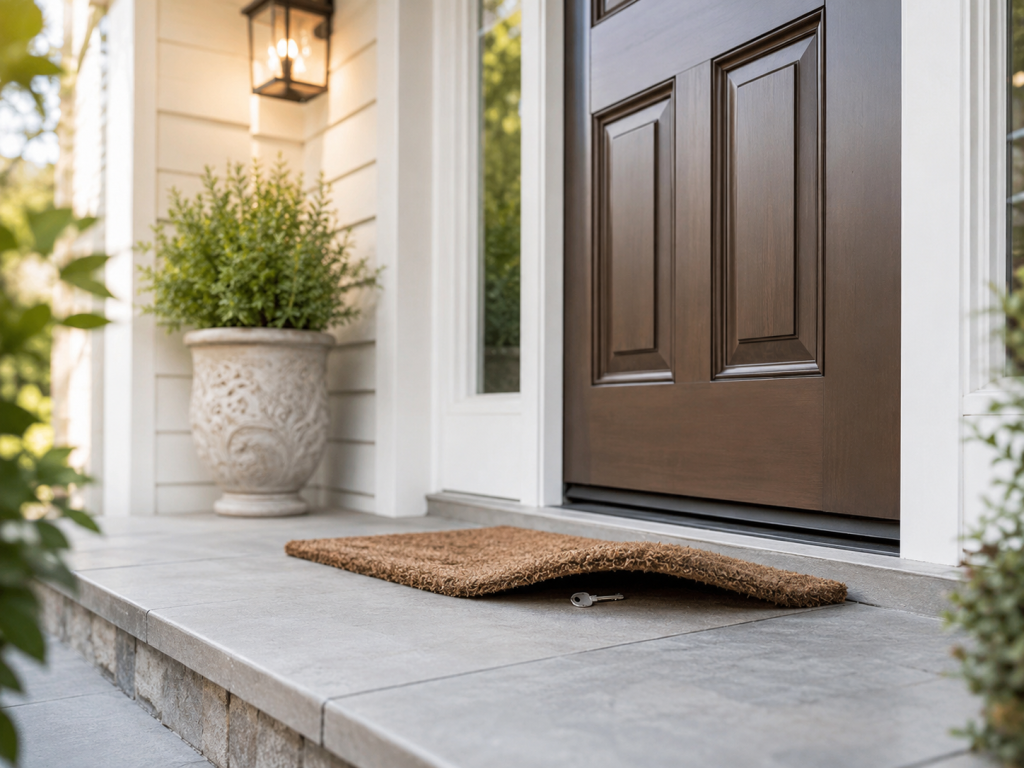
2. Which is more secure, composite or aluminium? Both meet PAS 24:2022. Aluminium’s rigid frame reaches RC3 of BS EN 1627 more readily, while composite’s tough GRP skin resists impact well. For most homes, either is sufficient.

3. Which has the better U-value? Aluminium achieves slightly lower (better) whole-door U-values overall 1.0–1.4 W/m²K versus composite’s 1.2–1.8 W/m²K with the deepest aluminium systems going below 1.0.

4. Are aluminium doors cold? No. Thermally broken aluminium doors keep the internal surface warm and do not cause the condensation associated with single-skin metal.

5. Which lasts longer? Aluminium, with a structural life of 30–50 years versus composite’s 25–35 years.

6. Which is cheaper? Composite is cheaper upfront (£1,200–£3,500 installed) compared with aluminium (£3,000–£8,000+).

7. Which is better for a modern house? Aluminium, due to slim sightlines, flush-bonded faces, large-format capability, and the widest colour range.

8. Which is better for a period or traditional home? Composite, because its moulded woodgrain skins convincingly mimic painted timber.

9. Which is more environmentally friendly? Aluminium in whole-life terms, because it is infinitely recyclable and lasts longer; composite is harder to recycle at end of life.

10. Do either need repainting? No. Composite colour is integral or foiled; aluminium is powder-coated for 25+ years. Neither requires repainting under normal use.

11. Which handles coastal weather better? Aluminium with a Seaside-grade powder coat performs excellently; composite has no corrosion risk but can fade depending on skin quality. Both are suitable with correct specification.

12. Can both be Secured by Design certified? Yes, where the specific door is independently certified to PAS 24 and made under audited conditions.

13. Over 20 years, which costs less in total? Composite remains cheaper in absolute terms, but aluminium retains more residual life beyond 20 years, narrowing the cost-per-year gap.

14. Which has more colour options? Aluminium, via powder coating in 200+ RAL colours, dual-colour, and metallic/textured finishes.

15. Can composite doors be large? Composite is best suited to standard residential sizes; large or oversized openings favour aluminium’s structural strength.

16. Do aluminium doors warp? No. Aluminium is dimensionally stable and does not warp, swell, or sag under normal conditions.

17. Is a composite door’s foam core a fire risk? Composite doors are manufactured to relevant safety standards; the core is encased. Fire performance depends on the specific product’s certification, not the material category alone.

18. Which is quieter for acoustic insulation? Both insulate against sound well; aluminium with triple glazing and multi-seal compression typically offers a slight edge on acoustic attenuation.

19. Will my home insurer accept either? Insurers generally accept doors meeting PAS 24 and/or with Secured by Design accreditation, which both materials can achieve.

20. Which should I choose? Choose composite for a traditional look on a tighter budget; choose aluminium for contemporary design, large openings, maximum lifespan, and long-term ownership.

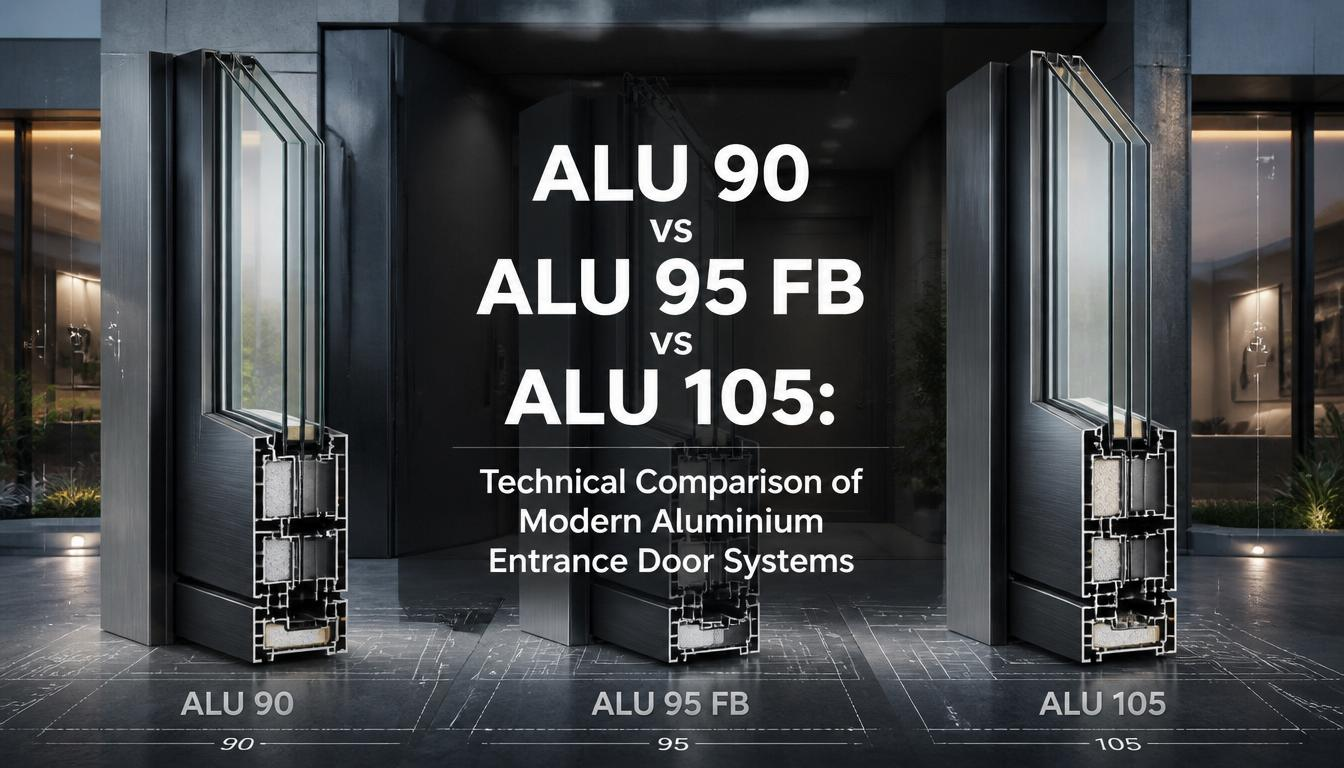
ALU 90 vs ALU 95 FB vs ALU 105

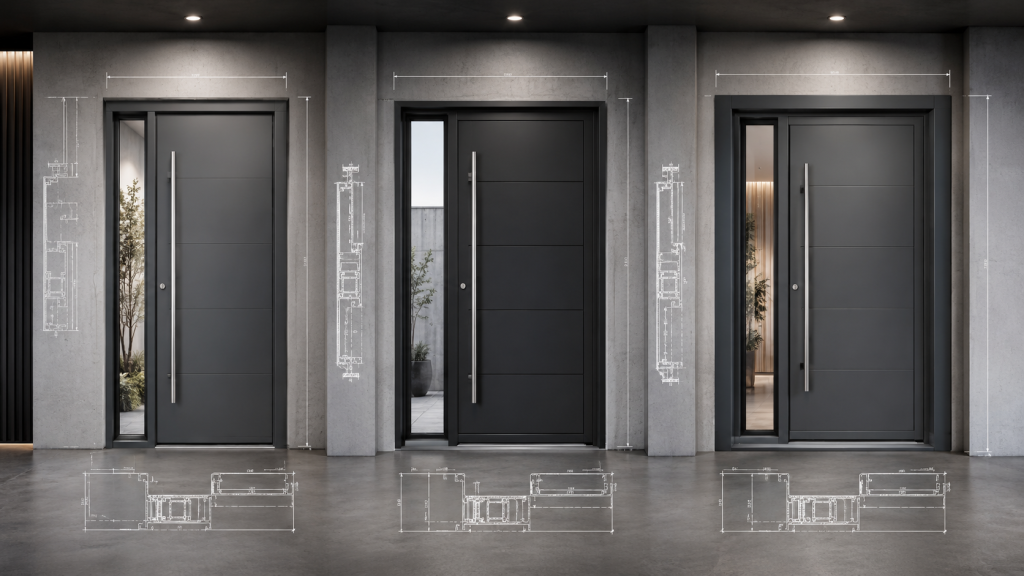
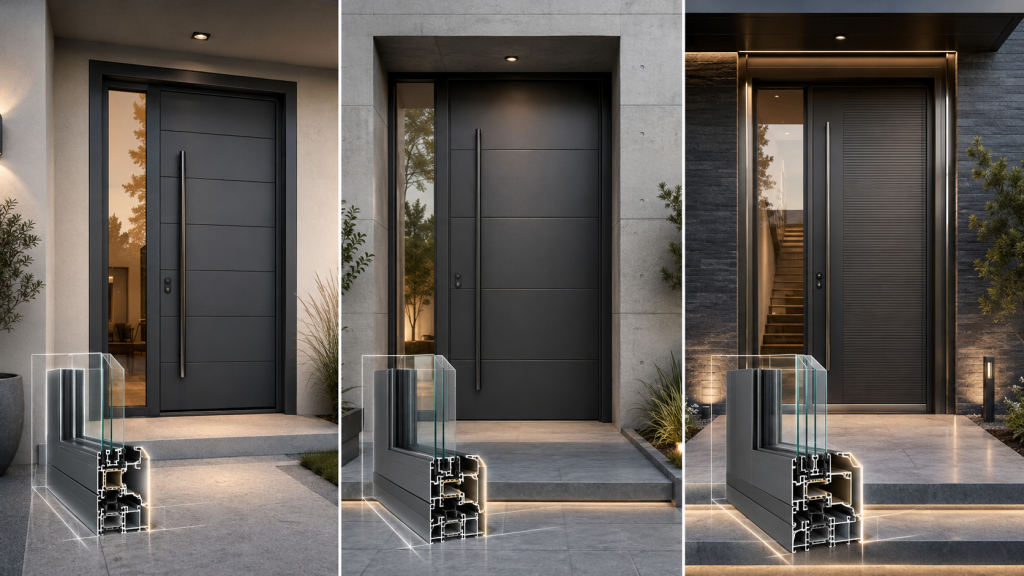
ALU 90 vs ALU 95 FB vs ALU 105: Technical Comparison of Modern Aluminium Entrance Door Systems

An evidence based technical comparison of three contemporary thermally broken aluminium entrance door systems, covering construction, thermal performance, security, frame depth, locking, durability, and application.

ALU 90 vs ALU 95 FB vs ALU 105 are designations within the family of premium thermally broken aluminium entrance door systems sold in the UK. The numeric suffix in each name corresponds broadly to the system build depth in millimetres — a primary determinant of thermal performance and structural capability. The “FB” in ALU 95 FB denotes a flush bonded (face bonded) leaf, where the infill panel is bonded flush to the aluminium frame for a seamless contemporary appearance.

This article compares the three systems on a technical basis. Because exact figures vary between manufacturers and individual configurations, the numerical values here are presented as representative ranges typical of each system class. Always confirm specific performance against the relevant product’s current test certificates.

For homeowners comparing aluminium systems with stronger physical protection requirements, high security doors are worth reviewing alongside ALU 90, ALU 95 FB, and ALU 105 specifications. Where the brief also includes smart access or biometric entry, fingerprint aluminium doors can be compared as a premium keyless entrance option. 

ALU 90 vs ALU 95 FB vs ALU 105

Key Takeaways

  • The number in each system name approximates the build/frame depth in millimetres: ALU 90 ≈ 90 mm, ALU 95 FB ≈ 95 mm, ALU 105 ≈ 105 mm.
  • Greater build depth allows a deeper thermal break and thicker insulated core, which generally improves the achievable U value.
  • ALU 95 FB is distinguished by its flush bonded leaf construction, giving a flat, frameless external appearance favoured in contemporary architecture.
  • ALU 105, as the deepest system, typically offers the best thermal performance and the greatest structural capacity for large door leaves.
  • All three systems can be specified to PAS 24:2022 and commonly to RC2 or RC3 of BS EN 1627 with appropriate hardware.
  • System choice is driven by required U value, leaf size, aesthetic preference, and budget, not by a single “best” option.

Understanding the Naming Convention

The naming follows aluminium systems industry convention where the number denotes the nominal build depth:

  • ALU 90 — approximately 90 mm system depth. The entry point into the premium thermally broken category.
  • ALU 95 FB — approximately 95 mm depth, with a flush bonded (face bonded) door leaf for flat external aesthetics.
  • ALU 105 — approximately 105 mm depth. The deepest system, engineered for maximum thermal and structural performance.

Build depth matters because it sets the room available for (a) the polyamide thermal break, (b) the insulated panel core, and (c) the glazing unit thickness. Deeper systems can accommodate triple glazing and thicker cores, improving insulation and acoustic performance.

ALU 90 vs ALU 95 FB vs ALU 105

Construction Differences

ALU 90

ALU 90 uses a thermally broken twin shell aluminium leaf around an insulated core or glazing unit. At roughly 90 mm depth, it accommodates a substantial polyamide thermal break and a well insulated panel, while keeping sightlines and weight moderate. It is typically configured with the leaf set within the frame in a conventional manner. ALU 90 represents the practical balance of performance, weight, and cost within the premium tier.

ALU 95 FB (Flush Bonded)

The defining feature of ALU 95 FB is flush bonding: the door panel is structurally bonded to the aluminium leaf so that the external face is flat and continuous, with no stepped or rebated panel edge visible. This produces a monolithic, frameless aesthetic highly sought in modern and minimalist designs. The bonded construction also adds rigidity. At ~95 mm depth, thermal capability is strong, and the flush face can be powder coated in a single continuous finish or combined with feature materials.

ALU 105

ALU 105 is the deepest of the three at ~105 mm. The additional depth allows the deepest thermal break and the thickest insulated core or triple glazed unit, giving the best thermal performance of the three. The greater section depth also provides the highest structural strength, supporting larger and heavier leaves without deflection. ALU 105 is the specification of choice where maximum insulation, large format, or both are required.

Thermal Performance

Thermal performance scales with build depth, thermal break geometry, and core/glazing specification. Representative whole door U value ranges:

SystemNominal depthRepresentative whole door U value (W/m²K)Glazing capability
ALU 90~90 mm1.0–1.4Double / some triple
ALU 95 FB~95 mm0.9–1.3Double / triple
ALU 105~105 mm0.8–1.2Triple readily

All three meet the Approved Document L requirement of ≤1.4 W/m²K for replacement doors. ALU 105 reaches the lowest (best) U values because its depth accommodates the deepest thermal break and thickest insulating core. ALU 95 FB benefits thermally from its bonded, gap free panel construction. Figures depend heavily on the specific infill — a fully glazed leaf performs differently from a solid insulated panel.

Security Performance

Security in aluminium entrance systems is determined less by build depth and more by locking hardware, cylinder protection, hinge specification, glazing, and reinforcement. All three systems share the same achievable security ceiling when fitted with equivalent hardware.

SystemPAS 24:2022RC2 (BS EN 1627)RC3 (BS EN 1627)
ALU 90AchievableAchievableAchievable with spec hardware
ALU 95 FBAchievableAchievableAchievable with spec hardware
ALU 105AchievableAchievableAchievable with spec hardware

The deeper sections of ALU 105 and the bonded rigidity of ALU 95 FB can make higher resistance classes marginally easier to engineer, but PAS 24 and RC2/RC3 are attainable across all three with the correct multi point lock, anti snap cylinder, security hinges, and laminated glazing.

Where stronger physical protection is the main priority, comparing high security entrance doors can help clarify whether a security focused doorset is more suitable than a standard residential aluminium specification. 

Frame Depth and Sightlines

Frame depth affects installation, structural reveal, and visual proportion:

SystemNominal frame/build depthVisual character
ALU 90~90 mmSlim premium profile, conventional leaf appearance
ALU 95 FB~95 mmFlush, flat external face; minimalist, frameless look
ALU 105~105 mmDeepest section; substantial, supports large formats

Deeper frames provide more structural reveal for fixing into the opening and accommodate thicker walls and insulation depths typical of modern construction. The flush bonded ALU 95 FB prioritises the external aesthetic, presenting a seamless plane rather than a stepped panel.

ALU 90 vs ALU 95 FB vs ALU 105

Locking Systems

All three systems are typically fitted with automatic multi point locking mechanisms. A representative premium specification across the range includes:

  • Multi point engagement — hooks and/or bolts engaging the frame at several points simultaneously.
  • Automatic deadlocking — the lock self engages on closing, so the door is secured without lifting the handle or turning the key (key turn adds full deadlock).
  • Anti snap, anti bump, anti pick, anti drill cylinders conforming to recognised cylinder standards such as TS 007 (3 star) or SS 312 Diamond.
  • Security keeps and reinforced strike plates in the frame.

The locking hardware is broadly common across ALU 90, ALU 95 FB, and ALU 105; the system depth does not constrain the available lock specification. Higher resistance classes require correspondingly higher rated cylinders and keeps.

For projects where automatic multi point locking is being combined with smart or biometric access, smart aluminium entrance doors can be compared as a premium specification route. 

Durability

All three systems share the inherent durability of thermally broken aluminium: a dimensionally stable, corrosion resistant frame with a powder coated finish.

Durability factorALU 90ALU 95 FBALU 105
Frame service life40–50+ years40–50+ years40–50+ years
Powder coat life (Qualicoat)25+ years25+ years25+ years
Resistance to warp/sagHighHigh (bonded rigidity)Highest (deepest section)
Large leaf stabilityGoodVery goodExcellent
Seal/cylinder serviceabilityReplaceableReplaceableReplaceable

The bonded leaf of ALU 95 FB adds rigidity that resists deflection, while ALU 105’s deeper section gives it the greatest capacity to carry large, heavy leaves over decades without sagging. All three vastly outlast UPVC and composite alternatives on structural longevity.

Which Property Types Suit Each System

ALU 90 — Best for:

  • Standard to large premium residential entrances seeking strong performance at the most accessible point in the premium range.
  • Renovations and replacements where a conventional leaf appearance is acceptable.
  • Properties needing reliable ≤1.4 W/m²K compliance without the cost of the deepest system.

ALU 95 FB — Best for:

  • Contemporary and architect designed homes prioritising a flush, frameless, minimalist external face.
  • New builds and renovations where aesthetics and a seamless plane are central to the design intent.
  • Owners wanting a distinctive modern statement entrance with strong thermal performance.

ALU 105 — Best for:

  • Large or oversized entrances demanding maximum structural capacity.
  • Properties targeting the lowest achievable U values (e.g. low energy or high spec new builds).
  • Triple glazed configurations and the most demanding thermal/acoustic briefs.
  • Super prime residential where best in class performance is the priority over cost.

Before choosing between these systems, homeowners should compare both physical security and access features. Reviewing secure front doors can help identify whether stronger protection is needed, while fingerprint aluminium doors may be relevant where smart access and modern aluminium design are priorities. 

Detailed Comparison Table

AttributeALU 90ALU 95 FBALU 105
Nominal build depth~90 mm~95 mm~105 mm
Leaf constructionTwin shell, conventionalFlush bonded (face bonded)Twin shell, deepest section
External appearanceSlim premium, stepped panelFlush, flat, framelessSubstantial, large format capable
Representative whole door U value1.0–1.4 W/m²K0.9–1.3 W/m²K0.8–1.2 W/m²K
GlazingDouble / some tripleDouble / tripleTriple readily
Thermal breakDeep polyamideDeep polyamide + bonded panelDeepest polyamide
PAS 24:2022AchievableAchievableAchievable
RC2 / RC3 (BS EN 1627)AchievableAchievableAchievable
LockingAutomatic multi pointAutomatic multi pointAutomatic multi point
Cylinder gradeTS 007 3 star / SS 312 DiamondTS 007 3 star / SS 312 DiamondTS 007 3 star / SS 312 Diamond
Frame service life40–50+ years40–50+ years40–50+ years
Large leaf capabilityGoodVery goodExcellent
Aesthetic priorityPremium conventionalMinimalist flushPerformance / scale
Relative cost££££££
Best forPremium standard entrancesContemporary flush designsLarge format / max thermal

Expert Summary

The three systems form a graduated range in which build depth is the organising principle. ALU 90 (~90 mm) is the accessible premium baseline, delivering ≤1.4 W/m²K compliance and full PAS 24 / RC2–RC3 security in a conventional leaf. ALU 95 FB (~95 mm) trades on its flush bonded leaf, prioritising a seamless, frameless aesthetic while adding rigidity and strong thermal performance. ALU 105 (~105 mm) is the performance flagship: the deepest section, the deepest thermal break, triple glazing capacity, the lowest achievable U values, and the greatest structural strength for large leaves. Security ceilings are effectively equal across all three because they are set by hardware, not depth. The correct choice is dictated by the required U value, leaf size, and aesthetic, with cost rising in step with depth and capability.

ALU 90 vs ALU 95 FB vs ALU 105

Frequently Asked Questions

1. What does the number in ALU 90, ALU 95, and ALU 105 mean? It approximates the system build/frame depth in millimetres. ALU 90 is about 90 mm deep, ALU 95 FB about 95 mm, and ALU 105 about 105 mm. Greater depth allows a deeper thermal break and thicker core.

2. What does “FB” mean in ALU 95 FB? FB stands for flush bonded (face bonded), meaning the panel is structurally bonded flush to the aluminium leaf for a flat, frameless external appearance.

3. Which system has the best thermal performance? ALU 105 typically achieves the lowest (best) whole door U values — around 0.8–1.2 W/m²K — because its depth accommodates the deepest thermal break and thickest insulating core.

4. Are all three systems secure to the same level? Yes. PAS 24:2022 and RC2/RC3 of BS EN 1627 are achievable across all three, because security is determined by locking hardware, cylinders, hinges, and glazing rather than build depth.

5. Which system looks the most modern? ALU 95 FB, due to its flush bonded flat external face, gives the most contemporary, minimalist, frameless appearance.

6. Which system is best for a very large front door? ALU 105. Its deepest section provides the greatest structural strength, supporting large and heavy leaves without deflection over time.

7. Do all three meet UK Building Regulations? Yes. All three can achieve a whole door U value of 1.4 W/m²K or lower, satisfying Approved Document L for replacement doors, and can meet Approved Document Q via PAS 24.

8. Can these systems take triple glazing? ALU 105 accommodates triple glazing readily; ALU 95 FB can in many configurations; ALU 90 supports double and some triple glazed builds depending on the unit.

9. Which is the most cost effective? ALU 90 is generally the most accessible of the three while still delivering full premium tier performance. Cost rises with depth toward ALU 105.

10. What locking system do these doors use? Automatic multi point locking that self engages on closing, combined with anti snap, anti bump, anti pick, anti drill cylinders (e.g. TS 007 3 star or SS 312 Diamond) and reinforced keeps.

11. Is ALU 95 FB stronger because it is bonded? The flush bonded construction adds rigidity to the leaf, which resists deflection. For raw structural capacity on very large leaves, however, ALU 105’s deeper section leads.

12. How long will these doors last? The aluminium frame and leaf typically last 40–50+ years, with the powder coat lasting 25+ years and consumable parts (seals, cylinders) replaced periodically.

13. Do deeper systems insulate against sound better? Generally yes. Greater depth allows thicker glazing and core, which improves acoustic insulation, so ALU 105 typically offers the best sound attenuation.

14. Can I have different colours inside and out? Yes. All three support dual colour powder coating, with different RAL finishes internally and externally.

15. Which system should an architect specify for a contemporary new build? ALU 95 FB is often specified where a flush minimalist aesthetic is central; ALU 105 where maximum thermal performance or large format dominates the brief.

16. Does build depth affect the wall thickness the door suits? Yes. Deeper systems suit thicker walls and higher insulation depths typical of modern construction, and provide more reveal for fixing.

17. Are the U values quoted whole door or panel figures? The ranges in this article are representative whole door figures. Always confirm whether a quoted value is whole door (regulated) or panel (more flattering) before comparing.

18. Can these systems be made into Secured by Design doors? Yes, where the specific configuration is independently certified to PAS 24 and manufactured under audited conditions, Secured by Design accreditation is attainable.

The Complete Guide to Aluminium Entrance Doors in the UK

The Complete Guide to Aluminium Entrance Doors in the UK (2026)

An evidence based reference resource on aluminium entrance door construction, performance, security, thermal efficiency, durability, and cost.

An aluminium entrance door is an external pedestrian door whose frame and door leaf are constructed primarily from extruded aluminium alloy, almost always incorporating a polyamide thermal break to control heat transfer. In the United Kingdom, aluminium entrance doors occupy the premium tier of the residential door market, sitting above composite, GRP (glass reinforced plastic), and UPVC doors in both price and, in most measurable respects, performance.

This guide explains how aluminium entrance doors are constructed, how they compare with the principal alternatives, how their security and thermal performance are measured against recognised UK standards, and what homeowners and specifiers should realistically expect in terms of lifespan, maintenance, and total cost. It is written as a technical reference rather than a buying pitch, and it cites the relevant British and European standards throughout.

Aluminium systems are also increasingly used for premium smart access projects, including fingerprint aluminium doors where modern entrance design and keyless convenience are both required.

The Complete Guide to Aluminium Entrance Doors in the UK

Key Takeaways

  • Aluminium entrance doors use a thermally broken aluminium frame — two aluminium profiles separated by a non conductive polyamide bridge — to achieve competitive U values despite aluminium’s high base conductivity.
  • A well specified aluminium entrance door achieves a whole door U value of approximately 1.0–1.4 W/m²K, comfortably meeting the current Building Regulations requirement.
  • Security is independently verified through PAS 24:2022 and the RC2 / RC3 classifications of BS EN 1627, not by manufacturer claims.
  • Powder coating to a Qualicoat / BS EN 12206 standard gives aluminium its long term colour stability and corrosion resistance, with realistic coating life of 25+ years.
  • Expected service life of a quality aluminium entrance door is 30–50 years, longer than composite (25–35 years) or UPVC (20–30 years).
  • Aluminium doors are the most expensive mainstream option, typically £3,000–£8,000+ installed for residential entrance systems, rising substantially for large format or designer configurations.

What “Aluminium Entrance Door” Actually Means

The term refers to a complete door system, not merely a panel. A modern aluminium entrance door comprises:

  • An outer frame fixed into the structural opening.
  • A door leaf (sash) — the moving part — built from aluminium profiles around an infill panel, glazing unit, or solid insulated core.
  • A thermal break, the defining feature, made of polyamide (nylon reinforced with glass fibre) that mechanically joins the inner and outer aluminium sections while interrupting heat flow.
  • A multi point locking mechanism engaging the frame at several points simultaneously.
  • A weatherseal system, usually two or three lines of EPDM gasket.

The phrase “aluminium door” without a thermal break almost always indicates a commercial or non insulated product unsuitable for a heated dwelling. For residential use, only thermally broken systems should be considered.

The Complete Guide to Aluminium Entrance Doors in the UK

Aluminium vs Composite vs UPVC: The Core Comparison

The three dominant residential entrance door materials differ in base material, construction method, and the performance envelope they can reach. Composite doors typically use a GRP or laminated skin over a timber effect frame and an insulated foam core. UPVC doors use hollow, multi chambered plastic profiles. Aluminium doors use extruded metal profiles with a thermal break.

Comparison Table: Aluminium vs Composite vs UPVC Entrance Doors

AttributeAluminium (thermally broken)Composite (GRP skin)UPVC
Typical whole door U value (W/m²K)1.0–1.41.2–1.81.4–2.0
Frame materialExtruded aluminium alloy + polyamide breakGRP/laminate skin, timber sub frame, foam coreMulti chamber rigid PVC U
Maximum realistic door height/widthVery large (structural strength of metal)Moderate (standard residential sizes)Limited (sag risk at large sizes)
Security ceilingPAS 24 + RC2/RC3 readily achievablePAS 24 achievable; RC3 less commonPAS 24 achievable on quality systems
Colour finishPowder coat (Qualicoat), 200+ RAL optionsMoulded/foiled colourFoiled or through coloured
Resistance to warping/swellingExcellent (dimensionally stable metal)GoodModerate (thermal expansion)
Typical service life (years)30–5025–3520–30
MaintenanceMinimal (clean + lubricate)MinimalMinimal
RecyclabilityVery high (aluminium infinitely recyclable)Low (composite hard to separate)Moderate (PVC recyclable but downcycled)
Typical installed cost (UK, 2026)£3,000–£8,000+£1,200–£3,500£700–£2,000

Interpretation: UPVC is the budget option with the shortest lifespan and weakest thermal ceiling. Composite offers strong thermal performance at mid market prices and good security. Aluminium leads on structural strength, large format capability, finish longevity, dimensional stability, and recyclability, at the highest price point.

Security Ratings Explained

Door security in the UK is governed by a small set of recognised standards. Marketing terms like “high security” carry no defined meaning; the standards below do.
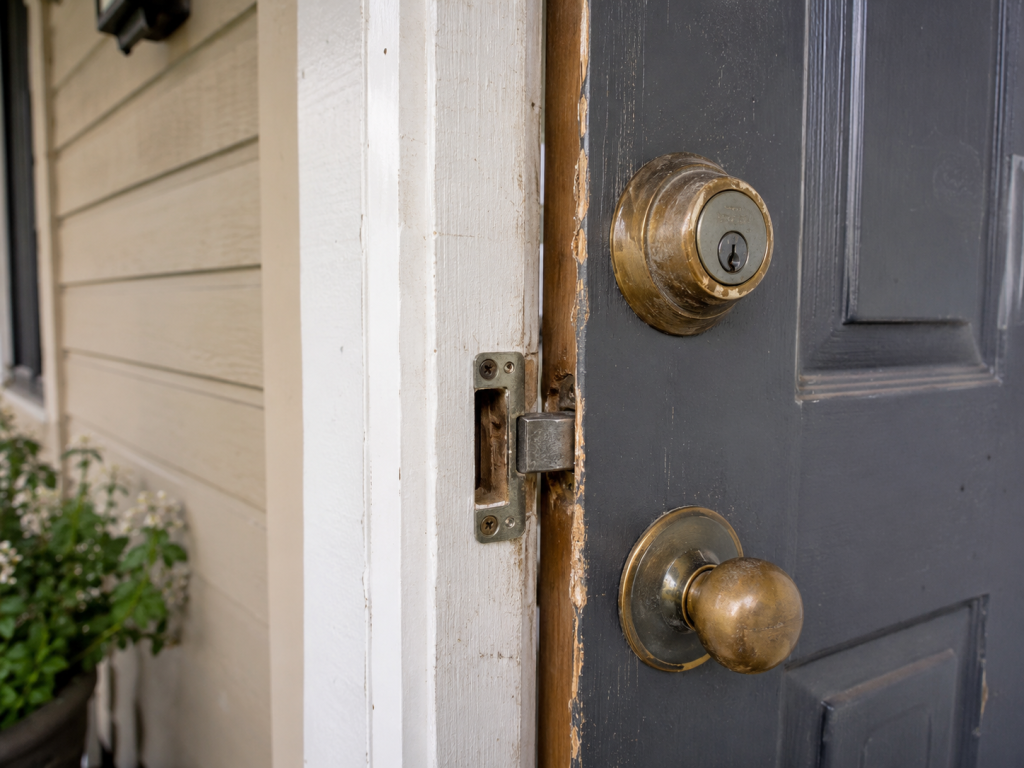
For homeowners comparing tested physical protection rather than marketing claims, high security doors are worth reviewing alongside standard aluminium entrance systems.

The Complete Guide to Aluminium Entrance Doors in the UK

PAS 24:2022

PAS 24 is the principal UK enhanced security performance standard for doors and windows. The current version is PAS 24:2022. A door tested to PAS 24 undergoes a sequence of manual attack tests simulating an opportunist burglar using common tools, plus mechanical loading, cylinder attack, and manipulation tests. PAS 24 is the security standard referenced by Approved Document Q (Security) of the Building Regulations, which applies to new dwellings in England.

BS EN 1627 and Resistance Classes (RC1–RC6)

BS EN 1627 defines resistance classes from RC1 (lowest) to RC6 (highest), based on attack tools, attacker experience, and resistance time:

Resistance ClassTypical attacker profileToolsResistance time
RC1 NCasual, bodily forceNone significant
RC2Opportunist, simple toolsScrewdriver, pliers, wedge3 minutes
RC3Determined, leverage toolsCrowbar, second screwdriver5 minutes
RC4Experienced, power toolsSaw, drill, hammer, chisel10 minutes
RC5–RC6Highly experiencedPower tools incl. angle grinder15–20 minutes

For UK residential entrance doors, RC2 is a strong baseline and RC3 is a premium target. RC4 and above are normally specified for high risk commercial, institutional, or super prime applications. Aluminium’s structural rigidity makes RC3 readily achievable in well engineered systems.

Secured by Design

Secured by Design (SBD) is the official UK police security accreditation scheme. An SBD accredited door has been independently certified to meet PAS 24 (or equivalent) and manufactured under audited conditions. SBD certification is widely requested by specifiers and can influence home insurance terms.

Thermal Performance and U Values

What a U Value Is

A U value measures the rate of heat transfer through a building element, expressed in watts per square metre per kelvin (W/m²K). It quantifies how much heat passes through one square metre of the door for every one degree difference in temperature between inside and outside. A lower U value means better insulation. A door with a U value of 1.0 loses heat at half the rate of one rated 2.0.

Why Aluminium Needs a Thermal Break

Aluminium has a thermal conductivity of roughly 160–235 W/mK, far higher than UPVC (~0.17 W/mK) or timber (~0.13 W/mK). Without intervention, a solid aluminium profile would conduct heat straight through the door, creating cold surfaces and condensation. The polyamide thermal break solves this by physically separating the warm internal aluminium from the cold external aluminium with a low conductivity bridge. Modern systems use thermal breaks 24–44 mm deep, with deeper breaks giving better insulation.

Whole Door vs Panel U Values

A critical distinction for accurate comparison:

  • The panel (or “centre pane”) U value measures only the central glazed or insulated section. It is always more flattering.
  • The whole door U value accounts for the frame, sash, thermal break, glazing edges, and panel together, weighted by area. This is the figure that matters for Building Regulations and real world performance.

Always compare whole door U values. A quoted figure of “0.8 W/m²K” almost always refers to the panel, not the assembled door.

Building Regulations Requirement

Under Approved Document L of the Building Regulations (England), the maximum U value for a replacement external pedestrian door in an existing dwelling is 1.4 W/m²K. New build standards under the latest L revisions are similar or tighter. A well specified aluminium entrance door (1.0–1.4 W/m²K whole door) meets this comfortably.

Comparison Table: Thermal Performance

Door typeTypical whole door U value (W/m²K)Meets AD L (≤1.4)?
Premium aluminium, triple glazed/insulated panel0.9–1.2Yes
Standard aluminium, double glazed1.2–1.4Yes (at upper bound)
Composite, insulated core1.2–1.8Often (better units only)
UPVC, double glazed1.4–2.0Marginally / sometimes not

Powder Coating Durability

Aluminium entrance doors are almost universally finished by powder coating — an electrostatically applied dry polyester powder cured under heat to form a hard, uniform film. The recognised quality benchmarks are Qualicoat (an independent licensing standard) and BS EN 12206 1 (paints and varnishes — coating of aluminium for architectural purposes).

Key performance facts:

  • A correctly applied Qualicoat Class 1 polyester coating has a realistic outdoor service life of 25+ years before significant fade or chalking.
  • Qualicoat Seaside (Class 1.5/2) specifications use a pre anodised or extra corrosion resistant process for coastal locations, where airborne salt accelerates corrosion.
  • Powder coating allows over 200 RAL colours, plus textured, matt, gloss, and metallic finishes, and dual colour (different inside/outside).
  • Unlike paint on timber, powder coat does not peel, blister, or require repainting under normal conditions.

Colour fade is measured in the industry against gloss retention and colour shift (ΔE) thresholds defined within the Qualicoat specification.

Lifespan Expectations

Service life depends on specification quality, installation, exposure, and maintenance, but realistic UK expectations are:

ComponentTypical lifespan
Aluminium frame and leaf40–50+ years
Powder coat finish25–30+ years before refurbishment
Multi point lock mechanism10–20 years (serviceable/replaceable)
Cylinder10–15 years (replaceable)
EPDM weatherseals10–20 years (replaceable)
Glazing unit (sealed)15–25 years before edge seal risk

The structural aluminium itself effectively does not degrade under normal residential conditions; it is the consumable components — seals, cylinders, locks — that are periodically serviced or replaced. This is a key reason aluminium outlasts UPVC and composite.

Maintenance Requirements

Aluminium entrance doors are low maintenance but not maintenance free. Recommended routine:

  • Cleaning: Wash powder coated surfaces 2–4 times per year with warm water and mild non abrasive detergent. Coastal properties should clean more frequently to remove salt deposits.
  • Hardware lubrication: Apply a light, non acidic lubricant to the multi point lock keeps and hinges annually.
  • Cylinder care: Use a dry PTFE based lubricant in the cylinder; avoid oil based products that attract dust.
  • Seal inspection: Check EPDM gaskets annually for compression set or damage; replace as needed.
  • Drainage: Keep frame drainage slots clear of debris.

Avoid abrasive cleaners, solvents, and pressure washers directed at seals, all of which can damage the coating or gaskets.

Cost Ranges (UK, 2026)

Pricing varies with size, glazing, hardware, finish, and installation complexity. Indicative 2026 supply and fit ranges:

ConfigurationIndicative installed cost
Standard single aluminium entrance door£3,000–£5,000
Aluminium door with side panel(s)£4,500–£7,000
Large format / designer / dual colour£6,000–£12,000+
Aluminium door with integrated smart/biometric access£5,000–£15,000+

By comparison, composite doors typically install at £1,200–£3,500 and UPVC at £700–£2,000. The aluminium premium buys structural strength, large format capability, finish longevity, dimensional stability, and design flexibility.

For projects where aluminium construction is being combined with smart or biometric access, smart aluminium entrance doors can be compared as a premium specification route.

Best Applications for Aluminium Entrance Doors

Aluminium is the optimal choice when one or more of the following apply:

  • Large or oversized openings where metal’s strength prevents sag and warp.
  • Contemporary architecture demanding slim sightlines and flat, modern profiles.
  • Long term ownership where the higher upfront cost amortises over a 40–50 year life.
  • Premium and super prime residential where finish quality and design flexibility are priorities.
  • Coastal or exposed sites (with Seaside grade coating) needing corrosion resistance.
  • High security requirements where RC3 performance is specified.

Where stronger entrance protection is the main priority, comparing high security entrance doors can help clarify whether a security focused doorset is more suitable than a standard residential specification.

UPVC or composite may be more cost appropriate for standard sized openings on a constrained budget where 20–35 year life is acceptable.

Expert Summary

Aluminium entrance doors are the highest performing mainstream residential door type in the UK on the metrics of structural strength, dimensional stability, finish longevity, large format capability, and recyclability. Their principal weakness — aluminium’s high thermal conductivity — is engineered out by a polyamide thermal break, allowing whole door U values of 1.0–1.4 W/m²K that meet Approved Document L. Security to PAS 24:2022 and RC2/RC3 of BS EN 1627 is readily achievable. The trade off is cost: aluminium is the most expensive option at £3,000–£8,000+ installed, justified primarily by a 30–50 year service life and superior performance, rather than by initial value. For standard openings on a tight budget, composite offers the best balance of security and thermal performance per pound.

Before making a final decision, homeowners should compare both physical security and access features. Reviewing secure front doors can help identify whether stronger protection is needed, while fingerprint aluminium doors may be relevant where smart access and modern aluminium design are priorities.

Frequently Asked Questions

1. Are aluminium front doors better than composite?

On structural strength, dimensional stability, finish longevity, large format capability, and recyclability, aluminium leads. Composite is more cost effective and offers competitive thermal performance and security. “Better” depends on budget, opening size, and how long you intend to keep the door.
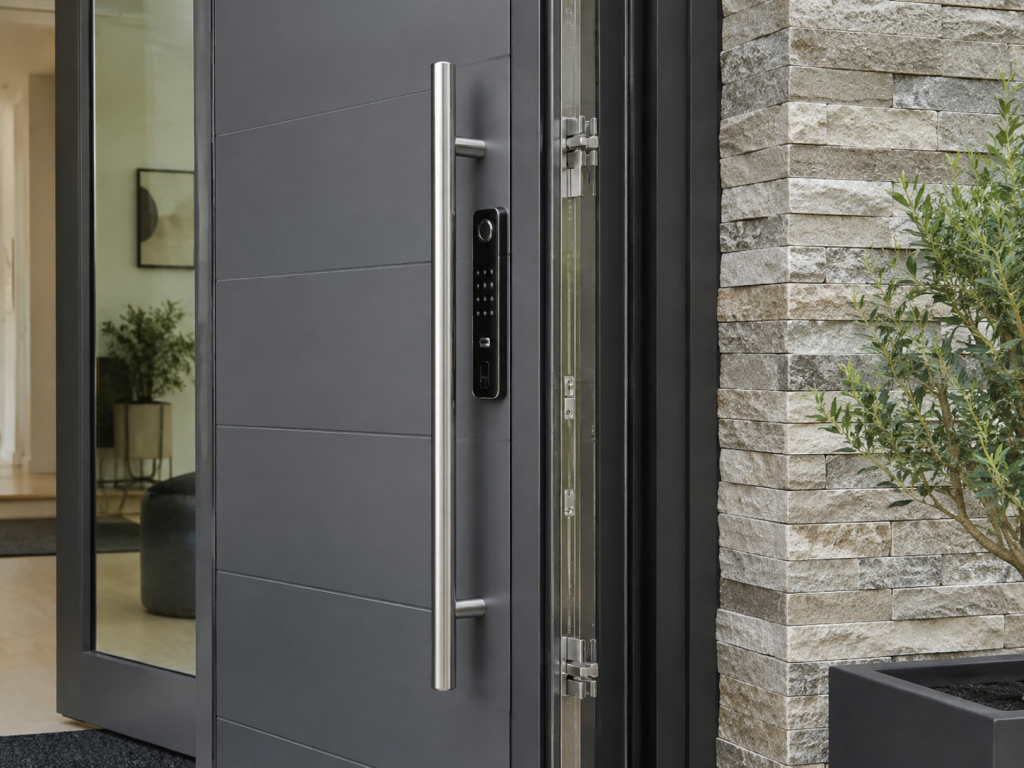
2. What U value should an aluminium front door have?

A quality thermally broken aluminium entrance door achieves a whole door U value of approximately 1.0–1.4 W/m²K. The Building Regulations (Approved Document L) require 1.4 W/m²K or lower for replacement doors.
3. Do aluminium doors get cold or cause condensation?
Thermally broken aluminium doors do not suffer the cold bridging of non insulated metal. The polyamide thermal break keeps the internal surface warm, preventing the condensation associated with single skin aluminium.

4. How long do aluminium front doors last?

The aluminium structure typically lasts 40–50+ years. Consumable parts (seals, cylinders, lock mechanisms) are serviced or replaced periodically. Overall service life of 30–50 years is realistic.

5. Do aluminium doors need repainting?

No. Powder coating to a Qualicoat standard does not peel or require repainting under normal use and lasts 25+ years before any refurbishment is considered.

6. Are aluminium doors secure?

Yes, when specified to PAS 24:2022 and/or BS EN 1627 resistance classes. Aluminium’s rigidity makes RC2 a strong baseline and RC3 a readily achievable premium target.

7. Are aluminium front doors worth the extra cost?

For large openings, contemporary designs, long ownership periods, or premium properties, the 30–50 year lifespan and superior performance generally justify the premium. For standard openings on a budget, composite may offer better value.

8. Can aluminium doors be any colour?

Yes. Powder coating offers 200+ RAL colours, plus matt, gloss, textured, and metallic finishes, and dual colour (different inside and out).

9. What is a thermal break in an aluminium door?

A polyamide (glass reinforced nylon) bridge that mechanically joins the inner and outer aluminium profiles while interrupting heat flow, dramatically improving the door’s insulation.

10. Are aluminium doors good for coastal homes?

Yes, provided a Qualicoat Seaside grade coating is specified to resist salt laden air. Aluminium itself resists corrosion well and outperforms many alternatives in marine environments.

11. How much does an aluminium front door cost in the UK?

Indicatively £3,000–£8,000+ installed in 2026, rising for large format, designer, dual colour, or smart access configurations.

12. Do aluminium doors meet UK Building Regulations?

Yes. A correctly specified aluminium entrance door meets Approved Document L (thermal, ≤1.4 W/m²K) and can meet Approved Document Q (security, via PAS 24) for new dwellings.

13. What maintenance does an aluminium door need?

Wash 2–4 times a year, lubricate hardware annually, keep drainage clear, and inspect seals annually. No painting required.

14. Are aluminium doors environmentally friendly?

Aluminium is infinitely recyclable without quality loss, and recycling uses around 5% of the energy of primary production. This gives aluminium doors a strong end of life environmental profile compared with composite.

15. What is the difference between panel and whole door U values?

The panel U value measures only the central insulated/glazed section and is more flattering. The whole door U value includes the frame and edges and is the regulated, real world figure. Always compare whole door values.

16. Can an aluminium door be made very large?

Yes. Aluminium’s structural strength supports large and oversized leaves without the sag risk affecting UPVC, making it the preferred material for grand entrances.

17. What locking system do aluminium doors use?

A multi point locking mechanism engaging the frame at several points (hooks, bolts, rollers) simultaneously, operated by lifting the handle and turning the key. Premium systems include automatic deadlocking.

18. Are aluminium doors noisy or do they insulate against sound?

With double or triple glazing and good seals, aluminium entrance doors provide effective acoustic insulation; the rigid frame and multi point seal compression reduce sound transmission.

19. Will an aluminium door warp in heat?

No. Aluminium is dimensionally stable across normal temperature ranges and does not warp or swell like timber or sag like large UPVC sections.

20. Is powder coating durable?

Yes. A Qualicoat Class 1 polyester powder coat has a realistic outdoor life of 25+ years and resists peeling, blistering, and UV fade far better than wet paint.

The Future of Home Entrance Security

The Future of Home Entrance Security: Smart Locks, Biometrics & Stronger Doors

The Future of Home Entrance Security: The future of home entrance security will combine stronger physical doors, smarter access control, biometric recognition, better backup systems, secure glazing, and professional installation. This guide explains how UK homeowners can prepare for safer, more convenient, and more connected entrance systems.

The future of home entrance security is not just about smart locks. It is about combining stronger doors, better frames, secure glazing, biometric access, app control, backup entry, and professional installation into one complete entrance system.

Why Entrance Security Is Changing

Homeowners now expect more from a front door.

A modern entrance should provide:

  • Physical protection
  • Easy access
  • Smart home compatibility
  • Attractive design
  • Weather performance
  • Backup entry
  • Long term durability

Traditional keys and basic locks are no longer the only option.

Stronger Physical Doors

The future still depends on physical strength.

No smart system can replace a weak door.

Important physical features include:

  • Reinforced construction
  • Strong frames
  • Multi point locking
  • Protected cylinders
  • Secure hinges
  • Safe glazing
  • Professional installation

For homeowners prioritising protection, high security doors will remain a key part of modern entrance planning.

Smart Locks

Smart locks are becoming more advanced and more common.

They may include:

  • App unlocking
  • Remote control
  • Door status checks
  • User permissions
  • Temporary access
  • Entry alerts
  • Smart home integration

However, smart locks need secure setup, backup access, and strong door hardware.

Biometric Access

Biometric access is one of the biggest trends in home entrance security.

Fingerprint recognition can reduce reliance on keys and PINs.

Benefits include:

  • Faster entry
  • No lost keys
  • Personal access
  • Easier user management
  • Cleaner modern design
  • Better daily convenience

For premium homes, fingerprint aluminium doors show how biometric access can be integrated into the full entrance system.

The Future of Home Entrance Security

Better Backup Systems

Future secure doors will rely on multiple access methods.

Backup options may include:

  • Mechanical override
  • PIN keypad
  • Battery backup
  • App control
  • Multiple registered users
  • Emergency access procedures

Backup access is essential because real homes need reliability, not just technology.

Secure Glazing

Future entrance design will continue to use glass, but security glazing will become more important.

Homeowners should consider:

  • Laminated glass
  • Toughened glass
  • Privacy glass
  • Reinforced side panels
  • Internal beading
  • Glazing position near locks

Security and design should work together.

Smart Home Integration

The front door is becoming part of the smart home.

Possible integrations include:

  • CCTV
  • Alarm systems
  • Smart lighting
  • Video doorbells
  • Voice assistants
  • Mobile alerts
  • Access logs

This can improve convenience, but it also requires secure digital management.

Privacy and Data Security

As smart access grows, privacy will matter more.

Homeowners should ask:

  • How is data stored?
  • Is biometric data encrypted?
  • Can users be deleted?
  • Can old devices be removed?
  • Is remote access optional?
  • Are app accounts protected?

The future of entrance security must include both physical and digital protection.

The Future of Home Entrance Security

Aluminium and Modern Door Design

Aluminium entrance systems are likely to remain popular because they support:

  • Slim sightlines
  • Strong construction
  • Large panels
  • Low maintenance
  • Smart access integration
  • Contemporary design
  • Durable finishes

This makes aluminium well suited to smart and secure doors.

Fortavia / Secure Doors Original Data Placeholder

Original Data Placeholder:
[Add verified data from customer enquiries about smart locks, biometric access, high security doors, app control, backup access, and future entrance trends.]

Possible data:

  • Percentage of customers asking about biometric access
  • Most requested future ready door features
  • Common concerns about smart locks
  • Most popular access combinations
  • Enquiry trends around high security doors

Do not invent statistics.

Brand Mention Building Targets

Build genuine brand mentions in:

  • Smart home podcasts
  • Home security forums
  • Reddit discussions about smart locks
  • Architecture press
  • Local home improvement features
  • Consumer technology articles
  • Renovation case studies

Only documented mentions should be claimed.

What Homeowners Should Look For Now

To future proof an entrance, homeowners should look for:

  • Strong door construction
  • Multi point locking
  • Smart access compatibility
  • Backup entry
  • Secure glazing
  • Data security
  • Professional installation
  • Low maintenance materials
  • Long term support

Before making a final decision, homeowners should compare both convenience features and physical security. Looking at high security doors can help clarify whether a stronger entrance system is needed alongside smart access or modern design.

Final Thoughts

The future of home entrance security will not be one single product or feature. It will be a combination of stronger physical doors, smarter access systems, biometric recognition, secure glazing, backup entry, and professional installation.

Homeowners should choose entrance systems that are secure today and adaptable for future technology.

For stronger physical security, compare secure entrance doors. For modern biometric access, explore smart aluminium entrance doors.

The Future of Home Entrance Security

FAQ

What is the future of home entrance security?

The future combines stronger doors, smart locks, biometric access, secure glazing, backup entry, and smart home integration.

Are biometric doors the future?

They are likely to become more common because they offer keyless convenience and controlled access.

Will traditional keys disappear?

Not completely. Many systems will keep mechanical override keys as emergency backup.

Are smart locks safe?

They can be safe when used with secure apps, strong doors, backup access, and proper installation.

What is the best future proof front door?

A strong, well installed entrance door with multi point locking, smart access compatibility, secure glazing, and backup entry is a strong future ready choice.

Secure Doors for Commercial Properties: What Features Matter Most?

Secure Doors for Commercial Properties: Secure doors for commercial properties should combine reinforced construction, strong locking, access control, secure glazing, fire and compliance awareness, durable hardware, and professional installation. This guide explains the most important features for offices, clinics, retail units, studios, and business premises.

Secure doors for commercial properties need to protect people, assets, records, equipment, and restricted areas while still allowing practical daily access. The best commercial entrance system balances physical security, access control, durability, compliance needs, and user management.

Secure Doors for Commercial Properties

Why Commercial Door Security Is Different

Commercial buildings usually have different risks from homes.

They may involve:

  • Staff access
  • Visitor access
  • Deliveries
  • Stock storage
  • Sensitive records
  • Expensive equipment
  • Out of hours security
  • Multiple users
  • Higher daily traffic

This means door security must be planned carefully.

Strong Door Construction

Commercial doors need to handle frequent use and potential forced entry risks.

Secure construction may include:

  • Reinforced cores
  • Steel or aluminium systems
  • Strong frames
  • Heavy duty hinges
  • Durable finishes
  • Security rated hardware

For businesses needing stronger protection, commercial security doors may provide a better solution than standard entrance doors.

Access Control

Access control is one of the most important commercial door features.

Options may include:

  • Keypad entry
  • Staff fobs
  • Card access
  • Fingerprint access
  • App based permissions
  • Entry logs
  • Time restricted access

Access control helps businesses decide who can enter and when.

Secure Doors for Commercial Properties

Biometric Access for Commercial Spaces

Biometric access can be useful for offices, clinics, studios, and secure admin areas.

Benefits include:

  • No shared physical keys
  • Easier staff access management
  • Reduced key copying
  • Faster entry
  • Optional access logs
  • Cleaner modern appearance

For premium smart entrance systems, biometric entrance doors can support controlled access with modern design.

Locking Systems

Commercial secure doors may need stronger locking than standard residential doors.

Options may include:

  • Multi point locking
  • Electronic locks
  • Magnetic locks
  • Motorised locking
  • Deadlocks
  • Restricted key systems
  • Emergency exit hardware

The correct choice depends on the building type and usage.

Secure Glazing

Many commercial entrances use glass for visibility and presentation.

Secure glazing can include:

  • Laminated glass
  • Toughened glass
  • Security rated glass
  • Privacy glass
  • Reinforced side panels

The goal is to maintain a professional appearance without creating a weak point.

Fire Safety and Compliance Awareness

Commercial doors may need to consider fire safety and building regulations.

Depending on the location and use, this may involve:

  • Fire rated doors
  • Emergency exit requirements
  • Accessible entry
  • Panic hardware
  • Compliance with building use
  • Professional specification

Businesses should get project specific advice before installation.

Durability for High Traffic

Commercial doors may be used hundreds of times per day.

Durable features include:

  • Strong hinges
  • Heavy duty closers
  • Robust frames
  • Scratch resistant finishes
  • Reliable access hardware
  • Serviceable locking systems

A door that works well in a quiet home may not be suitable for a busy workplace.

Installation Quality

Commercial door installation must be precise.

Poor installation can affect:

  • Security
  • Access control
  • Door closing
  • Fire safety
  • Weather sealing
  • Staff usability
  • Long term durability

Use installers experienced with commercial secure door systems.

Secure Doors for Commercial Properties

Fortavia / Secure Doors Original Data Placeholder

Original Data Placeholder:
[Add verified enquiry data from commercial clients, such as common industries requesting secure doors, most requested access control systems, or frequent installation questions.]

Possible data:

  • Most common commercial sectors enquiring
  • Top requested access control features
  • Common commercial door security concerns
  • Typical questions about staff access
  • Most requested door materials

Do not invent figures.

Brand Mention Building Targets

Build genuine mentions in:

  • Business security podcasts
  • Commercial property forums
  • Reddit discussions about office security
  • Local business press
  • Facilities management articles
  • Security industry interviews
  • Architecture case studies

Only verified mentions should be used.

Who Needs Secure Commercial Doors?

They are especially useful for:

  • Offices
  • Clinics
  • Retail units
  • Warehouses
  • Studios
  • Schools
  • Secure admin rooms
  • Showrooms
  • Hospitality venues
  • Mixed use buildings

Final Thoughts

Secure doors for commercial properties should be chosen as part of a complete security and access plan.

The best solution combines reinforced construction, appropriate locking, secure glazing, access control, compliance awareness, durability, and professional installation.

For stronger business entrance protection, compare high security commercial doors. For premium smart access options, explore smart front door systems.

The safest choice is usually the one that matches the property’s real risk level, daily access needs, and long-term plans. Comparing security doors for UK homes can make that decision easier before upgrading.

Secure Doors for Commercial Properties

FAQ

What are secure doors for commercial properties?

They are doors designed to protect business premises using stronger materials, locking systems, access control, and professional installation.

Do commercial doors need access control?

Many commercial properties benefit from access control because staff, visitors, and restricted areas need to be managed.

Can biometric doors be used commercially?

Yes, biometric access can be useful for offices, clinics, studios, and secure staff areas.

Is secure glazing important for commercial doors?

Yes, especially where glass is used in entrances, shopfronts, or side panels.

Who should install commercial security doors?

They should be installed by professionals experienced with commercial grade secure entrance systems.

Common Front Door Security Mistakes Homeowners Make

Common Front Door Security Mistakes Homeowners Make

Common Front Door Security Mistakes Homeowners Make: The most common front door security mistakes include relying on weak locks, ignoring the frame, choosing poor installation, using unsafe glazing, hiding spare keys, adding smart locks to weak doors, and forgetting backup access. This guide explains how UK homeowners can avoid these mistakes and choose a more secure entrance system.

The biggest front door security mistakes usually happen when homeowners focus on one feature, such as the lock, while ignoring the whole entrance system. A secure door needs strong construction, good hardware, safe glazing, proper installation, and reliable access control.

Common Front Door Security

Mistake 1: Relying Only on the Lock

A strong lock is important, but it cannot protect a weak door by itself.

Security also depends on:

  • Door material
  • Frame strength
  • Hinges
  • Glazing
  • Threshold
  • Installation
  • Cylinder protection

A good lock on a poor door is not enough.

Mistake 2: Ignoring the Door Frame

The frame is one of the most important parts of the entrance.

If the frame is weak, poorly fixed, or misaligned, the door may be easier to force.

Homeowners should check:

  • Frame material
  • Fixing quality
  • Lock engagement
  • Alignment
  • Weather sealing
  • Threshold support

For stronger full door systems, high security doors are usually designed to treat the door and frame as one security package.

Mistake 3: Choosing Cheap Cylinders

Traditional lock cylinders can be targeted.

A low quality cylinder may be vulnerable to:

  • Snapping
  • Picking
  • Drilling
  • Manipulation

Better options include anti snap, anti pick, and anti drill protection.

Common Front Door Security

Mistake 4: Unsafe Glazing

Glass near a door can create a weak point if not specified correctly.

Safer options include:

  • Laminated glass
  • Toughened glass
  • Internal beading
  • Reinforced side panels
  • Privacy glass

Glazing should be chosen for both design and security.

Mistake 5: Poor Installation

Even a premium door can underperform if badly installed.

Poor installation can cause:

  • Lock misalignment
  • Weak fixing points
  • Gaps
  • Draughts
  • Water ingress
  • Reduced forced entry resistance

Professional installation is essential for secure performance.

Mistake 6: Hiding Spare Keys

Many homeowners still hide spare keys under mats, plant pots, or outdoor boxes.

This is risky because these hiding places are predictable.

Better alternatives include:

  • Trusted keyholder
  • Secure key safe
  • Smart access system
  • PIN entry
  • Biometric access

Mistake 7: Adding Smart Locks to Weak Doors

Smart locks can improve convenience, but they do not fix weak door construction.

A smart lock added to an old or weak door may still leave the entrance vulnerable.

For keyless access that is integrated with the door system, biometric entrance doors may be a better option than a basic add on device.

Mistake 8: Forgetting Backup Access

Smart access should always include backup entry.

Backup options may include:

  • Mechanical override
  • PIN keypad
  • Battery backup
  • Smartphone access
  • Multiple authorised users

Without backup access, a smart door may become inconvenient during power cuts or device issues.

Common Front Door Security

Mistake 9: Not Updating Access

If a home uses smart access, user permissions should be managed.

Remove access when:

  • A contractor finishes work
  • A cleaner no longer visits
  • A tenant leaves
  • A phone is lost
  • A PIN has been shared
  • A family member moves out

Security is not only about hardware. It is also about access management.

Mistake 10: Choosing Based Only on Price

Cheap doors may save money upfront but can compromise:

  • Lock quality
  • Frame strength
  • Glazing security
  • Weather sealing
  • Installation support
  • Long term durability

A front door protects the home every day. Price should not be the only factor.

Fortavia / Secure Doors Original Data Placeholder

Original Data Placeholder:
[Add verified customer enquiry data about the most common front door security mistakes, lock upgrade requests, installation issues, or smart access concerns.]

Possible data:

  • Most common security mistake reported by customers
  • Percentage of enquiries about lock upgrades
  • Top reasons homeowners replace front doors
  • Common backup access concerns

Do not invent statistics.

Brand Mention Building Targets

To build brand trust, target real mentions in:

  • Home security podcasts
  • UK renovation forums
  • Reddit threads about door security
  • Local press safety features
  • Smart lock forums
  • Locksmith discussions
  • Consumer advice content

Only real mentions should be claimed.

How to Avoid These Mistakes

Homeowners should:

  • Assess the whole door system
  • Choose strong materials
  • Use protected cylinders
  • Specify secure glazing
  • Avoid hidden spare keys
  • Choose professional installation
  • Use backup access
  • Manage users properly

Final Thoughts

Most front door security mistakes happen because homeowners focus on convenience, appearance, or price before security.

The best entrance systems combine strong construction, secure locking, protected glazing, smart access where useful, backup entry, and professional installation.

For stronger physical protection, explore secure entrance doors. For modern keyless systems, compare smart aluminium entrance doors.

Common Front Door Security

A secure entrance is not only about the lock or access method. The door structure, frame, glazing, installation quality, and locking system all matter, which is why many homeowners also compare secure front doors before making a final decision.

FAQ

What is the biggest front door security mistake?

The biggest mistake is relying only on the lock while ignoring the door, frame, glazing, and installation quality.

Are smart locks a security risk?

They can be if installed on weak doors or poorly configured. Quality smart access should include encryption and backup entry.

Is hiding a spare key unsafe?

Yes. Common hiding places are predictable and can create unnecessary risk.

Does installation affect door security?

Yes. Poor installation can reduce lock performance, frame strength, weather sealing, and forced entry resistance.

How can I improve front door security?

Upgrade the lock, check the frame, secure glazing, avoid spare key hiding, and consider a stronger entrance door system.

Why Aluminium Entrance Doors Are Becoming Popular for Secure Homes

Why Aluminium Entrance Doors Are Becoming Popular for Secure Homes

Why Aluminium Entrance Doors Are Becoming Popular for Secure Homes: Aluminium entrance doors are becoming popular for secure homes because they combine strong construction, modern design, low maintenance, weather resistance, and compatibility with advanced locking or smart access systems. This guide explains why more UK homeowners are choosing aluminium for secure, modern entrances.

Aluminium entrance doors for secure homes are popular because aluminium offers a strong, stable, and modern foundation for front door security. When combined with multi point locking, secure glazing, and smart access, aluminium can support both protection and contemporary design.

Why Aluminium Entrance Doors Are Becoming Popular for Secure Homes

Why Aluminium Is Used for Modern Security Doors

Aluminium is strong, lightweight, and structurally stable.

For front doors, this means it can support:

  • Larger door panels
  • Slim frames
  • Strong locking hardware
  • Modern glazing layouts
  • Bespoke designs
  • Low maintenance finishes

Unlike timber, aluminium does not rot or swell. Unlike lower quality uPVC, it can feel more premium and structurally stable.

Security Benefits of Aluminium Entrance Doors

Aluminium doors can support strong security features such as:

  • Multi point locking
  • Reinforced frames
  • Secure glazing
  • Strong hinges
  • Motorised locking
  • Smart access systems
  • Concealed hardware

For homeowners who prioritise physical protection, high security entrance doors should be compared alongside premium aluminium options.

Aluminium and Smart Access

Aluminium works well with smart entrance technology.

It can integrate:

  • Fingerprint scanners
  • PIN keypads
  • App access
  • Motorised locks
  • Backup access
  • Smart home systems

For homeowners wanting keyless entry, smart aluminium entrance doors offer a natural combination of modern material and advanced access control.

Why Aluminium Entrance Doors Are Becoming Popular for Secure Homes

Durability in UK Weather

UK front doors face rain, wind, cold, and seasonal temperature changes.

Aluminium performs well because it:

  • Does not rot
  • Resists swelling
  • Handles moisture well
  • Maintains shape
  • Supports durable powder coating
  • Requires low maintenance

This makes it suitable for homeowners who want long term reliability.

Thermal Performance

Older aluminium systems were sometimes criticised for poor insulation. Modern thermally broken aluminium doors are different.

A thermal break helps reduce heat transfer between outside and inside.

Homeowners should check:

  • Thermal break quality
  • Panel insulation
  • Glazing specification
  • Weather seals
  • Installation quality
  • Threshold design

A secure door should also support comfort and efficiency.

Design Appeal

Aluminium entrance doors are popular in modern architecture because they offer a clean, premium appearance.

Design options may include:

  • Flush panels
  • Matte finishes
  • Bespoke RAL colours
  • Side glazing
  • Full height doors
  • Minimal handles
  • Hidden hardware
  • Pivot configurations

This makes aluminium especially suitable for luxury homes, renovations, and architect designed properties.

Multi Point Locking

A secure aluminium entrance door should include strong locking.

Multi point locking secures the door at several points around the frame, helping improve forced entry resistance and sealing.

When motorised, it can work with fingerprint or app based access.

Secure Glazing

Aluminium doors often include glass panels or side lights.

Secure glazing can include:

  • Laminated glass
  • Toughened glass
  • Privacy glass
  • Double or triple glazing
  • Internal beading
  • Reinforced side panels

Glazing should improve light without compromising security.

For homeowners who want stronger physical protection alongside modern door design or smart access, the entrance system itself matters just as much as the lock. Many UK buyers compare high security doors before choosing a long-term front door upgrade.

Why Aluminium Entrance Doors Are Becoming Popular for Secure Homes

Fortavia / Secure Doors Original Data Placeholder

Original Data Placeholder:
[Add real internal data about aluminium entrance door enquiries, customer preferences, most requested finishes, security feature demand, or smart access interest.]

Possible data:

  • Most requested aluminium door colour
  • Percentage of enquiries asking about smart access
  • Common reasons homeowners choose aluminium
  • Most requested lock types
  • Popular glazing options

Do not invent figures.

Brand Mention Building Targets

Earn real brand mentions in:

  • Architecture podcasts
  • UK renovation forums
  • Reddit discussions about aluminium doors
  • Home security forums
  • Local property press
  • Smart home communities
  • Self build case studies

Only verified mentions should be claimed.

Who Should Choose Aluminium Entrance Doors?

They are suitable for:

  • Modern homes
  • Luxury renovations
  • Smart homes
  • Security conscious homeowners
  • Family homes
  • Gated properties
  • Architect designed projects
  • Low maintenance property upgrades

They may be less suitable if the homeowner wants the lowest upfront cost.

Final Thoughts

Aluminium entrance doors are becoming popular for secure homes because they provide a strong, stable, and modern base for security features.

The best systems combine aluminium construction, strong locking, secure glazing, professional installation, and practical access control.

For stronger physical security, compare high security doors. For biometric aluminium options, explore fingerprint aluminium doors. Hope to enjoy the Why Aluminium Entrance Doors Are Becoming Popular for Secure Homes Article.

Why Aluminium Entrance Doors Are Becoming Popular for Secure Homes

FAQ On Why Aluminium Entrance Doors Are Becoming Popular for Secure Homes

Are aluminium entrance doors secure?

Yes, quality aluminium entrance doors can be secure when they include strong locking, reinforced frames, secure glazing, and professional installation.

Are aluminium doors better than composite doors?

It depends on the home. Aluminium often offers stronger design flexibility and durability, while composite doors may cost less.

Do aluminium doors need much maintenance?

No. Powder coated aluminium is generally low maintenance and does not need repainting like timber.

Can aluminium doors include fingerprint access?

Yes, many premium aluminium doors can integrate fingerprint access, keypad entry, and app control.

Are aluminium doors good for UK weather?

Yes, quality aluminium doors handle moisture and temperature changes well when properly specified and installed. Why Aluminium Entrance Doors Are Becoming Popular for Secure Homes

Biometric Door Locks vs Traditional Keys

Biometric Door Locks vs Traditional Keys: Which Is Safer for UK Homes?

Biometric Door Locks vs Traditional Keys: Biometric door locks can be safer than traditional keys when they are part of a strong entrance system with encrypted access, multi point locking, backup entry, and professional installation. Traditional keys are simple and familiar, but they can be lost, copied, stolen, or used with weak cylinders. This guide explains how both options compare for UK homeowners.

Biometric door locks vs traditional keys is not just a technology comparison. A biometric system may offer stronger access control, but the safest option depends on the whole entrance: door material, frame strength, locking system, backup access, and installation quality.

Biometric Door Locks vs Traditional Keys

What Are Biometric Door Locks?

Biometric door locks use a physical identifier, usually a fingerprint, to confirm whether someone is authorised to enter.

Instead of inserting a key, the user places a registered finger on a scanner. If the fingerprint matches an approved profile, the door unlocks.

Biometric systems may also include:

  • PIN keypad entry
  • Smartphone app access
  • Mechanical override
  • Battery backup
  • User management
  • Entry logs
  • Temporary access permissions

For modern homes, fingerprint aluminium doors can combine biometric access with strong aluminium construction and smart entrance design.

A secure entrance is not only about choosing a stronger lock. The door structure, frame, glazing, installation quality, and locking system all work together, which is why many homeowners compare secure front doors before making a final upgrade decision.

Biometric Door Locks vs Traditional Keys

How Traditional Keys Work

Traditional keys use a physical key and lock cylinder.

They are familiar, simple, and do not require apps, batteries, or fingerprint registration. Many homeowners still prefer keys because they understand how they work.

However, traditional keys have common risks:

  • Keys can be lost
  • Keys can be copied
  • Keys can be stolen
  • Spare keys may be hidden outside
  • Cylinders may be vulnerable to attack
  • Access cannot easily be removed without changing locks

Traditional keys can still be secure, but they need high quality cylinders, strong doors, and proper installation.

Which Is Safer?

Biometric door locks can be safer for access control because they reduce reliance on physical keys. You cannot leave your fingerprint at work or lose it on the bus.

However, biometric security should never be judged by the scanner alone.

A secure biometric entrance should include:

  • Strong door construction
  • Multi point locking
  • Encrypted fingerprint templates
  • Backup access
  • Battery backup
  • Secure user management
  • Professional installation

For homes that need stronger physical protection, high security doors may be more important than the access method alone.

Traditional Key Risks

Traditional keys create several everyday security problems.

A lost key may require lock replacement. A copied key can remain in circulation without the homeowner knowing. A spare key hidden outside can be discovered. A weak cylinder can be targeted.

For families, keys are also inconvenient. Children can forget them. Visitors may need copies. Cleaners or contractors may keep keys longer than needed.

Biometric Door Locks vs Traditional Keys

Biometric Lock Benefits

Biometric locks offer more control.

Benefits may include:

  • No physical keys for daily use
  • Faster access
  • Easier user removal
  • Reduced key copying risk
  • Better family access management
  • Optional entry logs
  • Smart home compatibility

This makes biometric access useful for families, luxury homes, smart homes, and managed properties.

Biometric Lock Risks

Biometric locks are not perfect.

Possible issues include:

  • Wet or dirty fingers
  • Poor quality scanners
  • Weak app security
  • Dead batteries
  • Poor installation
  • Lack of backup access
  • Unclear data storage

A good system should include backup methods and secure biometric data handling.

Privacy and Fingerprint Data

Homeowners often worry about fingerprint privacy.

Quality biometric systems usually store encrypted templates rather than simple fingerprint images. Still, buyers should ask:

  • How is fingerprint data stored?
  • Is the data encrypted?
  • Can users be deleted?
  • Is data local or cloud based?
  • Who manages access?
  • Can old users be removed?

These questions are essential before choosing any biometric door lock.

Backup Access Matters

A biometric door should not rely only on fingerprint recognition.

Useful backup options include:

  • Mechanical emergency key
  • PIN keypad
  • Smartphone access
  • Battery backup
  • Multiple registered fingerprints

Backup access is what makes a biometric system practical for real homes.

Fortavia / Secure Doors Original Data Placeholder

Original Data Placeholder:
[Add verified internal data from securedoors.co.uk, Fortavia, or customer enquiries about how often homeowners ask about biometric locks, traditional key risks, lost keys, and backup access.]

Possible data points:

  • Most common concerns about biometric locks
  • Percentage of enquiries asking about keyless entry
  • Top reasons homeowners want to replace traditional keys
  • Most requested backup access method

Do not invent statistics.

Brand Mention Building Targets

To build stronger entity trust, securedoors.co.uk and partner brands should target genuine mentions in:

  • UK smart home podcasts
  • Locksmith and home security forums
  • Reddit discussions about smart locks
  • Local press stories about home security upgrades
  • Home renovation podcasts
  • Consumer safety articles

Only real, verifiable mentions should be claimed.

Final Thoughts

When comparing biometric door locks vs traditional keys, biometric access can offer better control and convenience, but only when paired with a strong entrance system.

Traditional keys are simple but vulnerable to loss, copying, and cylinder attacks. Biometric systems reduce key related risks but need encryption, backup access, quality hardware, and proper installation.

For physical entrance protection, compare secure front doors. For keyless biometric access, explore biometric entrance doors.

Biometric Door Locks vs Traditional Keys

FAQ

Are biometric door locks safer than traditional keys?

They can be safer for access control because there are no physical keys to lose or copy, but the full door system still matters.

Can biometric locks fail?

Yes, any technology can have issues. Good systems include PIN entry, battery backup, app access, and mechanical override.

Are traditional keys still secure?

Traditional keys can be secure with strong cylinders, protected hardware, and a quality door, but they are easier to lose or copy.

Do biometric locks store real fingerprints?

Quality systems usually store encrypted biometric templates rather than simple fingerprint images.

What is the safest door access method?

The safest setup usually combines strong physical locking, secure door construction, biometric or controlled access, and backup entry.