Are Fingerprint Doors Safe for Families with Children? A UK Homeowner’s Guide
For many UK homeowners, upgrading to a smart entrance system raises one important question:
Are fingerprint doors safe for families with children?
It is a sensible concern. A front door is not just a design feature. It controls access to the home, protects family members, and needs to work reliably every single day. Parents want convenience, but not at the expense of safety or security.
The good news is that modern fingerprint doors for families are designed with multiple layers of protection. A quality biometric entrance system does not rely only on one fingerprint scanner. It usually combines fingerprint access, smart app control, backup entry methods, motorised multi point locking, and strong aluminium construction.
For families with children, this can make daily life easier while reducing some of the most common problems linked to traditional keys.
If you are unfamiliar with biometric entrance technology, start with our fingerprint aluminium door beginner guide.
What Are Fingerprint Doors for Families?
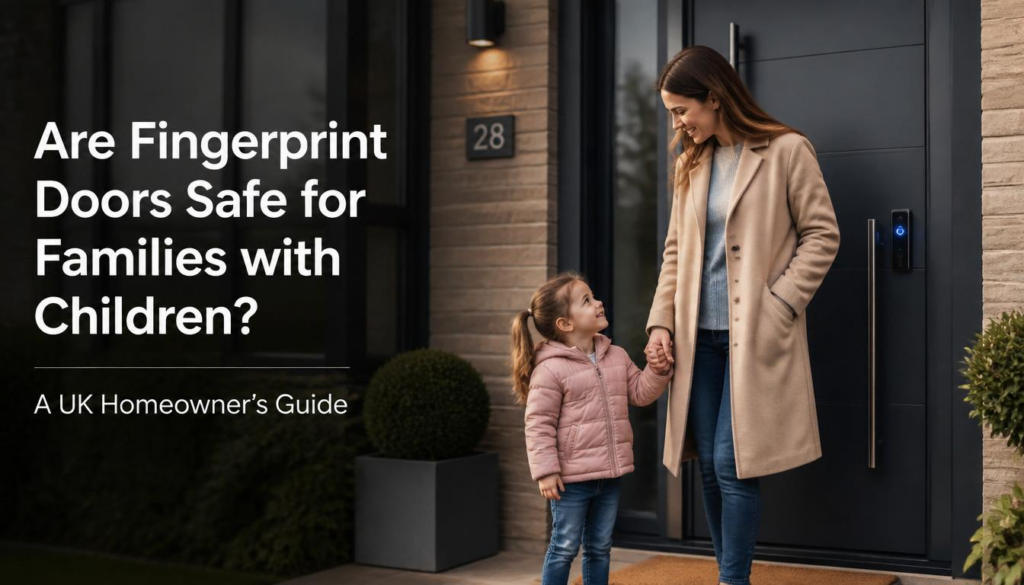
Fingerprint doors for families are smart entrance doors that allow authorised users to unlock the door using biometric fingerprint recognition.
Instead of using a traditional key every time, a parent or child places a registered finger on the scanner. If the system recognises the fingerprint, the door unlocks.
Most premium systems can also include:
- Smartphone app access
- PIN keypad entry
- Backup mechanical key access
- Battery backup
- Motorised multi point locking
- Remote access control
- User permission management
- Entry activity logs
When combined with a high quality aluminium entrance door, the result is a secure, modern, and practical front door system for busy households.
Why Families Consider Fingerprint Doors
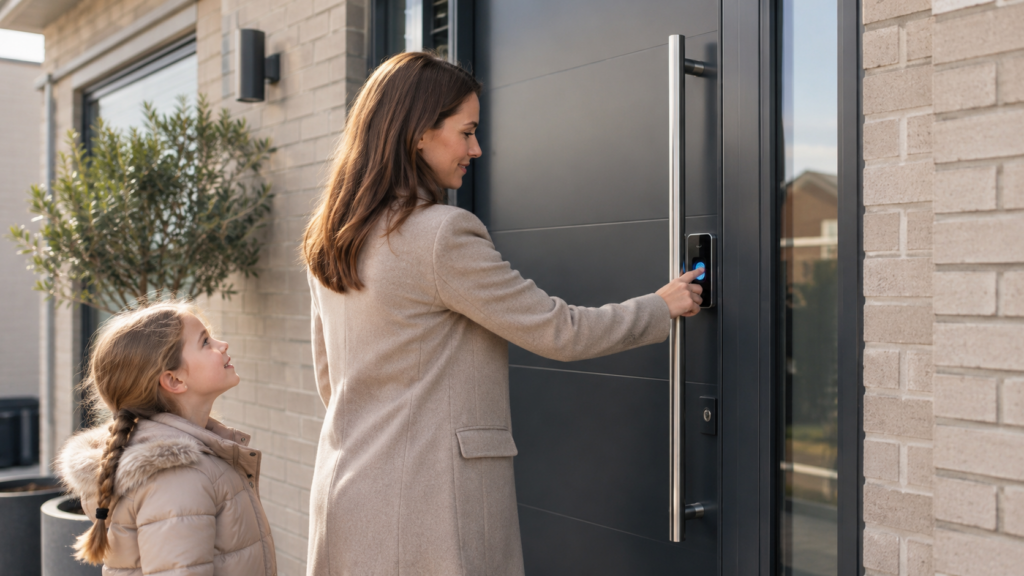
Family life is busy. Children lose keys. Parents juggle shopping bags, school bags, prams, sports kits, pets, and deliveries. A traditional front door can become a daily frustration.
Fingerprint access solves several common family problems.
Children do not need to carry physical keys. Parents can manage who has access. Entry becomes faster. There is less need to hide spare keys outside. And the front entrance feels more connected to the rest of a modern smart home.
For many families, the biggest benefit is not just security. It is convenience.
Are Fingerprint Doors for Families Safe for Children?
Yes, quality fingerprint doors for families can be safe for children when they are properly specified, installed, and managed.
A good system does not simply unlock for anyone. It only recognises authorised fingerprints that have been registered by the homeowner. Parents can decide whose fingerprints are added, removed, or updated.
This gives families more control than traditional keys in many situations.
With a key, once a child loses it, the key could be found or copied. With fingerprint access, there is no physical key to lose. If a user no longer needs access, their permission can usually be removed from the system.
To understand the security side in more detail, read biometric door security and technology explained.
How Fingerprint Access Helps Children
For school age children, fingerprint entry can be especially practical.
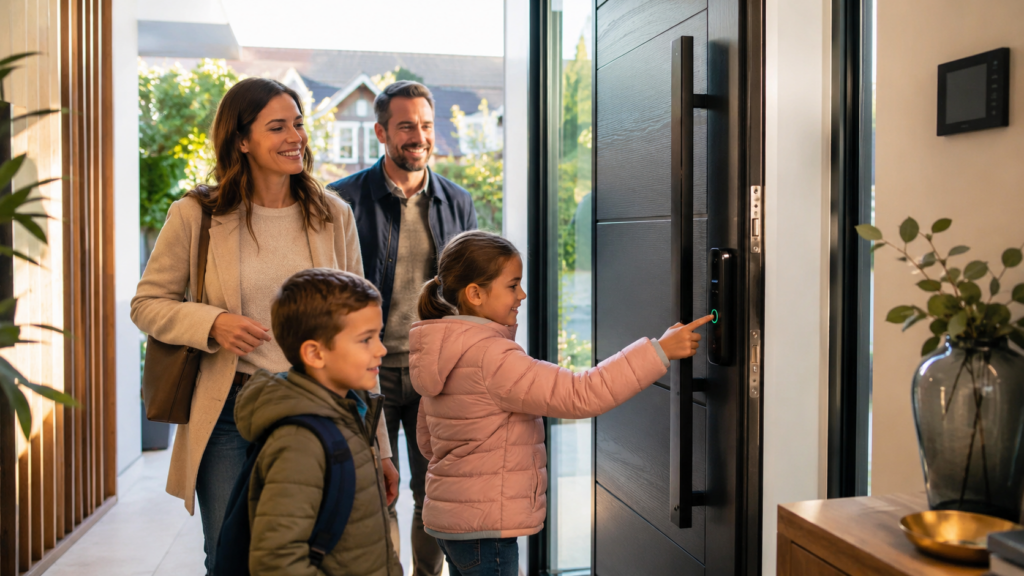
A child coming home from school may not need to remember a key. They can unlock the door with their registered fingerprint, provided the parents have authorised that access.
This can reduce:
- Forgotten keys
- Lost keys
- Lockouts after school
- Spare key hiding
- Repeated key cutting
- Worries about copied keys
For parents, this creates a cleaner and more controlled access routine.
Real Life Example: After School Access
Imagine a family with two children who return home before one parent finishes work.
With a traditional key system, each child may need their own key. If one key is lost, the family may worry about who finds it. If the key is forgotten, the child may be locked out.
With a fingerprint aluminium door, each child can have an authorised fingerprint profile. The door recognises them when they arrive. Some smart systems may also allow parents to check activity logs or receive access notifications, depending on the setup.
This does not remove the need for parental supervision and sensible safety rules, but it can reduce everyday access problems.
Security Benefits for Family Homes
A family front door needs to protect against both everyday inconvenience and real security risks.
Traditional key based doors can be vulnerable to:
- Lost keys
- Stolen keys
- Key copying
- Lock snapping
- Picking
- Weak cylinders
- Poor quality hardware
Premium fingerprint aluminium doors approach security differently.
They may include:
- Biometric access control
- Encrypted fingerprint templates
- Motorised multi point locking
- Concealed backup access
- Anti tamper features
- Strong aluminium construction
- Remote user management
This makes the entrance system more controlled and less dependent on physical keys.
Why Aluminium Matters for Family Security
The door material itself is important.
A fingerprint scanner is only one part of the system. If the door structure is weak, the smart technology alone will not make the entrance secure.
Aluminium entrance doors are popular in premium residential projects because aluminium is strong, stable, and well suited to large modern door designs.
A quality aluminium door:
- Does not warp easily
- Handles daily family use well
- Resists swelling and moisture damage
- Supports strong locking systems
- Works well with modern smart access hardware
- Maintains a clean architectural appearance
For families planning a long term home upgrade, this durability matters.
Motorised Multi Point Locking for Family Homes
One of the most important features to look for is motorised multi point locking.
This means the door locks at several points around the frame, rather than relying on a single lock point. When the fingerprint system unlocks the door, the motorised mechanism retracts the locking points automatically.
For families, this offers two major advantages.
First, it improves physical security. Multiple locking points help resist forced entry better than simple single point systems.
Second, it improves ease of use. Children and adults do not need to manually operate several bolts or struggle with a stiff lock.
What Happens If a Child’s Fingerprint Changes?
This is a common parent concern.
Children grow, and their fingerprints may become easier to scan as they get older. In most systems, authorised fingerprints can be updated, removed, or re enrolled when needed.
Many systems also allow more than one finger to be registered per user. This means a child can have multiple authorised fingerprints stored.
For example:
- Right index finger
- Left index finger
- Thumb
- Backup finger
This helps if one finger is wet, dirty, injured, or not recognised properly.
What If the Fingerprint Scanner Does Not Work?
A good fingerprint door should never rely on one access method only.
Premium family friendly systems usually include several backup options, such as:
- Smartphone app access
- PIN keypad entry
- Mechanical override key
- Battery backup
- Additional registered fingerprints
This is especially important for families because daily routines are unpredictable.
A child may have wet hands. A parent may change phone. A power cut may happen. A scanner may need cleaning. A reliable system is designed with these situations in mind.
Do Fingerprint Doors Work During Power Cuts?
Most premium smart entrance systems include battery backup.
During a power cut, the backup battery helps the fingerprint reader and locking system continue operating temporarily. The exact backup duration depends on the system, battery capacity, and usage frequency.
Many systems also include an emergency mechanical key override. This means the homeowner can still unlock the door manually if both mains power and backup power are unavailable.
For families, this layered approach is important. It reduces the chance of being locked out because of a single technical issue.
Are Fingerprint Doors Easy for Children to Use?
Yes, most children find fingerprint access simple once the system is set up properly.
The process is usually:
- Place finger on the scanner
- Wait for recognition
- Door unlocks
- Enter the home
There is no key turning, no bag searching, and no need to remember a code.
However, parents should still teach children basic access rules. For example:
- Do not let strangers follow you inside
- Do not show others how the door works
- Do not share PIN codes if a keypad is used
- Tell a parent if the scanner does not recognise your fingerprint
- Keep backup access rules clear
Technology helps, but family safety habits still matter.
Privacy and Fingerprint Data
Some parents worry about where fingerprint data is stored.
Quality biometric systems do not usually store a simple image of a fingerprint. Instead, they store an encrypted mathematical template that the system uses for recognition.
This is an important distinction.
The system is not normally keeping a visible fingerprint photo. It is storing encoded recognition data.
Still, homeowners should ask the supplier:
- How is fingerprint data stored?
- Is the data encrypted?
- Is it stored locally or in the cloud?
- Can users be deleted easily?
- What happens if the system is reset?
- Who can manage user profiles?
These questions are especially important when choosing a smart entrance system for a family home.
Fingerprint Doors vs Traditional Keys for Families
Traditional keys are familiar, but they are not always the easiest option for families.
Traditional Keys
Pros:
- Simple and familiar
- No technology learning curve
- Lower upfront cost
Cons:
- Easy for children to lose
- Can be copied
- Can be stolen
- May require lock changes if lost
- Children may forget them
- Spare keys are often hidden insecurely
Fingerprint Doors
Pros:
- No physical key needed for daily use
- Easier child access
- User permissions can be managed
- Can include backup access methods
- Works well with smart home systems
- Supports modern aluminium door design
Cons:
- Higher upfront cost
- Requires proper setup
- Needs quality installation
- Technology may feel unfamiliar at first
For many modern families, fingerprint access offers a better balance of convenience and control.
Fingerprint Doors vs Keypad Entry for Children
Some families consider keypad access instead of fingerprint entry.
Keypads can be useful, but they have one weakness: codes can be shared.
A child might tell a friend the PIN. Someone might watch the code being entered. Over time, families may forget to update old codes.
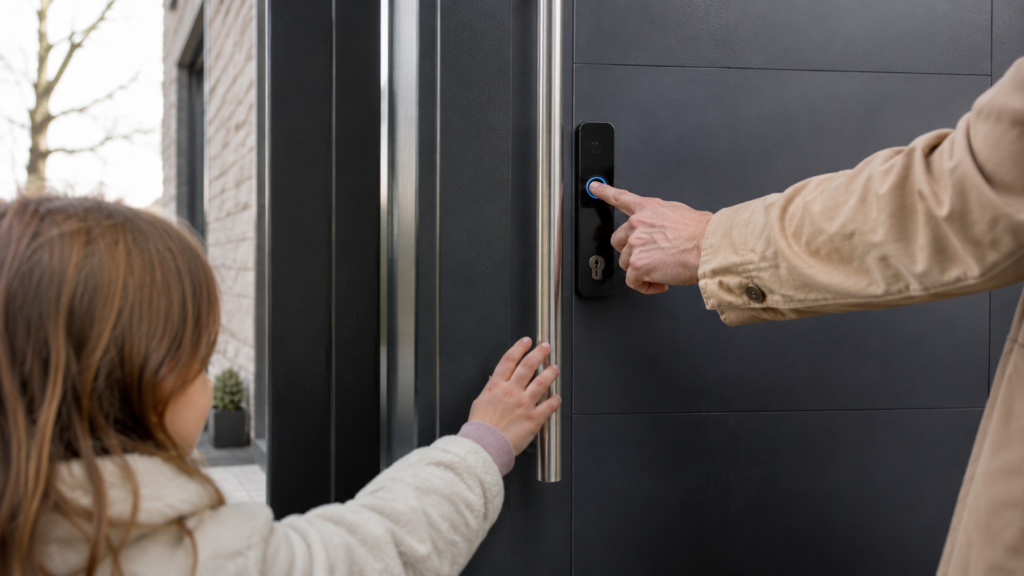
Fingerprint access is more personal. The child does not need to remember or share anything.
That said, many premium systems combine both options. Fingerprint access can be used for daily entry, while PIN access can act as a backup.
Design Benefits for Modern Family Homes
A family front door does not need to look purely functional.
Modern smart aluminium entrance doors are often chosen because they improve both security and appearance.
They can support:
- Flush door panels
- Minimal handles
- Concealed hardware
- Large entrance designs
- Side glazing
- Contemporary colours
- Smart access integration
This makes fingerprint aluminium doors suitable for modern renovations, new builds, and luxury family homes.
Parents often want a door that feels secure, but they also want the entrance to look premium. Aluminium systems allow both.
You can configure your fingerprint entrance door based on your property style, family access needs, and security priorities.
Maintenance for Busy Families
Family doors get used heavily.
School runs, deliveries, visitors, pets, children, and daily routines all put pressure on the entrance system.
A good fingerprint aluminium door should be low maintenance, but it still needs basic care.
Typical maintenance may include:
- Wiping the fingerprint sensor
- Cleaning the aluminium frame
- Checking seals
- Keeping the threshold clear
- Replacing backup batteries when needed
- Updating user profiles
- Booking professional checks if the lock feels misaligned
The sensor should be kept clean, especially if children use it with wet or dirty hands.
Installation Quality Matters
A fingerprint door is only as reliable as its installation.
Poor installation can cause:
- Lock alignment problems
- Sensor issues
- Poor weather sealing
- Reduced thermal performance
- Stiff operation
- Long term reliability problems
For families, reliability is critical. The door needs to work every morning, every evening, and during unexpected situations.
That is why homeowners should choose experienced installers who understand both aluminium entrance systems and smart locking technology.
Are Fingerprint Doors Suitable for Young Children?
Fingerprint doors are usually more suitable for school age children than very young children.
For toddlers or very young children, parents may not want independent front door access. In that case, fingerprint access should be limited to adults or older children only.
The benefit of biometric systems is that access can be controlled by user. Parents can decide who gets access and when.
This makes the system flexible as children grow.
Who Are Fingerprint Doors for Families Best Suited To?
Fingerprint doors are especially suitable for:
- Busy families with school age children
- Parents tired of lost keys
- Smart home users
- Modern UK homeowners
- Luxury renovation projects
- New build family homes
- Gated properties
- Families wanting stronger access control
- Homes with frequent visitors or deliveries
They are also useful for households where different family members need different access methods.
For example, parents may use app control, children may use fingerprint access, and grandparents may prefer keypad or backup key access.
Who May Not Need a Fingerprint Door?
A fingerprint door may not be necessary for every family.
A simpler entrance door may be better if:
- Budget is the main priority
- You prefer fully mechanical locks
- Children are too young for independent access
- You rarely use the front entrance
- You do not want smart technology
- You are upgrading a short term rental property with a low budget
Fingerprint aluminium doors are premium systems. They make most sense when the homeowner values long term security, convenience, durability, and design.
Cost and Long Term Value
Fingerprint aluminium doors cost more than standard front doors.
The final price depends on:
- Door size
- Aluminium system quality
- Fingerprint scanner type
- Locking mechanism
- Glazing options
- Smart features
- Custom colours
- Installation complexity
- Side panels or architectural details
For families planning to stay in the home long term, the value is not only in the technology.
The long term benefits can include:
- Fewer lost key problems
- Better access control
- Stronger entrance security
- Lower maintenance than timber
- Modern kerb appeal
- Better smart home integration
- A more convenient daily routine
For many homeowners, those daily benefits become more important than expected.
Key Features Parents Should Look For
Before choosing a fingerprint door for a family home, look for these features:
Security Features
- Motorised multi point locking
- Encrypted fingerprint templates
- Anti tamper design
- Strong aluminium construction
- Concealed backup access
Family Convenience Features
- Multiple user profiles
- Easy user removal
- Multiple fingerprints per user
- Smartphone control
- PIN backup
- Fast recognition
Reliability Features
- Battery backup
- Emergency key override
- Weather resistant scanner
- Professional installation
- Aftercare support
Design Features
- Thermally broken aluminium
- Modern finishes
- Custom colours
- Suitable glazing options
- Clean hardware integration
Choosing the right system is not just about buying a smart lock. It is about choosing a complete entrance solution.
The right entrance door should match the home’s design, daily routine, and security needs. Looking at secure front doors can help homeowners make a more informed decision before choosing a final specification.
Final Thoughts: Are Fingerprint Doors Safe for Families?
For many UK households, yes, fingerprint doors for families can be a safe, practical, and convenient upgrade.
They reduce reliance on physical keys, give parents more control over access, and make daily entry easier for children and adults. When combined with a premium aluminium entrance door, motorised multi point locking, encrypted biometric access, and reliable backup methods, the result can be stronger and more convenient than a traditional key only front door.
The key is choosing the right system.
Families should look beyond the fingerprint scanner itself and consider the full entrance package: door construction, locking hardware, backup access, installation quality, privacy settings, and long term support.
Explore available options carefully before choosing a final specification. You can also request a sample or showroom visit to compare finishes, hardware, and smart access features in person.
FAQ
Are fingerprint doors safe for families with children?
Yes, quality fingerprint doors for families can be safe when properly installed and configured. Parents can control which fingerprints are authorised and remove users when needed.
Can children use fingerprint doors easily?
Most school age children can use fingerprint doors easily after setup. They simply place an authorised finger on the scanner to unlock the door.
What happens if my child’s fingerprint is not recognised?
Most premium systems include backup options such as PIN entry, smartphone access, mechanical override keys, and multiple registered fingerprints per user.
Do fingerprint doors work during a power cut?
Many smart aluminium entrance doors include battery backup systems. Premium systems may also include concealed mechanical override access for emergencies.
Are fingerprint doors better than keys for families?
For many families, fingerprint doors are more convenient than keys because children cannot lose a fingerprint. They also reduce the need for spare keys and repeated key cutting.
Leave a Reply