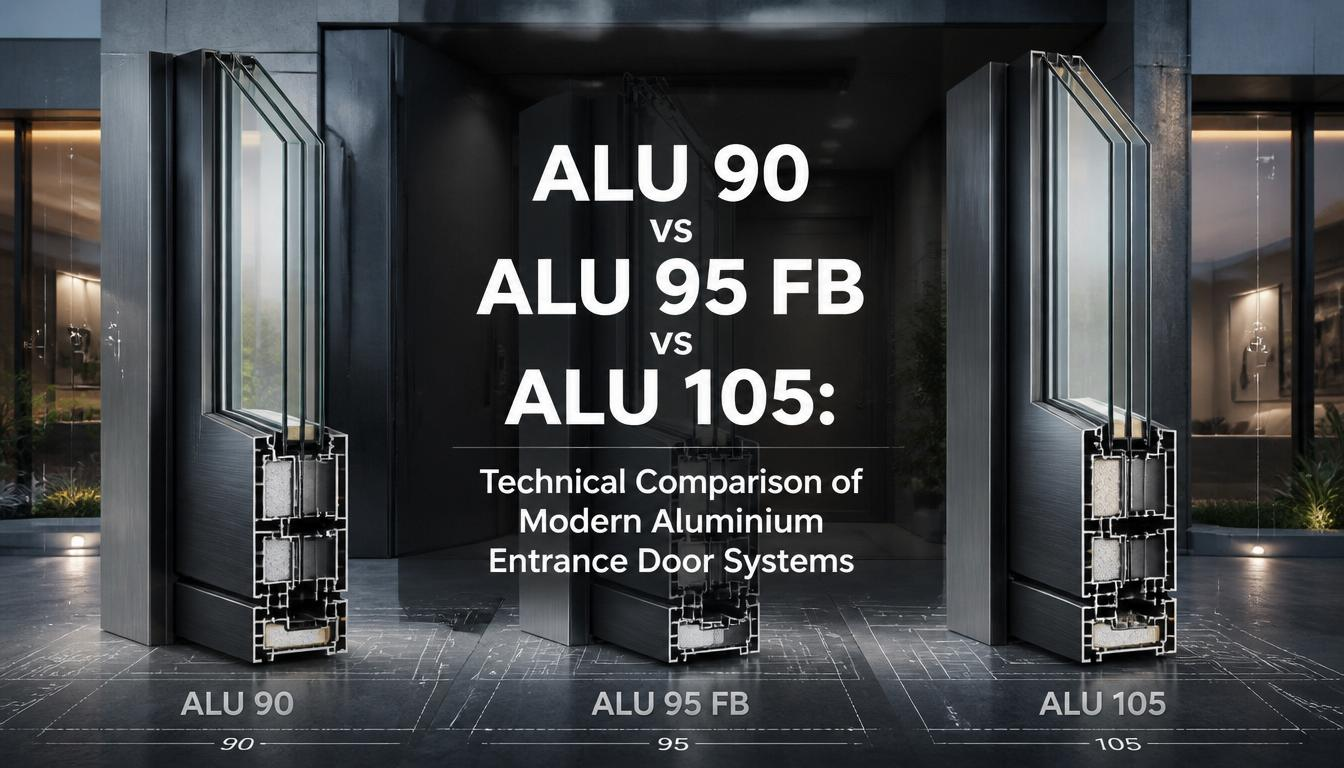
ALU 90 vs ALU 95 FB vs ALU 105: Technical Comparison of Modern Aluminium Entrance Door Systems
An evidence based technical comparison of three contemporary thermally broken aluminium entrance door systems, covering construction, thermal performance, security, frame depth, locking, durability, and application.
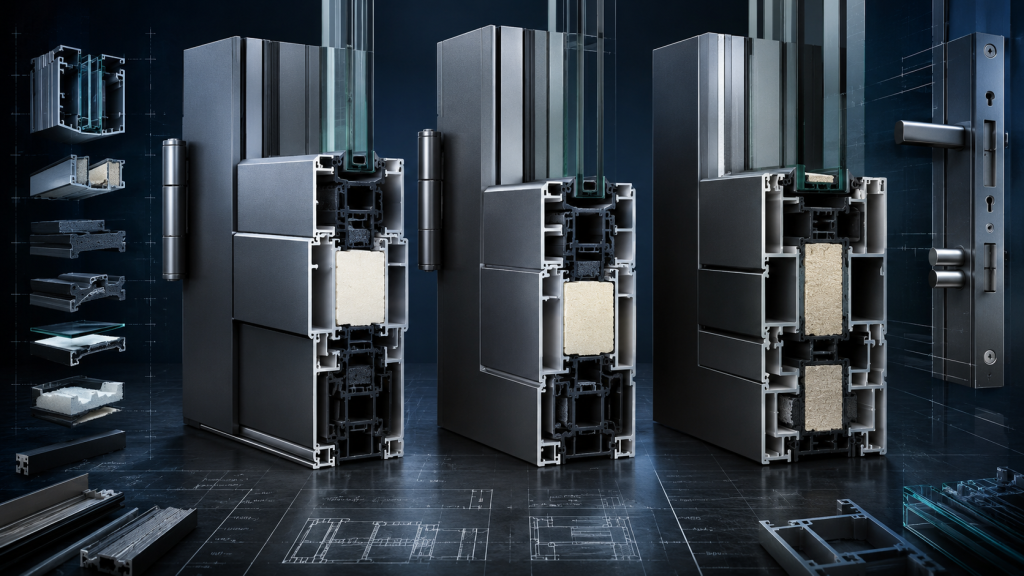
ALU 90 vs ALU 95 FB vs ALU 105 are designations within the family of premium thermally broken aluminium entrance door systems sold in the UK. The numeric suffix in each name corresponds broadly to the system build depth in millimetres — a primary determinant of thermal performance and structural capability. The “FB” in ALU 95 FB denotes a flush bonded (face bonded) leaf, where the infill panel is bonded flush to the aluminium frame for a seamless contemporary appearance.
This article compares the three systems on a technical basis. Because exact figures vary between manufacturers and individual configurations, the numerical values here are presented as representative ranges typical of each system class. Always confirm specific performance against the relevant product’s current test certificates.
For homeowners comparing aluminium systems with stronger physical protection requirements, high security doors are worth reviewing alongside ALU 90, ALU 95 FB, and ALU 105 specifications. Where the brief also includes smart access or biometric entry, fingerprint aluminium doors can be compared as a premium keyless entrance option.
Key Takeaways
- The number in each system name approximates the build/frame depth in millimetres: ALU 90 ≈ 90 mm, ALU 95 FB ≈ 95 mm, ALU 105 ≈ 105 mm.
- Greater build depth allows a deeper thermal break and thicker insulated core, which generally improves the achievable U value.
- ALU 95 FB is distinguished by its flush bonded leaf construction, giving a flat, frameless external appearance favoured in contemporary architecture.
- ALU 105, as the deepest system, typically offers the best thermal performance and the greatest structural capacity for large door leaves.
- All three systems can be specified to PAS 24:2022 and commonly to RC2 or RC3 of BS EN 1627 with appropriate hardware.
- System choice is driven by required U value, leaf size, aesthetic preference, and budget, not by a single “best” option.
Understanding the Naming Convention
The naming follows aluminium systems industry convention where the number denotes the nominal build depth:
- ALU 90 — approximately 90 mm system depth. The entry point into the premium thermally broken category.
- ALU 95 FB — approximately 95 mm depth, with a flush bonded (face bonded) door leaf for flat external aesthetics.
- ALU 105 — approximately 105 mm depth. The deepest system, engineered for maximum thermal and structural performance.
Build depth matters because it sets the room available for (a) the polyamide thermal break, (b) the insulated panel core, and (c) the glazing unit thickness. Deeper systems can accommodate triple glazing and thicker cores, improving insulation and acoustic performance.
Construction Differences
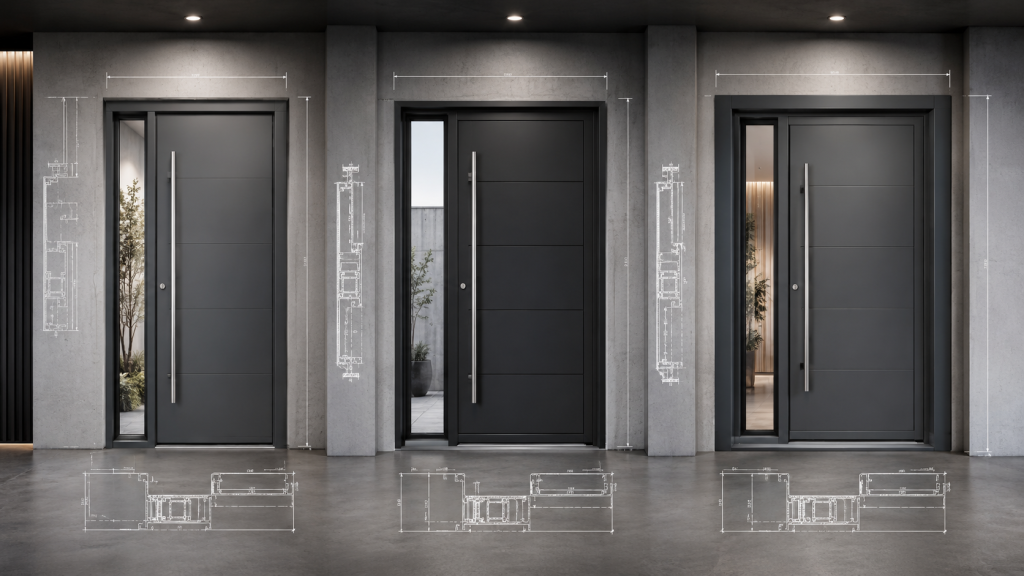
ALU 90
ALU 90 uses a thermally broken twin shell aluminium leaf around an insulated core or glazing unit. At roughly 90 mm depth, it accommodates a substantial polyamide thermal break and a well insulated panel, while keeping sightlines and weight moderate. It is typically configured with the leaf set within the frame in a conventional manner. ALU 90 represents the practical balance of performance, weight, and cost within the premium tier.
ALU 95 FB (Flush Bonded)
The defining feature of ALU 95 FB is flush bonding: the door panel is structurally bonded to the aluminium leaf so that the external face is flat and continuous, with no stepped or rebated panel edge visible. This produces a monolithic, frameless aesthetic highly sought in modern and minimalist designs. The bonded construction also adds rigidity. At ~95 mm depth, thermal capability is strong, and the flush face can be powder coated in a single continuous finish or combined with feature materials.
ALU 105
ALU 105 is the deepest of the three at ~105 mm. The additional depth allows the deepest thermal break and the thickest insulated core or triple glazed unit, giving the best thermal performance of the three. The greater section depth also provides the highest structural strength, supporting larger and heavier leaves without deflection. ALU 105 is the specification of choice where maximum insulation, large format, or both are required.
Thermal Performance
Thermal performance scales with build depth, thermal break geometry, and core/glazing specification. Representative whole door U value ranges:
| System | Nominal depth | Representative whole door U value (W/m²K) | Glazing capability |
|---|---|---|---|
| ALU 90 | ~90 mm | 1.0–1.4 | Double / some triple |
| ALU 95 FB | ~95 mm | 0.9–1.3 | Double / triple |
| ALU 105 | ~105 mm | 0.8–1.2 | Triple readily |
All three meet the Approved Document L requirement of ≤1.4 W/m²K for replacement doors. ALU 105 reaches the lowest (best) U values because its depth accommodates the deepest thermal break and thickest insulating core. ALU 95 FB benefits thermally from its bonded, gap free panel construction. Figures depend heavily on the specific infill — a fully glazed leaf performs differently from a solid insulated panel.
Security Performance
Security in aluminium entrance systems is determined less by build depth and more by locking hardware, cylinder protection, hinge specification, glazing, and reinforcement. All three systems share the same achievable security ceiling when fitted with equivalent hardware.
| System | PAS 24:2022 | RC2 (BS EN 1627) | RC3 (BS EN 1627) |
|---|---|---|---|
| ALU 90 | Achievable | Achievable | Achievable with spec hardware |
| ALU 95 FB | Achievable | Achievable | Achievable with spec hardware |
| ALU 105 | Achievable | Achievable | Achievable with spec hardware |
The deeper sections of ALU 105 and the bonded rigidity of ALU 95 FB can make higher resistance classes marginally easier to engineer, but PAS 24 and RC2/RC3 are attainable across all three with the correct multi point lock, anti snap cylinder, security hinges, and laminated glazing.
Where stronger physical protection is the main priority, comparing high security entrance doors can help clarify whether a security focused doorset is more suitable than a standard residential aluminium specification.
Frame Depth and Sightlines
Frame depth affects installation, structural reveal, and visual proportion:
| System | Nominal frame/build depth | Visual character |
|---|---|---|
| ALU 90 | ~90 mm | Slim premium profile, conventional leaf appearance |
| ALU 95 FB | ~95 mm | Flush, flat external face; minimalist, frameless look |
| ALU 105 | ~105 mm | Deepest section; substantial, supports large formats |
Deeper frames provide more structural reveal for fixing into the opening and accommodate thicker walls and insulation depths typical of modern construction. The flush bonded ALU 95 FB prioritises the external aesthetic, presenting a seamless plane rather than a stepped panel.
Locking Systems
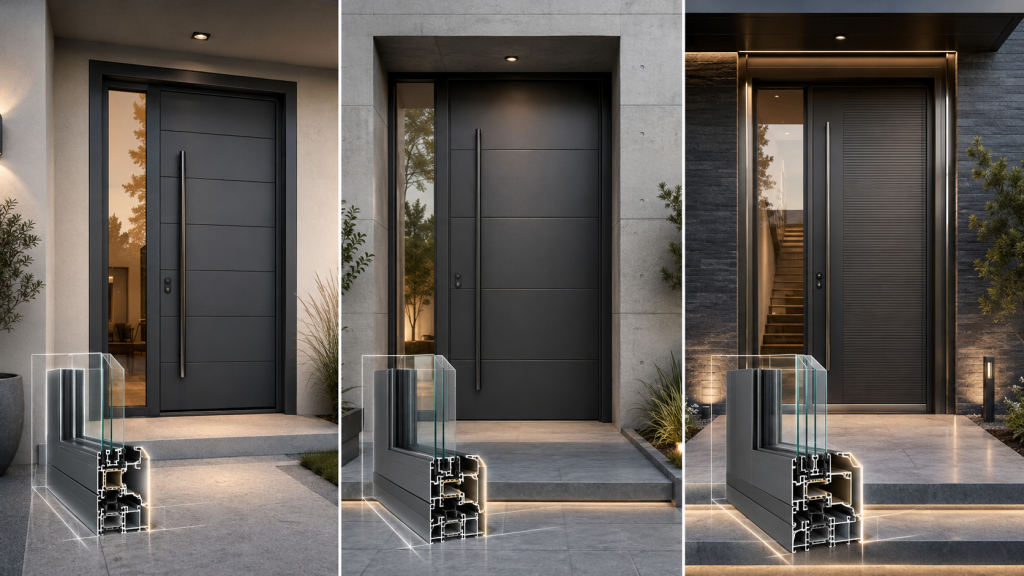
All three systems are typically fitted with automatic multi point locking mechanisms. A representative premium specification across the range includes:
- Multi point engagement — hooks and/or bolts engaging the frame at several points simultaneously.
- Automatic deadlocking — the lock self engages on closing, so the door is secured without lifting the handle or turning the key (key turn adds full deadlock).
- Anti snap, anti bump, anti pick, anti drill cylinders conforming to recognised cylinder standards such as TS 007 (3 star) or SS 312 Diamond.
- Security keeps and reinforced strike plates in the frame.
The locking hardware is broadly common across ALU 90, ALU 95 FB, and ALU 105; the system depth does not constrain the available lock specification. Higher resistance classes require correspondingly higher rated cylinders and keeps.
For projects where automatic multi point locking is being combined with smart or biometric access, smart aluminium entrance doors can be compared as a premium specification route.
Durability
All three systems share the inherent durability of thermally broken aluminium: a dimensionally stable, corrosion resistant frame with a powder coated finish.
| Durability factor | ALU 90 | ALU 95 FB | ALU 105 |
|---|---|---|---|
| Frame service life | 40–50+ years | 40–50+ years | 40–50+ years |
| Powder coat life (Qualicoat) | 25+ years | 25+ years | 25+ years |
| Resistance to warp/sag | High | High (bonded rigidity) | Highest (deepest section) |
| Large leaf stability | Good | Very good | Excellent |
| Seal/cylinder serviceability | Replaceable | Replaceable | Replaceable |
The bonded leaf of ALU 95 FB adds rigidity that resists deflection, while ALU 105’s deeper section gives it the greatest capacity to carry large, heavy leaves over decades without sagging. All three vastly outlast UPVC and composite alternatives on structural longevity.
Which Property Types Suit Each System
ALU 90 — Best for:
- Standard to large premium residential entrances seeking strong performance at the most accessible point in the premium range.
- Renovations and replacements where a conventional leaf appearance is acceptable.
- Properties needing reliable ≤1.4 W/m²K compliance without the cost of the deepest system.
ALU 95 FB — Best for:
- Contemporary and architect designed homes prioritising a flush, frameless, minimalist external face.
- New builds and renovations where aesthetics and a seamless plane are central to the design intent.
- Owners wanting a distinctive modern statement entrance with strong thermal performance.
ALU 105 — Best for:
- Large or oversized entrances demanding maximum structural capacity.
- Properties targeting the lowest achievable U values (e.g. low energy or high spec new builds).
- Triple glazed configurations and the most demanding thermal/acoustic briefs.
- Super prime residential where best in class performance is the priority over cost.
Before choosing between these systems, homeowners should compare both physical security and access features. Reviewing secure front doors can help identify whether stronger protection is needed, while fingerprint aluminium doors may be relevant where smart access and modern aluminium design are priorities.
Detailed Comparison Table
| Attribute | ALU 90 | ALU 95 FB | ALU 105 |
|---|---|---|---|
| Nominal build depth | ~90 mm | ~95 mm | ~105 mm |
| Leaf construction | Twin shell, conventional | Flush bonded (face bonded) | Twin shell, deepest section |
| External appearance | Slim premium, stepped panel | Flush, flat, frameless | Substantial, large format capable |
| Representative whole door U value | 1.0–1.4 W/m²K | 0.9–1.3 W/m²K | 0.8–1.2 W/m²K |
| Glazing | Double / some triple | Double / triple | Triple readily |
| Thermal break | Deep polyamide | Deep polyamide + bonded panel | Deepest polyamide |
| PAS 24:2022 | Achievable | Achievable | Achievable |
| RC2 / RC3 (BS EN 1627) | Achievable | Achievable | Achievable |
| Locking | Automatic multi point | Automatic multi point | Automatic multi point |
| Cylinder grade | TS 007 3 star / SS 312 Diamond | TS 007 3 star / SS 312 Diamond | TS 007 3 star / SS 312 Diamond |
| Frame service life | 40–50+ years | 40–50+ years | 40–50+ years |
| Large leaf capability | Good | Very good | Excellent |
| Aesthetic priority | Premium conventional | Minimalist flush | Performance / scale |
| Relative cost | £ | ££ | £££ |
| Best for | Premium standard entrances | Contemporary flush designs | Large format / max thermal |
Expert Summary
The three systems form a graduated range in which build depth is the organising principle. ALU 90 (~90 mm) is the accessible premium baseline, delivering ≤1.4 W/m²K compliance and full PAS 24 / RC2–RC3 security in a conventional leaf. ALU 95 FB (~95 mm) trades on its flush bonded leaf, prioritising a seamless, frameless aesthetic while adding rigidity and strong thermal performance. ALU 105 (~105 mm) is the performance flagship: the deepest section, the deepest thermal break, triple glazing capacity, the lowest achievable U values, and the greatest structural strength for large leaves. Security ceilings are effectively equal across all three because they are set by hardware, not depth. The correct choice is dictated by the required U value, leaf size, and aesthetic, with cost rising in step with depth and capability.
Frequently Asked Questions
1. What does the number in ALU 90, ALU 95, and ALU 105 mean? It approximates the system build/frame depth in millimetres. ALU 90 is about 90 mm deep, ALU 95 FB about 95 mm, and ALU 105 about 105 mm. Greater depth allows a deeper thermal break and thicker core.
2. What does “FB” mean in ALU 95 FB? FB stands for flush bonded (face bonded), meaning the panel is structurally bonded flush to the aluminium leaf for a flat, frameless external appearance.
3. Which system has the best thermal performance? ALU 105 typically achieves the lowest (best) whole door U values — around 0.8–1.2 W/m²K — because its depth accommodates the deepest thermal break and thickest insulating core.
4. Are all three systems secure to the same level? Yes. PAS 24:2022 and RC2/RC3 of BS EN 1627 are achievable across all three, because security is determined by locking hardware, cylinders, hinges, and glazing rather than build depth.
5. Which system looks the most modern? ALU 95 FB, due to its flush bonded flat external face, gives the most contemporary, minimalist, frameless appearance.
6. Which system is best for a very large front door? ALU 105. Its deepest section provides the greatest structural strength, supporting large and heavy leaves without deflection over time.
7. Do all three meet UK Building Regulations? Yes. All three can achieve a whole door U value of 1.4 W/m²K or lower, satisfying Approved Document L for replacement doors, and can meet Approved Document Q via PAS 24.
8. Can these systems take triple glazing? ALU 105 accommodates triple glazing readily; ALU 95 FB can in many configurations; ALU 90 supports double and some triple glazed builds depending on the unit.
9. Which is the most cost effective? ALU 90 is generally the most accessible of the three while still delivering full premium tier performance. Cost rises with depth toward ALU 105.
10. What locking system do these doors use? Automatic multi point locking that self engages on closing, combined with anti snap, anti bump, anti pick, anti drill cylinders (e.g. TS 007 3 star or SS 312 Diamond) and reinforced keeps.
11. Is ALU 95 FB stronger because it is bonded? The flush bonded construction adds rigidity to the leaf, which resists deflection. For raw structural capacity on very large leaves, however, ALU 105’s deeper section leads.
12. How long will these doors last? The aluminium frame and leaf typically last 40–50+ years, with the powder coat lasting 25+ years and consumable parts (seals, cylinders) replaced periodically.
13. Do deeper systems insulate against sound better? Generally yes. Greater depth allows thicker glazing and core, which improves acoustic insulation, so ALU 105 typically offers the best sound attenuation.
14. Can I have different colours inside and out? Yes. All three support dual colour powder coating, with different RAL finishes internally and externally.
15. Which system should an architect specify for a contemporary new build? ALU 95 FB is often specified where a flush minimalist aesthetic is central; ALU 105 where maximum thermal performance or large format dominates the brief.
16. Does build depth affect the wall thickness the door suits? Yes. Deeper systems suit thicker walls and higher insulation depths typical of modern construction, and provide more reveal for fixing.
17. Are the U values quoted whole door or panel figures? The ranges in this article are representative whole door figures. Always confirm whether a quoted value is whole door (regulated) or panel (more flattering) before comparing.
18. Can these systems be made into Secured by Design doors? Yes, where the specific configuration is independently certified to PAS 24 and manufactured under audited conditions, Secured by Design accreditation is attainable.
Leave a Reply