The Complete Guide to Aluminium Entrance Doors in the UK (2026)
An evidence based reference resource on aluminium entrance door construction, performance, security, thermal efficiency, durability, and cost.
An aluminium entrance door is an external pedestrian door whose frame and door leaf are constructed primarily from extruded aluminium alloy, almost always incorporating a polyamide thermal break to control heat transfer. In the United Kingdom, aluminium entrance doors occupy the premium tier of the residential door market, sitting above composite, GRP (glass reinforced plastic), and UPVC doors in both price and, in most measurable respects, performance.
This guide explains how aluminium entrance doors are constructed, how they compare with the principal alternatives, how their security and thermal performance are measured against recognised UK standards, and what homeowners and specifiers should realistically expect in terms of lifespan, maintenance, and total cost. It is written as a technical reference rather than a buying pitch, and it cites the relevant British and European standards throughout.
Aluminium systems are also increasingly used for premium smart access projects, including fingerprint aluminium doors where modern entrance design and keyless convenience are both required.
Key Takeaways
- Aluminium entrance doors use a thermally broken aluminium frame — two aluminium profiles separated by a non conductive polyamide bridge — to achieve competitive U values despite aluminium’s high base conductivity.
- A well specified aluminium entrance door achieves a whole door U value of approximately 1.0–1.4 W/m²K, comfortably meeting the current Building Regulations requirement.
- Security is independently verified through PAS 24:2022 and the RC2 / RC3 classifications of BS EN 1627, not by manufacturer claims.
- Powder coating to a Qualicoat / BS EN 12206 standard gives aluminium its long term colour stability and corrosion resistance, with realistic coating life of 25+ years.
- Expected service life of a quality aluminium entrance door is 30–50 years, longer than composite (25–35 years) or UPVC (20–30 years).
- Aluminium doors are the most expensive mainstream option, typically £3,000–£8,000+ installed for residential entrance systems, rising substantially for large format or designer configurations.
What “Aluminium Entrance Door” Actually Means
The term refers to a complete door system, not merely a panel. A modern aluminium entrance door comprises:
- An outer frame fixed into the structural opening.
- A door leaf (sash) — the moving part — built from aluminium profiles around an infill panel, glazing unit, or solid insulated core.
- A thermal break, the defining feature, made of polyamide (nylon reinforced with glass fibre) that mechanically joins the inner and outer aluminium sections while interrupting heat flow.
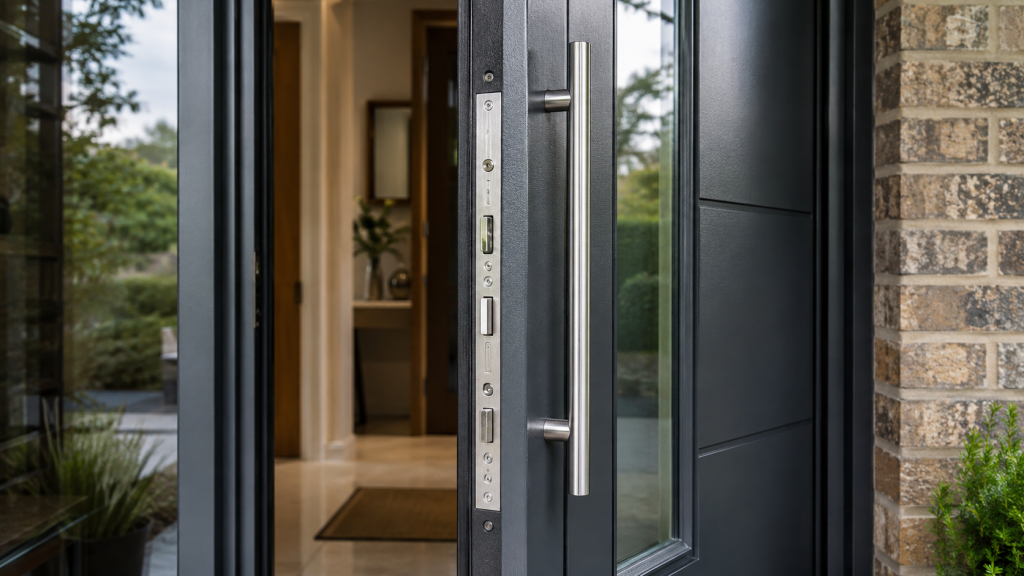
- A multi point locking mechanism engaging the frame at several points simultaneously.
- A weatherseal system, usually two or three lines of EPDM gasket.
The phrase “aluminium door” without a thermal break almost always indicates a commercial or non insulated product unsuitable for a heated dwelling. For residential use, only thermally broken systems should be considered.
Aluminium vs Composite vs UPVC: The Core Comparison
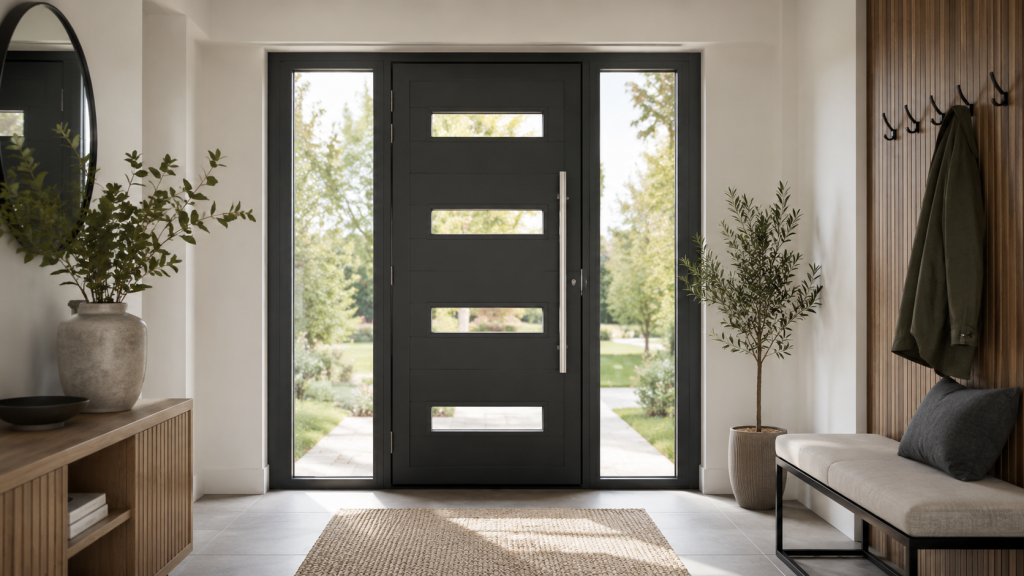
The three dominant residential entrance door materials differ in base material, construction method, and the performance envelope they can reach. Composite doors typically use a GRP or laminated skin over a timber effect frame and an insulated foam core. UPVC doors use hollow, multi chambered plastic profiles. Aluminium doors use extruded metal profiles with a thermal break.
Comparison Table: Aluminium vs Composite vs UPVC Entrance Doors
| Attribute | Aluminium (thermally broken) | Composite (GRP skin) | UPVC |
| Typical whole door U value (W/m²K) | 1.0–1.4 | 1.2–1.8 | 1.4–2.0 |
| Frame material | Extruded aluminium alloy + polyamide break | GRP/laminate skin, timber sub frame, foam core | Multi chamber rigid PVC U |
| Maximum realistic door height/width | Very large (structural strength of metal) | Moderate (standard residential sizes) | Limited (sag risk at large sizes) |
| Security ceiling | PAS 24 + RC2/RC3 readily achievable | PAS 24 achievable; RC3 less common | PAS 24 achievable on quality systems |
| Colour finish | Powder coat (Qualicoat), 200+ RAL options | Moulded/foiled colour | Foiled or through coloured |
| Resistance to warping/swelling | Excellent (dimensionally stable metal) | Good | Moderate (thermal expansion) |
| Typical service life (years) | 30–50 | 25–35 | 20–30 |
| Maintenance | Minimal (clean + lubricate) | Minimal | Minimal |
| Recyclability | Very high (aluminium infinitely recyclable) | Low (composite hard to separate) | Moderate (PVC recyclable but downcycled) |
| Typical installed cost (UK, 2026) | £3,000–£8,000+ | £1,200–£3,500 | £700–£2,000 |
Interpretation: UPVC is the budget option with the shortest lifespan and weakest thermal ceiling. Composite offers strong thermal performance at mid market prices and good security. Aluminium leads on structural strength, large format capability, finish longevity, dimensional stability, and recyclability, at the highest price point.
Security Ratings Explained
Door security in the UK is governed by a small set of recognised standards. Marketing terms like “high security” carry no defined meaning; the standards below do.
For homeowners comparing tested physical protection rather than marketing claims, high security doors are worth reviewing alongside standard aluminium entrance systems.
PAS 24:2022
PAS 24 is the principal UK enhanced security performance standard for doors and windows. The current version is PAS 24:2022. A door tested to PAS 24 undergoes a sequence of manual attack tests simulating an opportunist burglar using common tools, plus mechanical loading, cylinder attack, and manipulation tests. PAS 24 is the security standard referenced by Approved Document Q (Security) of the Building Regulations, which applies to new dwellings in England.
BS EN 1627 and Resistance Classes (RC1–RC6)
BS EN 1627 defines resistance classes from RC1 (lowest) to RC6 (highest), based on attack tools, attacker experience, and resistance time:
| Resistance Class | Typical attacker profile | Tools | Resistance time |
| RC1 N | Casual, bodily force | None significant | — |
| RC2 | Opportunist, simple tools | Screwdriver, pliers, wedge | 3 minutes |
| RC3 | Determined, leverage tools | Crowbar, second screwdriver | 5 minutes |
| RC4 | Experienced, power tools | Saw, drill, hammer, chisel | 10 minutes |
| RC5–RC6 | Highly experienced | Power tools incl. angle grinder | 15–20 minutes |
For UK residential entrance doors, RC2 is a strong baseline and RC3 is a premium target. RC4 and above are normally specified for high risk commercial, institutional, or super prime applications. Aluminium’s structural rigidity makes RC3 readily achievable in well engineered systems.
Secured by Design
Secured by Design (SBD) is the official UK police security accreditation scheme. An SBD accredited door has been independently certified to meet PAS 24 (or equivalent) and manufactured under audited conditions. SBD certification is widely requested by specifiers and can influence home insurance terms.
Thermal Performance and U Values
What a U Value Is
A U value measures the rate of heat transfer through a building element, expressed in watts per square metre per kelvin (W/m²K). It quantifies how much heat passes through one square metre of the door for every one degree difference in temperature between inside and outside. A lower U value means better insulation. A door with a U value of 1.0 loses heat at half the rate of one rated 2.0.
Why Aluminium Needs a Thermal Break
Aluminium has a thermal conductivity of roughly 160–235 W/mK, far higher than UPVC (~0.17 W/mK) or timber (~0.13 W/mK). Without intervention, a solid aluminium profile would conduct heat straight through the door, creating cold surfaces and condensation. The polyamide thermal break solves this by physically separating the warm internal aluminium from the cold external aluminium with a low conductivity bridge. Modern systems use thermal breaks 24–44 mm deep, with deeper breaks giving better insulation.
Whole Door vs Panel U Values
A critical distinction for accurate comparison:
- The panel (or “centre pane”) U value measures only the central glazed or insulated section. It is always more flattering.
- The whole door U value accounts for the frame, sash, thermal break, glazing edges, and panel together, weighted by area. This is the figure that matters for Building Regulations and real world performance.
Always compare whole door U values. A quoted figure of “0.8 W/m²K” almost always refers to the panel, not the assembled door.
Building Regulations Requirement
Under Approved Document L of the Building Regulations (England), the maximum U value for a replacement external pedestrian door in an existing dwelling is 1.4 W/m²K. New build standards under the latest L revisions are similar or tighter. A well specified aluminium entrance door (1.0–1.4 W/m²K whole door) meets this comfortably.
Comparison Table: Thermal Performance
| Door type | Typical whole door U value (W/m²K) | Meets AD L (≤1.4)? |
| Premium aluminium, triple glazed/insulated panel | 0.9–1.2 | Yes |
| Standard aluminium, double glazed | 1.2–1.4 | Yes (at upper bound) |
| Composite, insulated core | 1.2–1.8 | Often (better units only) |
| UPVC, double glazed | 1.4–2.0 | Marginally / sometimes not |
Powder Coating Durability
Aluminium entrance doors are almost universally finished by powder coating — an electrostatically applied dry polyester powder cured under heat to form a hard, uniform film. The recognised quality benchmarks are Qualicoat (an independent licensing standard) and BS EN 12206 1 (paints and varnishes — coating of aluminium for architectural purposes).
Key performance facts:
- A correctly applied Qualicoat Class 1 polyester coating has a realistic outdoor service life of 25+ years before significant fade or chalking.
- Qualicoat Seaside (Class 1.5/2) specifications use a pre anodised or extra corrosion resistant process for coastal locations, where airborne salt accelerates corrosion.
- Powder coating allows over 200 RAL colours, plus textured, matt, gloss, and metallic finishes, and dual colour (different inside/outside).
- Unlike paint on timber, powder coat does not peel, blister, or require repainting under normal conditions.
Colour fade is measured in the industry against gloss retention and colour shift (ΔE) thresholds defined within the Qualicoat specification.
Lifespan Expectations
Service life depends on specification quality, installation, exposure, and maintenance, but realistic UK expectations are:
| Component | Typical lifespan |
| Aluminium frame and leaf | 40–50+ years |
| Powder coat finish | 25–30+ years before refurbishment |
| Multi point lock mechanism | 10–20 years (serviceable/replaceable) |
| Cylinder | 10–15 years (replaceable) |
| EPDM weatherseals | 10–20 years (replaceable) |
| Glazing unit (sealed) | 15–25 years before edge seal risk |
The structural aluminium itself effectively does not degrade under normal residential conditions; it is the consumable components — seals, cylinders, locks — that are periodically serviced or replaced. This is a key reason aluminium outlasts UPVC and composite.
Maintenance Requirements
Aluminium entrance doors are low maintenance but not maintenance free. Recommended routine:
- Cleaning: Wash powder coated surfaces 2–4 times per year with warm water and mild non abrasive detergent. Coastal properties should clean more frequently to remove salt deposits.
- Hardware lubrication: Apply a light, non acidic lubricant to the multi point lock keeps and hinges annually.
- Cylinder care: Use a dry PTFE based lubricant in the cylinder; avoid oil based products that attract dust.
- Seal inspection: Check EPDM gaskets annually for compression set or damage; replace as needed.
- Drainage: Keep frame drainage slots clear of debris.
Avoid abrasive cleaners, solvents, and pressure washers directed at seals, all of which can damage the coating or gaskets.
Cost Ranges (UK, 2026)
Pricing varies with size, glazing, hardware, finish, and installation complexity. Indicative 2026 supply and fit ranges:
| Configuration | Indicative installed cost |
| Standard single aluminium entrance door | £3,000–£5,000 |
| Aluminium door with side panel(s) | £4,500–£7,000 |
| Large format / designer / dual colour | £6,000–£12,000+ |
| Aluminium door with integrated smart/biometric access | £5,000–£15,000+ |
By comparison, composite doors typically install at £1,200–£3,500 and UPVC at £700–£2,000. The aluminium premium buys structural strength, large format capability, finish longevity, dimensional stability, and design flexibility.
For projects where aluminium construction is being combined with smart or biometric access, smart aluminium entrance doors can be compared as a premium specification route.
Best Applications for Aluminium Entrance Doors
Aluminium is the optimal choice when one or more of the following apply:
- Large or oversized openings where metal’s strength prevents sag and warp.
- Contemporary architecture demanding slim sightlines and flat, modern profiles.
- Long term ownership where the higher upfront cost amortises over a 40–50 year life.
- Premium and super prime residential where finish quality and design flexibility are priorities.
- Coastal or exposed sites (with Seaside grade coating) needing corrosion resistance.
- High security requirements where RC3 performance is specified.
Where stronger entrance protection is the main priority, comparing high security entrance doors can help clarify whether a security focused doorset is more suitable than a standard residential specification.
UPVC or composite may be more cost appropriate for standard sized openings on a constrained budget where 20–35 year life is acceptable.
Expert Summary
Aluminium entrance doors are the highest performing mainstream residential door type in the UK on the metrics of structural strength, dimensional stability, finish longevity, large format capability, and recyclability. Their principal weakness — aluminium’s high thermal conductivity — is engineered out by a polyamide thermal break, allowing whole door U values of 1.0–1.4 W/m²K that meet Approved Document L. Security to PAS 24:2022 and RC2/RC3 of BS EN 1627 is readily achievable. The trade off is cost: aluminium is the most expensive option at £3,000–£8,000+ installed, justified primarily by a 30–50 year service life and superior performance, rather than by initial value. For standard openings on a tight budget, composite offers the best balance of security and thermal performance per pound.
Before making a final decision, homeowners should compare both physical security and access features. Reviewing secure front doors can help identify whether stronger protection is needed, while fingerprint aluminium doors may be relevant where smart access and modern aluminium design are priorities.
Frequently Asked Questions
1. Are aluminium front doors better than composite?
On structural strength, dimensional stability, finish longevity, large format capability, and recyclability, aluminium leads. Composite is more cost effective and offers competitive thermal performance and security. “Better” depends on budget, opening size, and how long you intend to keep the door.
2. What U value should an aluminium front door have?
A quality thermally broken aluminium entrance door achieves a whole door U value of approximately 1.0–1.4 W/m²K. The Building Regulations (Approved Document L) require 1.4 W/m²K or lower for replacement doors.
3. Do aluminium doors get cold or cause condensation?
Thermally broken aluminium doors do not suffer the cold bridging of non insulated metal. The polyamide thermal break keeps the internal surface warm, preventing the condensation associated with single skin aluminium.
4. How long do aluminium front doors last?
The aluminium structure typically lasts 40–50+ years. Consumable parts (seals, cylinders, lock mechanisms) are serviced or replaced periodically. Overall service life of 30–50 years is realistic.
5. Do aluminium doors need repainting?
No. Powder coating to a Qualicoat standard does not peel or require repainting under normal use and lasts 25+ years before any refurbishment is considered.
6. Are aluminium doors secure?
Yes, when specified to PAS 24:2022 and/or BS EN 1627 resistance classes. Aluminium’s rigidity makes RC2 a strong baseline and RC3 a readily achievable premium target.
7. Are aluminium front doors worth the extra cost?
For large openings, contemporary designs, long ownership periods, or premium properties, the 30–50 year lifespan and superior performance generally justify the premium. For standard openings on a budget, composite may offer better value.
8. Can aluminium doors be any colour?
Yes. Powder coating offers 200+ RAL colours, plus matt, gloss, textured, and metallic finishes, and dual colour (different inside and out).
9. What is a thermal break in an aluminium door?
A polyamide (glass reinforced nylon) bridge that mechanically joins the inner and outer aluminium profiles while interrupting heat flow, dramatically improving the door’s insulation.
10. Are aluminium doors good for coastal homes?
Yes, provided a Qualicoat Seaside grade coating is specified to resist salt laden air. Aluminium itself resists corrosion well and outperforms many alternatives in marine environments.
11. How much does an aluminium front door cost in the UK?
Indicatively £3,000–£8,000+ installed in 2026, rising for large format, designer, dual colour, or smart access configurations.
12. Do aluminium doors meet UK Building Regulations?
Yes. A correctly specified aluminium entrance door meets Approved Document L (thermal, ≤1.4 W/m²K) and can meet Approved Document Q (security, via PAS 24) for new dwellings.
13. What maintenance does an aluminium door need?
Wash 2–4 times a year, lubricate hardware annually, keep drainage clear, and inspect seals annually. No painting required.
14. Are aluminium doors environmentally friendly?
Aluminium is infinitely recyclable without quality loss, and recycling uses around 5% of the energy of primary production. This gives aluminium doors a strong end of life environmental profile compared with composite.
15. What is the difference between panel and whole door U values?
The panel U value measures only the central insulated/glazed section and is more flattering. The whole door U value includes the frame and edges and is the regulated, real world figure. Always compare whole door values.
16. Can an aluminium door be made very large?
Yes. Aluminium’s structural strength supports large and oversized leaves without the sag risk affecting UPVC, making it the preferred material for grand entrances.
17. What locking system do aluminium doors use?
A multi point locking mechanism engaging the frame at several points (hooks, bolts, rollers) simultaneously, operated by lifting the handle and turning the key. Premium systems include automatic deadlocking.
18. Are aluminium doors noisy or do they insulate against sound?
With double or triple glazing and good seals, aluminium entrance doors provide effective acoustic insulation; the rigid frame and multi point seal compression reduce sound transmission.
19. Will an aluminium door warp in heat?
No. Aluminium is dimensionally stable across normal temperature ranges and does not warp or swell like timber or sag like large UPVC sections.
20. Is powder coating durable?
Yes. A Qualicoat Class 1 polyester powder coat has a realistic outdoor life of 25+ years and resists peeling, blistering, and UV fade far better than wet paint.
Leave a Reply