
Understanding Door U Values, Thermal Performance and Energy Efficiency
An evidence based technical guide to door U values: what they mean, whole door versus panel figures, Building Regulations, heat loss calculation, aluminium thermal breaks, composite insulation, triple glazing, and how to compare door specifications correctly.
Understanding Door U Values, Thermal Performance and Energy Efficiency. The thermal performance of an external door is one of the most frequently quoted and most frequently misunderstood figures in the door market. The headline metric is the U value, and small differences in how it is measured and reported can make a poor door look better than a good one. Understanding what a U value actually represents, the difference between a panel figure and a whole door figure, and how the number translates into real heat loss is essential to comparing doors fairly and to meeting the Building Regulations.
This guide explains door thermal performance from first principles, with the relevant calculation methods and UK regulatory thresholds, and sets out how homeowners and specifiers should interpret and compare the figures manufacturers publish.
For homeowners comparing energy efficiency with stronger entrance protection, high security doors are worth reviewing alongside standard thermal performance specifications. Where the brief also includes smart access or biometric entry, fingerprint aluminium doors can be compared as a premium thermally broken entrance option.

Key Takeaways
- A U value is the rate of heat transfer through a building element, measured in W/m²K. Lower is better.
- Always compare the whole door U value (the regulated, real world figure), not the panel/centre U value (which is always more flattering).
- Under Approved Document L, a replacement external pedestrian door in England must have a U value of 1.4 W/m²K or lower.
- Aluminium needs a polyamide thermal break because the metal itself is highly conductive; the thermal break is what makes aluminium doors energy efficient.
- Composite doors insulate inherently through a high density foam core.
- Triple glazing and deeper thermal breaks push whole door U values below 1.0 W/m²K in the best systems.
What a U Value Means
A U value (thermal transmittance) measures how much heat passes through one square metre of a building element for each one degree Kelvin (or Celsius) temperature difference between the two sides. Its units are watts per square metre per kelvin (W/m²K).
The relationship is simple and linear:
Heat loss (watts) = U value × Area (m²) × Temperature difference (K)
A door with a U value of 1.0 W/m²K loses heat at half the rate of one rated 2.0 W/m²K of the same size under the same conditions. The lower the U value, the better the insulation and the less heat escapes.
The U value is the inverse of total thermal resistance (the R value): U = 1 / R total. A door’s R total is the sum of the resistances of its layers (skin, core, glazing, air films), so adding insulation or interrupting conductive paths raises R and lowers U.
Whole Door vs Panel U Values
This is the single most important distinction for comparing doors honestly.
- The panel U value (also called centre panel or centre pane U value) measures heat transfer through only the central insulated or glazed section of the door, away from the frame and edges. Because the centre is the best insulated part, this figure is always the lowest and most flattering.
- The whole door U value (U_D) accounts for the entire assembled doorset frame, sash/leaf, thermal break, glazing edges, and panel area weighted into a single figure. The frame and edges conduct more heat than the centre, so the whole door figure is always higher (worse) than the panel figure.
| Metric | What it measures | Typical relationship | Use |
|---|---|---|---|
| Panel / centre U value | Central section only | Lowest (best looking) | Marketing; component data |
| Whole door U value (U_D) | Complete doorset incl. frame | Higher than panel | Building Regulations & real world |
A quoted “0.8 W/m²K” on a door almost always refers to the panel, not the assembled door. Building Regulations compliance and genuine energy performance are based on the whole door figure. Always ask which one a quote refers to.
Building Regulations
In England, door thermal performance is governed by Approved Document L (Conservation of fuel and power) of the Building Regulations.
- For a replacement external pedestrian door in an existing dwelling, the maximum permitted U value is 1.4 W/m²K.
- For new dwellings, doors are assessed within the building’s overall energy calculation (SAP), with notional door U values around 1.0 W/m²K in the latest standards driving toward lower whole element values.
- The figure used for compliance is the whole door U value, calculated or tested to the recognised methods below.
Equivalent regulations apply in the devolved administrations (Scotland’s Technical Handbooks, Wales’s Approved Documents, and Northern Ireland’s Technical Booklets), with broadly similar door U value thresholds.
Calculation and Test Standards
Whole door U values are determined by:
- BS EN ISO 10077 1 and 2 calculation of thermal transmittance of windows, doors, and shutters (the standard calculation route).
- BS EN ISO 12567 1 measurement of thermal transmittance by the hot box method (the test route).
- BS EN ISO 6946 calculation of thermal resistance and transmittance for building components generally.
A credible U value figure should state the method and the configuration it applies to.
Heat Loss Calculations
The practical impact of a U value is easy to quantify. Consider a standard single entrance door of approximately 2.0 m² area, with an internal temperature of 21°C and an external temperature of 1°C a temperature difference of 20 K:
| Whole door U value | Heat loss (U × Area × ΔT) | Relative loss |
|---|---|---|
| 2.0 W/m²K | 2.0 × 2.0 × 20 = 80 W | Baseline |
| 1.4 W/m²K | 1.4 × 2.0 × 20 = 56 W | −30% |
| 1.2 W/m²K | 1.2 × 2.0 × 20 = 48 W | −40% |
| 1.0 W/m²K | 1.0 × 2.0 × 20 = 40 W | −50% |
| 0.8 W/m²K | 0.8 × 2.0 × 20 = 32 W | −60% |
Interpretation: Upgrading from a 2.0 to a 1.0 W/m²K door halves the conductive heat loss through that door. However, the absolute difference between a 1.2 and a 1.0 door (8 W in this example) is small relative to a whole dwelling’s heat loss, so thermal performance should be weighed alongside security, durability, and aesthetics rather than pursued in isolation. A door is a small fraction of a home’s total thermal envelope; the U value matters, but marginal differences at the low end deliver diminishing returns.
For homeowners balancing thermal performance with physical protection, comparing high security entrance doors can
Aluminium Thermal Breaks
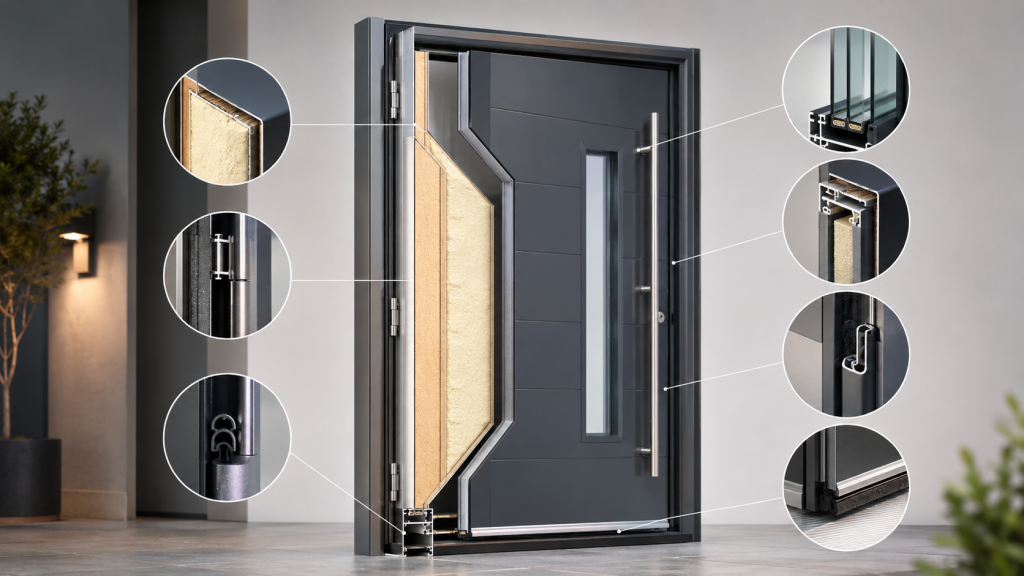
Aluminium has a thermal conductivity of roughly 160–235 W/mK orders of magnitude higher than UPVC (~0.17 W/mK) or timber (~0.13 W/mK). A solid aluminium profile would therefore conduct heat straight through the door, creating a cold bridge, cold internal surfaces, and condensation risk.
The thermal break solves this. It is a strip of polyamide (glass fibre reinforced nylon), with a thermal conductivity around 0.25–0.30 W/mK, mechanically swaged or bonded between the inner and outer aluminium profiles. This:
- Joins the inner and outer aluminium structurally.
- Interrupts the conductive heat path between them.
- Keeps the internal surface warm, eliminating cold bridging and condensation.
Deeper thermal breaks insulate better. Modern systems use breaks 24–44 mm deep; the deepest systems (e.g. ~105 mm build depth doors) accommodate the deepest breaks and thickest cores, achieving the lowest U values. The thermal break is the single feature that makes aluminium doors thermally competitive; without it, an aluminium door would be unfit for a heated dwelling.
For projects where thermally broken aluminium construction is being combined with smart or biometric access, smart aluminium entrance doors can be compared as a premium specification route.
Composite Door Insulation
Composite doors achieve insulation differently. Rather than interrupting a conductive metal, they are built around an inherently low conductivity high density polyurethane (PU) foam core, typically 40–48 mm thick, encased in a GRP or laminate skin with a timber/polymer sub frame.
- The PU foam core has low thermal conductivity (around 0.022–0.028 W/mK), giving strong insulation per unit thickness.
- The main conductive paths are the sub frame and the outer frame the door hangs in, which is where heat is lost relative to the well insulated core again making the whole door figure higher than the panel figure.
- A good composite door achieves a whole door U value of approximately 1.2–1.8 W/m²K.
The contrast is instructive: aluminium starts from a highly conductive material and engineers the heat path out with a thermal break, while composite starts from an insulating core and manages the lesser conductivity of its frame. Both can meet Building Regulations; aluminium’s deepest systems reach the lowest figures.
Triple Glazing Options
For doors with significant glazed area, the glazing unit’s performance heavily influences the whole door U value.
| Glazing | Typical centre pane U value (W/m²K) | Notes |
|---|---|---|
| Single glazing | ~5.0+ | Obsolete for external doors |
| Double glazing (standard) | ~1.4–1.6 | Argon filled, one low E coating |
| Double glazing (high performance) | ~1.0–1.2 | Argon, soft coat low E, warm edge spacer |
| Triple glazing | ~0.5–0.8 | Two cavities, two low E coatings, argon/krypton |
Triple glazing adds a third pane and a second insulating cavity, with low emissivity (low E) coatings and argon or krypton fill, and a warm edge spacer to reduce edge conduction. In deep aluminium systems, triple glazing helps drive whole door U values below 1.0 W/m²K. The trade offs are increased weight (requiring robust hinges and frame, which aluminium handles well) and higher cost. For predominantly solid doors, the insulated core matters more than glazing; for heavily glazed doors, triple glazing is the key lever.
How Homeowners Should Compare Door Specifications
Use this checklist to compare doors on a like for like basis:
- Confirm whole door, not panel. Ask explicitly: “Is this U value the whole door (U_D) figure or the centre panel figure?” Only compare whole door to whole door.
- Check the size it was calculated at. U values are calculated for a reference door size; very different sizes shift the figure because the frame to area ratio changes.
- Check the standard. A credible figure cites BS EN ISO 10077 (calculation) or BS EN ISO 12567 (hot box test).
- Match the glazing. A glazed door’s U value depends on its glazing unit; compare like glazing (double vs triple).
- Confirm regulatory compliance. The whole door figure must be ≤1.4 W/m²K for a replacement door under Approved Document L.
- Weigh against other factors. Below ~1.2 W/m²K, further U value reductions yield small absolute energy savings; balance them against security, durability, and cost.
| Comparison pitfall | What to do |
|---|---|
| Panel figure quoted as if whole door | Ask for the whole door (U_D) value |
| No calculation standard cited | Request BS EN ISO 10077 or 12567 basis |
| Different glazing being compared | Compare same glazing type |
| Different reference sizes | Compare at comparable door sizes |
| Chasing the lowest U value alone | Balance with security, durability, cost |
Before making a final decision, homeowners should compare both energy performance and physical security. Reviewing secure front doors can help identify whether stronger protection is needed, while fingerprint aluminium doors may be relevant where smart access and thermally broken aluminium design are priorities.
Expert Summary
A door’s U value measures heat transfer in W/m²K, and lower is better but only the whole door figure is meaningful for compliance and real performance. The panel U value, measuring just the central section, is always more flattering and is frequently quoted in marketing. Under Approved Document L, a replacement door in England must achieve a whole door U value of 1.4 W/m²K or lower. Aluminium doors reach competitive U values (1.0–1.4 W/m²K, below 1.0 in the deepest triple glazed systems) because a polyamide thermal break interrupts the metal’s otherwise high conductivity; composite doors achieve 1.2–1.8 W/m²K through an insulating foam core. When comparing doors, always confirm the figure is whole door, calculated to BS EN ISO 10077 or tested to BS EN ISO 12567, and at a comparable size and glazing. Below about 1.2 W/m²K, further reductions deliver diminishing absolute savings, so thermal performance should be balanced against security, durability, and cost rather than maximised in isolation.
Frequently Asked Questions
1. What is a good U value for a front door? For a UK external door, a whole door U value of 1.4 W/m²K meets Building Regulations; 1.0–1.2 W/m²K is very good; below 1.0 W/m²K is excellent and achievable with deep aluminium systems and triple glazing.
2. What does U value mean? It is the rate of heat transfer through a building element, in watts per square metre per kelvin (W/m²K). A lower U value means better insulation.
3. What is the difference between whole door and panel U values? The panel U value measures only the central section and is more flattering. The whole door U value includes the frame and edges and is the regulated, real world figure. Always compare whole door values.
4. What U value do UK Building Regulations require for a door? Under Approved Document L (England), a replacement external pedestrian door must have a whole door U value of 1.4 W/m²K or lower.
5. Why do aluminium doors need a thermal break? Aluminium is highly conductive (~160–235 W/mK), so without a thermal break it would conduct heat straight through, causing cold surfaces and condensation. The polyamide thermal break interrupts this heat path.
6. What is the lowest U value a door can achieve? The best deep aluminium systems with triple glazing achieve whole door U values below 1.0 W/m²K, sometimes around 0.8 W/m²K.
7. How much heat does a door lose? For a 2 m² door at a 20 K temperature difference, a 1.0 W/m²K door loses about 40 W, compared with 80 W for a 2.0 W/m²K door half the loss.
8. Is a lower U value always worth paying for? Not always. Below about 1.2 W/m²K, the absolute energy saving per further reduction is small relative to a whole home, so balance it against security, durability, and cost.
9. What U value do composite doors have? Composite doors typically achieve whole door U values of 1.2–1.8 W/m²K via their insulating foam core.
10. What U value do aluminium doors have? Thermally broken aluminium doors typically achieve whole door U values of 1.0–1.4 W/m²K, with the deepest triple glazed systems below 1.0.
11. Does triple glazing improve a door’s U value? Yes, significantly for glazed doors. Triple glazing has a centre pane U value around 0.5–0.8 W/m²K and helps drive whole door figures below 1.0 in deep systems.
12. How is a door’s U value calculated? By calculation to BS EN ISO 10077 1/ 2 or by hot box test to BS EN ISO 12567 1, area weighting the frame, edges, and panel into a single whole door figure.
13. What is a thermal break made of? Polyamide glass fibre reinforced nylon with a low thermal conductivity around 0.25–0.30 W/mK, swaged or bonded between the inner and outer aluminium profiles.
14. Do deeper aluminium doors insulate better? Generally yes. Deeper systems accommodate deeper thermal breaks and thicker insulating cores or triple glazing, achieving lower whole door U values.
15. Will a low U value door stop condensation? A thermally broken or well insulated door keeps the internal surface warm, which prevents the surface condensation associated with cold, conductive doors.
16. Is U value the same as energy rating? No. The U value measures conductive heat transfer; door energy ratings (where used) combine U value with air leakage and solar factors into a banded label.
17. Does door size affect the U value? Yes. U values are calculated at a reference size; the frame to area ratio changes with size, so figures should be compared at comparable sizes.
18. What is the R value and how does it relate to U value? The R value is thermal resistance; the U value is its inverse (U = 1/R total). Higher R and lower U both mean better insulation.
19. Does a solid door insulate better than a glazed door? Usually yes, because a well insulated solid core typically outperforms even good glazing. For glazed doors, triple glazing narrows the gap.
20. How do I compare two doors’ thermal claims fairly? Confirm both figures are whole door, calculated to the same standard, at comparable sizes and with comparable glazing, then compare directly.
21. What U value applies to new build doors? New dwellings are assessed in the overall SAP energy calculation, with notional door U values around 1.0 W/m²K in the latest Approved Document L standards.
Leave a Reply