Composite Doors vs Aluminium Doors: Which Is Better for UK Homes?
An evidence-based comparison of composite and aluminium entrance doors across security, energy efficiency, weather resistance, appearance, lifespan, environmental impact, 20-year cost of ownership, and common misconceptions.
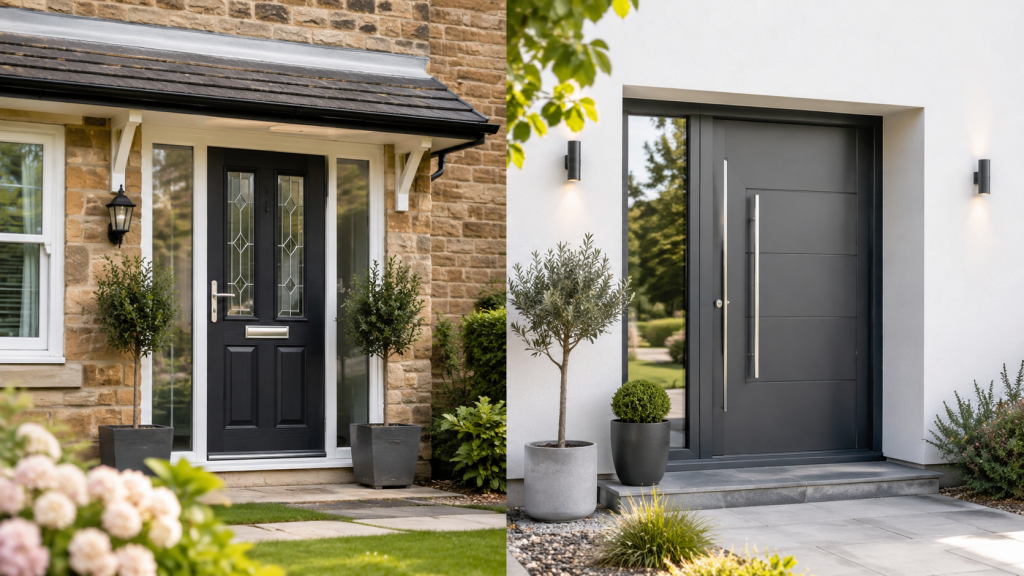
Composite Doors vs Aluminium Doors: Which Is Better for UK Homes?, having largely displaced timber and UPVC at the upper end of the market. They achieve comparable real-world results by very different means. A composite door is built from multiple materials typically a glass-reinforced plastic (GRP) or laminated skin, a timber or polymer sub-frame, and a high-density insulating foam core. An aluminium door is built from extruded aluminium profiles incorporating a polyamide thermal break around an insulated core or glazing unit.
This article compares the two objectively across the criteria that matter most to UK homeowners and specifiers, with reference to the relevant standards. Neither is universally “better”; each is optimal for different priorities.
For homeowners comparing material choice with stronger physical protection, high security doors are worth reviewing alongside standard composite and aluminium entrance systems. Where aluminium construction is being considered with smart or biometric access, fingerprint aluminium doors can also be compared as a premium keyless entrance option.
Key Takeaways
- Both can meet the same security standards PAS 24:2022 and, in many cases, RC2 of BS EN 1627. Aluminium more readily reaches RC3.
- Both can be highly energy efficient. Composite cores insulate inherently; aluminium relies on its thermal break. Quality examples of both achieve whole-door U-values ≤1.4 W/m²K.
- Aluminium leads on lifespan, large-format capability, dimensional stability, and recyclability.
- Composite leads on upfront affordability and offers a traditional timber-look aesthetic difficult to replicate in metal.
- Over 20 years, aluminium’s higher purchase price is partly offset by longer life and finish durability, narrowing the total-cost gap.
- A widespread misconception is that aluminium doors are cold; thermally broken aluminium doors are not.
Construction Compared
Composite Door Construction
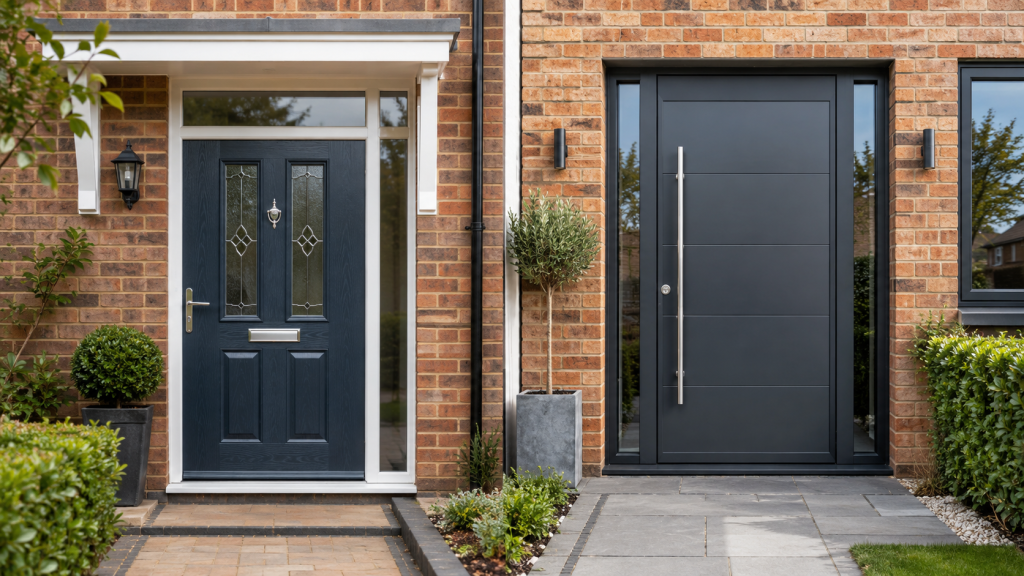
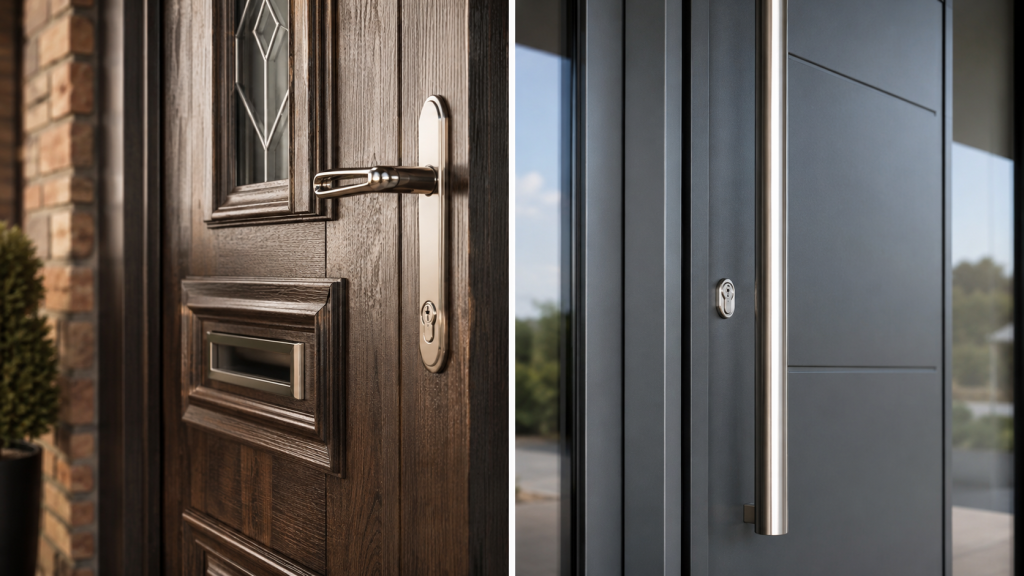
A typical composite door comprises an outer GRP or laminated skin (impact- and weather-resistant), a sub-frame of timber and/or polymer providing rigidity and fixing points, and a high-density polyurethane (PU) foam core that provides insulation. The skin is moulded, often with a woodgrain texture, and colour is integral or foiled. Composite doors are usually hung in a UPVC or aluminium outer frame.
Aluminium Door Construction
An aluminium door uses extruded aluminium alloy profiles for both frame and leaf, joined by a polyamide thermal break that interrupts heat flow. The leaf encloses an insulated core (for solid panels) or a double/triple-glazed unit. The finish is powder coating to a Qualicoat / BS EN 12206 standard. Aluminium’s strength permits slim sightlines and large formats.
Security
Both materials can be engineered to recognised UK security standards. The decisive factors are the locking system, cylinder, hinges, glazing, and reinforcement not the skin material alone.
| Security factor | Composite | Aluminium |
|---|---|---|
| PAS 24:2022 | Achievable | Achievable |
| RC2 (BS EN 1627) | Achievable | Achievable |
| RC3 (BS EN 1627) | Less common | Readily achievable |
| Resistance to impact/kick | High (GRP skin tough) | High (rigid metal leaf) |
| Resistance to leverage/jemmy | Good | Excellent (rigid frame) |
| Multi-point locking | Standard | Standard |
| Anti-snap cylinder (TS 007/SS 312) | Available | Available |
| Secured by Design eligible | Yes | Yes |
Verdict: Both are secure when properly specified. Composite’s tough GRP skin resists impact well; aluminium’s rigid frame better resists leverage attacks and reaches RC3 more easily. For most homes, either meets PAS 24 and satisfies insurers; for higher-risk or premium properties targeting RC3, aluminium has the edge.
Where stronger entrance protection is the main priority, comparing high security entrance doors can help clarify whether a security-focused doorset is more suitable than a standard residential specification.
Energy Efficiency
Both door types can be highly insulating, by different mechanisms.
- Composite doors insulate primarily through their PU foam core, which has inherently low thermal conductivity. A good composite door achieves a whole-door U-value of approximately 1.2–1.8 W/m²K.
- Aluminium doors overcome metal’s high conductivity with a polyamide thermal break and an insulated/triple-glazed core, achieving approximately 1.0–1.4 W/m²K whole-door, with the deepest systems reaching below 1.0.
| Energy metric | Composite | Aluminium (thermally broken) |
|---|---|---|
| Typical whole-door U-value | 1.2–1.8 W/m²K | 1.0–1.4 W/m²K |
| Best-case U-value | ~1.0 W/m²K | <1.0 W/m²K (deep systems, triple glazed) |
| Meets Approved Document L (≤1.4) | Better units only | Yes |
| Cold-bridging risk | Low (no metal path) | Eliminated by thermal break |
Verdict: Both can meet Building Regulations. The best composite doors rival mid-range aluminium, but aluminium’s deepest, triple-glazed systems achieve the lowest U-values overall.
Weather Resistanc
The UK climate subjects entrance doors to wind-driven rain, temperature swings, UV, and near coasts salt.
| Weather factor | Composite | Aluminium |
|---|---|---|
| Water ingress resistance | High | High (multi-seal EPDM) |
| Warping / swelling | Low (stable skin/core) | None (dimensionally stable metal) |
| UV colour fade | Low–moderate (skin dependent) | Very low (Qualicoat coating) |
| Corrosion | Not applicable (non-metal) | Resistant; Seaside grade for coast |
| Thermal expansion/contraction | Low | Low–moderate (accommodated by design) |
| Performance in exposed/coastal sites | Good | Excellent (with Seaside coating) |
Verdict: Both handle UK weather well. Aluminium has a slight edge in dimensional stability and finish longevity; composite carries no corrosion risk at all but can experience some colour fade depending on skin quality.
Appearance
Aesthetics often decide the choice between the two.
- Composite excels at traditional and timber-effect styles. Moulded woodgrain skins convincingly mimic painted timber, suiting period, cottage, and classic suburban properties. Colour range is good but typically narrower than powder coating.
- Aluminium excels at contemporary and minimalist designs. Slim sightlines, flush-bonded faces, large formats, and 200+ RAL powder-coat colours (plus dual-colour and metallic/textured finishes) suit modern architecture and statement entrances.
| Appearance factor | Composite | Aluminium |
|---|---|---|
| Traditional / timber look | Excellent | Limited |
| Contemporary / minimalist look | Moderate | Excellent |
| Colour options | Good (foiled/integral) | Excellent (200+ RAL, dual-colour) |
| Slim sightlines | Moderate | Excellent |
| Large-format capability | Limited | Excellent |
| Finish longevity | Good | Excellent (no repainting) |
Verdict: Choose composite for authentic traditional aesthetics; choose aluminium for contemporary designs, slim frames, large formats, and the widest colour and finish range.
For projects where a contemporary aluminium appearance is being combined with keyless or biometric access, smart aluminium entrance doors can be compared as a premium specification route.
Lifespan
| Component | Composite | Aluminium |
|---|---|---|
| Structural skin/frame | 25–35 years | 40–50+ years |
| Finish | Integral/foiled, no repaint | Powder coat 25+ years |
| Locking mechanism | 10–20 years (replaceable) | 10–20 years (replaceable) |
| Cylinder | 10–15 years (replaceable) | 10–15 years (replaceable) |
| Seals | 10–20 years (replaceable) | 10–20 years (replaceable) |
| Overall service life | 25–35 years | 30–50 years |
Verdict: Aluminium has the longer structural life. Composite cores and skins, while durable, are generally expected to give 25–35 years versus aluminium’s 30–50, because metal does not degrade structurally under normal residential conditions.
Environmental Impact
Environmental comparison spans manufacturing energy, lifespan, and recyclability.
- Aluminium is energy-intensive to produce from raw ore (primary aluminium), but it is infinitely recyclable without loss of quality, and recycling uses around 5% of the energy of primary production. A long service life and high end-of-life recyclability give aluminium a strong circular-economy profile. Many systems incorporate recycled content.
- Composite doors have lower embodied energy at manufacture in some respects, but the bonded mix of GRP, timber, foam, and polymer is difficult to separate and recycle at end of life, so most are not recycled and go to landfill or energy recovery.
| Environmental factor | Composite | Aluminium |
|---|---|---|
| Embodied energy (manufacture) | Lower–moderate | Higher (primary); low (recycled) |
| Recyclability at end of life | Low (bonded mixed materials) | Very high (infinitely recyclable) |
| Service life (longevity benefit) | 25–35 years | 30–50 years |
| Recycled-content potential | Limited | High |
Verdict: Aluminium’s recyclability and longer life favour it in whole-life terms, despite higher primary-production energy. Composite’s end-of-life recyclability is its main environmental weakness.
Cost of Ownership Over 20 Years
This is where upfront price and longevity interact. Indicative figures (UK, 2026):
| Cost element (20-year horizon) | Composite | Aluminium |
|---|---|---|
| Typical installed purchase cost | £1,200–£3,500 | £3,000–£8,000+ |
| Repainting/refinishing | £0 (no repaint) | £0 (no repaint) |
| Likely consumable replacements (seals, cylinder) over 20 yrs | £150–£400 | £150–£400 |
| Probability of full replacement within 20 yrs | Low–moderate (life 25–35 yrs) | Very low (life 30–50 yrs) |
| Residual life beyond 20 years | Limited–moderate | Substantial |
| Indicative 20-year total | £1,350–£3,900 | £3,150–£8,400+ |
Verdict: Over 20 years, composite remains the lower-cost option in absolute terms. However, aluminium retains substantially more residual life beyond year 20 (often another 10–30 years), so on a true whole-life (cost-per-year) basis the gap narrows considerably. For owners planning to stay long-term, aluminium’s cost-per-year of service can approach or match composite.
Common Misconceptions
“Aluminium doors are cold and cause condensation.” False for modern doors. Single-skin aluminium is cold-bridging, but every residential aluminium entrance door uses a polyamide thermal break that keeps the internal surface warm and prevents condensation.
“Composite doors are maintenance-free and last forever.” Composite doors are low-maintenance, but consumable parts still need servicing, and the door’s overall life is 25–35 years, not indefinite.
“Aluminium doors aren’t as secure as composite.” False. Both meet PAS 24:2022; aluminium’s rigid frame in fact reaches RC3 of BS EN 1627 more readily than composite.
“Composite doors can’t be made in modern styles.” Composite is best at traditional looks but is available in contemporary finishes; aluminium simply offers more design freedom for minimalist and large-format designs.
“A lower U-value door is always worth the extra cost.” The U-value difference between a 1.2 and a 1.0 W/m²K door produces only a small absolute heat-loss difference over a single door area; the decision should weigh aesthetics, lifespan, and security alongside thermal performance.
“Powder-coated aluminium needs repainting like timber.” False. Qualicoat powder coating lasts 25+ years without peeling or repainting.
Expert Summary
Composite and aluminium doors achieve comparable security and energy performance by different routes, and both meet UK Building Regulations when well specified. Composite is the more affordable choice and the better option for authentic traditional and timber-look aesthetics, with a typical service life of 25–35 years. Aluminium costs more upfront (£3,000–£8,000+ vs £1,200–£3,500) but leads on structural lifespan (30–50 years), dimensional stability, large-format capability, finish longevity, contemporary design freedom, and end-of-life recyclability. Over a 20-year horizon composite remains cheaper in absolute terms, but aluminium’s greater residual life narrows the gap on a cost-per-year basis. The right choice depends on budget, architectural style, opening size, and intended ownership period not on any single metric.
Before making a final decision, homeowners should compare both physical security and access features. Reviewing secure front doors can help identify whether stronger protection is needed, while fingerprint aluminium doors may be relevant where smart access and modern aluminium design are priorities.
Frequently Asked Questions
1. Are aluminium doors better than composite doors? Neither is universally better. Aluminium leads on lifespan, dimensional stability, large formats, contemporary aesthetics, and recyclability; composite leads on affordability and traditional looks. Both meet UK security and thermal standards.
2. Which is more secure, composite or aluminium? Both meet PAS 24:2022. Aluminium’s rigid frame reaches RC3 of BS EN 1627 more readily, while composite’s tough GRP skin resists impact well. For most homes, either is sufficient.
3. Which has the better U-value? Aluminium achieves slightly lower (better) whole-door U-values overall 1.0–1.4 W/m²K versus composite’s 1.2–1.8 W/m²K with the deepest aluminium systems going below 1.0.
4. Are aluminium doors cold? No. Thermally broken aluminium doors keep the internal surface warm and do not cause the condensation associated with single-skin metal.
5. Which lasts longer? Aluminium, with a structural life of 30–50 years versus composite’s 25–35 years.
6. Which is cheaper? Composite is cheaper upfront (£1,200–£3,500 installed) compared with aluminium (£3,000–£8,000+).
7. Which is better for a modern house? Aluminium, due to slim sightlines, flush-bonded faces, large-format capability, and the widest colour range.
8. Which is better for a period or traditional home? Composite, because its moulded woodgrain skins convincingly mimic painted timber.
9. Which is more environmentally friendly? Aluminium in whole-life terms, because it is infinitely recyclable and lasts longer; composite is harder to recycle at end of life.
10. Do either need repainting? No. Composite colour is integral or foiled; aluminium is powder-coated for 25+ years. Neither requires repainting under normal use.
11. Which handles coastal weather better? Aluminium with a Seaside-grade powder coat performs excellently; composite has no corrosion risk but can fade depending on skin quality. Both are suitable with correct specification.
12. Can both be Secured by Design certified? Yes, where the specific door is independently certified to PAS 24 and made under audited conditions.
13. Over 20 years, which costs less in total? Composite remains cheaper in absolute terms, but aluminium retains more residual life beyond 20 years, narrowing the cost-per-year gap.
14. Which has more colour options? Aluminium, via powder coating in 200+ RAL colours, dual-colour, and metallic/textured finishes.
15. Can composite doors be large? Composite is best suited to standard residential sizes; large or oversized openings favour aluminium’s structural strength.
16. Do aluminium doors warp? No. Aluminium is dimensionally stable and does not warp, swell, or sag under normal conditions.
17. Is a composite door’s foam core a fire risk? Composite doors are manufactured to relevant safety standards; the core is encased. Fire performance depends on the specific product’s certification, not the material category alone.
18. Which is quieter for acoustic insulation? Both insulate against sound well; aluminium with triple glazing and multi-seal compression typically offers a slight edge on acoustic attenuation.
19. Will my home insurer accept either? Insurers generally accept doors meeting PAS 24 and/or with Secured by Design accreditation, which both materials can achieve.
20. Which should I choose? Choose composite for a traditional look on a tighter budget; choose aluminium for contemporary design, large openings, maximum lifespan, and long-term ownership.
Leave a Reply